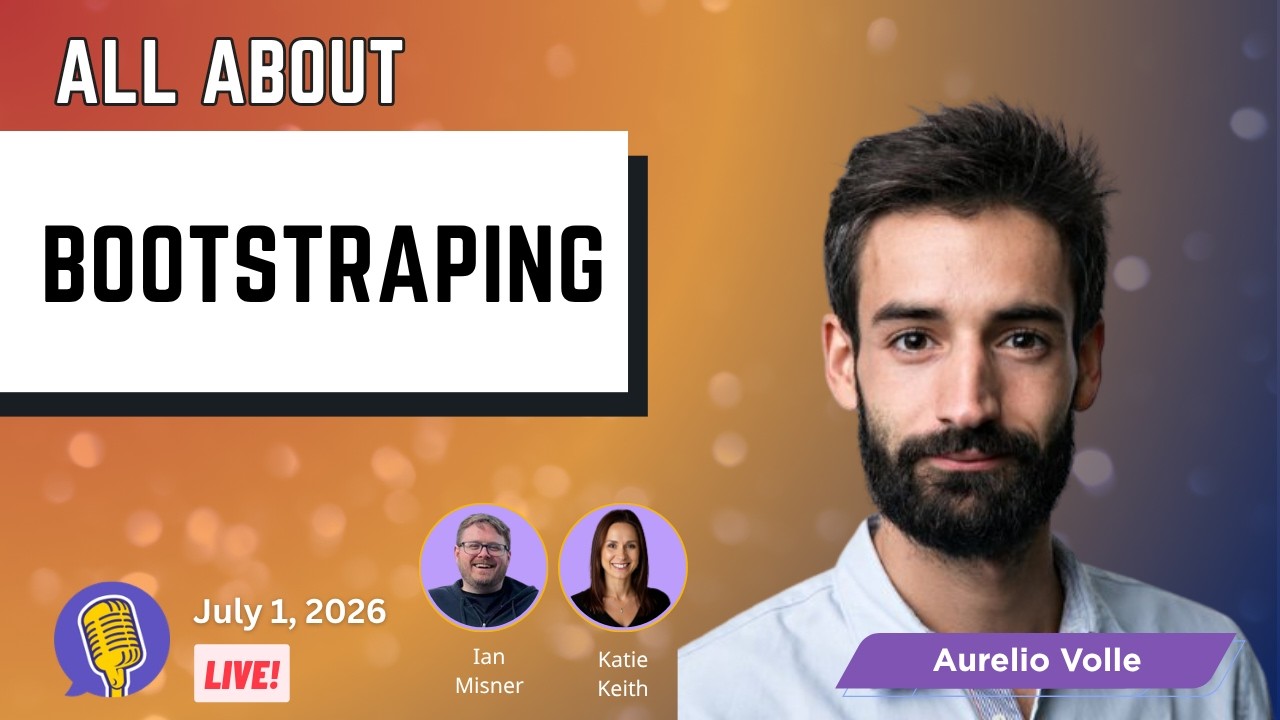

WordPress is often dismissed as a tool for small websites, but behind thousands of successful agencies lies a growing ecosystem of mission-critical infrastructure. On this episode of WP Product Talk, Katie Keith and Ian Misner sit down with Aurelio Volle, co-founder of WP Umbrella, to explore how a fully bootstrapped company built an essential platform that agencies rely on every day for site management, backups, monitoring, and security.
Aurelio shares the journey from startup to seven-figure ARR without outside funding, revealing how customer feedback shaped the product roadmap, why reliability became WP Umbrella’s greatest competitive advantage, and what it takes to earn the trust of agencies responsible for managing hundreds of client websites. Whether you’re building a WordPress product, running an agency, or growing a SaaS business without investors, this conversation offers practical lessons on shipping quickly, building in public, and creating infrastructure that customers can’t live without.
[00:00:00] Katie Keith: Every founder says that reliability matters, but it's so tempting to build shiny new features instead of focusing on boring things like how reliable your product is. But what if the boring work of keeping things running smoothly is actually your strongest competitive advantage? And what is the actual cost to build a product that is so good that customers don't even notice it unless it breaks?
[00:00:27] And how do you sell something that is invisible when you get it right? Let's talk about that today
[00:00:37] Matt Cromwell: This is WP Product Talk, the place where every week we bring you insights, product marketing, business management and growth, customer experience, product development, and more. It's your go-to podcast for WordPress product owners by WordPress product owners. And now, enjoy the show
[00:01:05] Katie Keith: Hi, I'm Katie Keith from Barn2.
[00:01:08] Ian Misner: And I'm Ian Misner from Kestrel.
[00:01:11] Katie Keith: Now, before we get started, if you benefit from WP Product Talk, then we'd love your support simply by hitting subscribe right now. It only takes a second, and it makes a big difference. Thanks.
[00:01:24] Ian Misner: Yeah, and a huge thanks to Freemius for being our exclusive growth partner.
[00:01:27] You know, they help software makers grow, monetize, and succeed as a merchant of record platform, handling, uh, everything around selling software. So checkout, payment, subscriptions, licensing, updates, and global tax compliance so you can just build your product.
[00:01:44] Katie Keith: Okay. Let's get into the show. Uh, we're talking about, um, reliability and why it is the ultimate moat.
[00:01:52] And for that, we've invited the perfect guest to talk about this topic, Aurelio. Hey.
[00:02:00] Aurelio Volle: Hey, Katie
[00:02:02] Katie Keith: Are you okay? Thank you so much for coming on. Um, could you tell us a bit about yourself to get started?
[00:02:08] Aurelio Volle: Uh, sure. I'm, uh, I'm Aurelio. I'm the co-founder of, uh, infrastructure for WordPress agencies, uh, based on a plugin, uh, which is named WP Umbrella.
[00:02:22] Uh, and for the people who know WordPress, we are an alternative to manage WP, uh, or main WP. Uh, and we've been building this platform for the past five years. We are a little team of six people distributed. Uh, and we are installed on about 80,000 WordPress sites. And what make us, uh, special, I guess, um, is two things, are two things, pardon.
[00:02:54] The first one is that, uh, we've, we are growing, uh, in the current, uh, in, in the current market condition. Um, and the second one is that we have a very clear ICP and just one ICP, which is agencies. Um, and that's it. We're a French-based company, uh, and, and I'm delighted to be here, uh, and I'm delighted to speak about, uh, reliability.
[00:03:25] Uh, so thanks for, thanks for the invitation, Katie and Ian. Yeah.
[00:03:30] Katie Keith: Yeah, it's all- Thank you for coming on. So, um, well, that seems perfect because that is so fundamental to what you do. Uh, for people watching live on YouTube, then please leave your comments, questions, whatever in the comments. Actually, if you're watching on Twitter or LinkedIn, you can also comment there, and we'll try to get to them during the show.
[00:03:51] But let's get started. Um, Aurelio, could, could you start by talking about what we mean by reliability? We all know the word, but what do we mean by it in this context? And specifically, in what way is it a product moat? Because those aren't necessarily concepts we think of together.
[00:04:12] Aurelio Volle: Um, I think that within WordPress, uh, I mean, within our WordPress ecosystem, uh, reliability means to have a product that's working everywhere with everything.
[00:04:28] And when I speak about everything, I'm speaking about the worst kind of share hosting plan, uh, where your solution has to work with other solution, uh, that can also be the most terrible WordPress plugin, right? Um, and the added value of WP Umbrella is that we aggregate all those sites so agencies can do bulk action, uh, in one click, and they can do the most dangerous, uh, bulk action of WordPress, which is, uh, in the first place, updating everything.
[00:05:08] Um, and, and so your product has to work, uh, with all plugins on all environments. And, and I think this is a real reliability challenge, uh, when you build a WordPress product because, uh, when I look at WP Umbrella, there is, um, SaaS parts, uh, that we own fully. So for instance, based on what you do with WP Umbrella, we send white label care report to your clients, and this is something we totally master, uh, because it's our data, our sending system, and it's not related to WordPress.
[00:05:45] Uh, and this is easy. You know, it's easy to build a software that doesn't interconnect with anything, especially nowadays. Uh, the hard part is the WordPress part, is how do you make sure that you are updating this premium plugin that doesn't respect any kind, uh, of coding pattern, coding norm, uh, that does not respect a changelog, um, changelog, changelog rules.
[00:06:14] Um, and, and this is a real challenge. Uh, and reliability applied to WordPress, in my opinion, mean that your product has to work in every kind of environment. And Uh, through the lens of WP Umbrella, um, it's that multiplied by 200 websites. And what we see is that sometimes, so we do safe updates to make sure that, and we have like screenshot, backup, and stuff.
[00:06:47] Uh, but we also do backups. And sometimes we have a client that decide to trigger 200 backups on 200 websites that are hosted on the same VPS. So reliability, and this obviously lead to a runtime. So reliability also mean, uh, in my opinion, anticipating this kind of use cases to make sure that your product doesn't have an impact, uh,
[00:07:19] within this interconnected ecosystem. Because, uh, it's too easy to blame, uh, a hosting provider or the plugin developer if, uh, you don't think things through, uh, to the point that your solution, um, don't compromise other environment. Uh, I, I don't know if I'm clear because it's a very broad question, uh, and it's at the core of everything we do.
[00:07:41] But this is how I perceive, uh, reliability inside WordPress.
[00:07:47] Ian Misner: Yeah. I mean, I would say right off the hop, I do fully agree with the problem of, you know, updates with a million plugins. You know, all of my stuff's on WooCommerce. The typical WooCommerce site has, you know, 50 plus plugins installed. Every round of updates is a scary thing that, you know, we, in our own plugins, try to test against a lot of popular plugins for every release.
[00:08:07] Um, that being said, it's like, uh, your product solving that at such a wide scale, like what... Can you share a few examples of like something that's like above and beyond? Like, what are you solving for that like is, uh... Teach other product builders one or two things that they should be thinking about, I guess.
[00:08:27] Aurelio Volle: Um- When you get, uh, a customer feedback, uh, often the tech team would tell, "Oh, this guy is stupid," or, "I'm not going to integrate with, uh, uh... to do the extra mile to integrate with Divi because the way Divi is managing licenses is not normal," you know? And most of the dev I know would stop to that. Um, and, and I think it's all about doing the extra mile and fixing all those use cases because this is where the value lies.
[00:09:05] You know, when you start to, "Okay, this guy has a problem," and it's a one-person problem until it's a 100-person problem. But as of today, as of, as of this ticket, this is a one-person problem, and we should fix it. Um, and I'm always saying, and it's so Dundermifflin, uh, if you have watched, uh, The Office, uh, but, but everything is customer support.
[00:09:31] Uh, and I mean it, uh, by every piece. Because if someone takes the time to tell you, "Hey, I like your platform," or even, "Hey, there is a bug on your platform and, and you should fix it," um, this has so much value. You know, like for instance, I never give feedback to people if something is not working. I just ditch the solution, and I mo- I move my way.
[00:09:56] I... And, and in WordPress, uh, people like to give feedback, and this is golden material. And people should really like see this as the best opportunity to improve a product rather than a criticism or, um... And good thing take times, even with AI. You know? Like, because this kind of edge cases, uh, Claude cannot guess them.
[00:10:22] Uh, it can fix them when you have the problem. Um, but building an infrastructure is building and having the Confidence that what you are going to build will last in two, three, five years from now, uh, and that fixing all those little edge cases has a lot of value.
[00:10:42] Ian Misner: Well, how far do you go with that? Because, like, let's say, I mean, there's 100 million payment gateways.
[00:10:49] Let's say you have a bug with one that has 10 installs on WordPress.org. Like, when you say you fix every single one, are you guys, like, lit- like, is that, is that the reliability that you're talking about? Like, you're literally doing it no matter what? Or is there still a threshold for you and your team?
[00:11:05] Aurelio Volle: W-
[00:11:05] Matt Cromwell: w-
[00:11:06] Aurelio Volle: what I look...
[00:11:06] We don't have threshold. Uh, but my, um, decision maker cursor is, do I have paying users? Uh, and I'm not talking with one side paying users because those are irrelevant. But do I have a guy who is spending, let's say, at least 40 euro on the WP Umbrella every month, which is about 500 euro per year, so it start to be meaningful.
[00:11:32] Is this guy having a product... a, a problem because, uh, there is a bug inside my platform that's not fixed? And if the answer is yes, I take the time to fix this bug, uh, rather than releasing a new feature because it's much harder to acquire new clients than keep happy the existing one. Um, and that's our philosophy and that's what we do.
[00:11:57] Uh, and sometimes it's very boring, especially for the tech team, you know, because you want to work on the next challenge. Uh, you don't want to fix someone else's problem. But at the end of the day, uh, today we are a growing product because we don't have any churn. Uh, and we don't have any churn because we don't take shortcuts and we take care of all those, um, little problem.
[00:12:25] Uh, and we exist actually because all of those little problems, you know?
[00:12:32] Katie Keith: Yeah, that's amazing, um, to have such low or zero churn. I love what you said about having to support other people's stuff because actually for all WordPress products, reliability is not just your own product because it's working in this wider context of a WordPress site with a theme, whatever version of PHP, and all the other plugins.
[00:12:55] So if your product doesn't work well with other people's, that actually says something about the reliability of your product, even if it's not your product's fault, because this is about perception as much as anything, isn't it?
[00:13:09] Aurelio Volle: I couldn't agree more. Uh, and, and for instance, uh, I have a very good example as from this afternoon.
[00:13:17] Uh, we were blocked, uh, by SiteGround during few hours for, um, a random like WAF reason. Um, and so the whole team, uh, and I mean, we are just six people, so it's not like a, that big of an army. But the whole team went after people we knew at Hostinger to get the problem fixed, and because Hostinger is a great hosting company, the problem was fixed, uh, very quickly.
[00:13:47] Uh, but at the end of the day, uh, your customer has a problem, which is your tool, uh, is not working. And to say, "Yeah, it's, it's the hosting," it's, it's not helping anyone, you know? Uh, so we, we do what we have to do. In the situation of, I mean, what happened today, for instance, with Hostinger, uh, it was because of the hosting.
[00:14:10] You know? Like we are blocked by the firewall, end of the game. Uh, they are our bottleneck. We know this. Uh, they know it. Uh, and once you have this information, you have to choice, either, uh, uh deal with, talk about it with your hosting company and nothing's get, get fixed, or you escalate things properly, you put pressure, and you fix the problem because at the end of the day, it's also affecting your users.
[00:14:36] And I think people like so much WP Umbrella, uh, because of this. Uh, and we like to work with hosting companies that have the same kind of standard. And surprisingly, most of the WordPress hosting company I know, uh, have a very good customer support. Uh, I, I don't like the way they restrict, uh, for instance, infrastructure usage, the shared hosting, uh, policy and so on that makes our life sometime miserable.
[00:15:05] But when it come to customer support, uh, all of them are actually very responsive, and I think we are very lucky to, to be operating in, in such ecosystem.
[00:15:18] Katie Keith: Yeah, that makes such a difference. So we normally do a show and tell section where we talk about our specific experiences and examples. You've already given quite a lot from WPUmbrella.
[00:15:30] Um, are there any other specific stories you want to share about where reliability made a huge difference?
[00:15:38] Aurelio Volle: Um, the, the problem with, uh... The, the problem with reliability is that it's not something you see, you know? Uh, so for instance, uh, tonight or tomorrow we are going to release a security driven activity log feature and like a security, a huge giant batch of security feature inside WPUmbrella.
[00:16:00] Uh, and this is going to drive, uh, acquisition. Uh, people are going to speak about it, and it's going to grow the business, and this is very visible. You know, we send the product update to fifteen thousand people. Uh, it generate a discussion. People loves it, and, and you get the dopamine shot, right? Um, when you fix a little bug, nobody sees that.
[00:16:24] There is just one user who was pissed and now is okay and happy that the bug was, was fixed. But, um, it's not something you can see and you can perceive. Um, the, the, the story I would tell is that, I think it was back in October, we got our first one-star review because the backup was not working, and the guy missed the alert.
[00:16:50] Site was down, and he had a terrible day. Um, and I talked to my, to my CTO and my lead of engineering, and I said, "Guys, we are..." I, I think at that time we are doing like one hundr- I don't remember, but 100K month of, uh, monthly recurring revenue, which is more money than what we need, right? Uh, profitable company, bootstrapped, everybody's happy.
[00:17:17] And I was, "Guy, uh, we could stop growing." we, if we keep our current user base, uh, and, uh, and, uh, more money at the end of the year that we could spend. So you know what? Till the end of year, I don't want anything new being shipped till we don't have a very clear understanding that our backup technology is the best, uh, inside the WordPress market.
[00:17:44] And there are many, like, good, good, good backup plugin like BlogVault or even ManageWP, which is, which is a good backup company too. Uh, and so for three months, uh, very little product updates, nothing shiny happening. The growth was, uh, still here, you know, but not exponential as, for instance, last month where we shipped the, uh, cloning and migration feature or broken link checker.
[00:18:11] Like, uh, steady organic growth. Um, and today it pays off so much because the churn, and, and churn doesn't diminish overnight either. You know, you fix a bug, uh, and it, it has no impact. But over time, it compound, and today we are growing a bit more than in the past. But because churn is so low, the growth is exponential.
[00:18:37] And, and, and, and this is, like, the most annoying thing is that it's a painful job You don't get any instant result. There is no dopamine highlight, just, uh, you and yourself being proud that you live up to your promise and that you ship a tool that's working. Often it's not even your fault. It's not even, uh, your liability.
[00:19:00] But over time, this is the most important thing you can do, and this would be my advice to every single, uh, product builder. If you have one paying client, or let's say ten or a hundred, so you have like a, a better like representation, uh, of what your audience need, make sure that what you give to those people is actually working.
[00:19:24] And if it's not, fix it before shipping something else. Because if you start to ship new stuff while what you have doesn't work, you are creating a technical debt and a support debt. And, uh, this was an advice I got from JB and Jonathan, the founder of WP Rocket, uh, who are our mentor and, and business angel back in the day, which was if they had to do WP Rocket all over again, they would hire dev over support to fix bugs in the first place rather than to try to deal with them.
[00:20:02] Uh, and it's a philosophy we have had from day one, uh, at WP Umbrella. Uh, and it's very frustrating. But if you are, if you, if you are in this product game, you know, like because nowadays I think many people are playing, uh, there is this ego, uh, AI thing where you think you can create anything. But the truth is, uh, it's not about creating something that's shiny and, and that's fast.
[00:20:28] It's about having the resilience to enter into this game and to be ready to fix all those boring edge cases that Claude will not see in the first place, uh, and to keep marketing day after day, episode after episode, to finally, at some point, grow an audience and grow a product that people love and that people buy because they can trust it.
[00:20:52] Uh, that's, that's my take. At least if you are, uh, like we are, into a monthly recurring, uh, business where every month people are paying for something and you need to show up. Uh, if you are selling like lifetime licenses and, and probably it's a, it's a different message, uh, but it's a market I know, I know less.
[00:21:11] But if you are in the, uh, B2B software, uh, game, uh, it's all about resilience, whether it's marketing or product.
[00:21:23] Ian Misner: Yeah, I, I really like that, and I think that you really hit something there that kind of ties back into the everything is customer support, right? And, you know, ultimately with AI, everything's AI now, but you can make a lot of the features that we all sell with Cloud.
[00:21:37] You can just go spin it up. You don't need to be all that clever. But you are responsible for it. You are... You know, that's where the reliability comes in. The, the fact that people trust your product and your brand enough to hand over, you know, a significant amount of their trust in maintaining their own business, that's what grows your company.
[00:21:58] It's the, the code was always a commodity, basically, right?
[00:22:02] Aurelio Volle: And, and I can give another, uh, very, very good example. Um, every week, uh, I mean, every Friday morning, this is our ritual, uh, the tech team, uh, does a little, uh, internal hackathon where they pen test and they try to pen test, uh, the application. Uh, and it's something, uh, probably nobody is doing inside WordPress.
[00:22:27] Uh, and very few software company are actually doing something like that. But for me, this is also... May- maybe we'll have a security flaw like, uh, se- se... I mean, security flaw is part of IT. Uh, Microsoft has security flaws. The biggest, uh, IT company have security flaw. Uh, but we, we've intent. We dedicate resources to make sure that our product is safe for the people who use it, and as safe as we can.
[00:22:57] Uh, and I always tell my team, like, "It's okay to make mistake, uh, but you should try to do your best." And that's what we try to do in everything we, we touch when it comes to this, uh, reliability/trust relationship. Um, and, and I think, and, and of course, it's based on our ICP, and I would nec- not necessarily do that if I was doing another product.
[00:23:23] But what we do is so-called business for agencies, uh, and agencies are in a, um, some kind of a rat race with clients, with finding new clients, with dealing with random clients' question, uh, that they don't want to deal with additional drama, right? So we do everything we can to serve them, uh, in that sense.
[00:23:46] Uh, and it takes times. Uh, it takes a lot of effort. Uh, and I'm hap- and I'm lucky that I have a tech team that's also, like, very, um, willing to help, uh, willing to and proud to do, like, a code that's safe, uh, and stuff like this. Uh, but it's what it took us and what it's taking us every, every day to, to, to build reliability
[00:24:15] Katie Keith: Hmm.
[00:24:17] Yeah, and it sounds like that's all made a huge difference because a lot of companies have a more lazy approach and, uh, don't do all those things. So Ian, what are your experiences in this area?
[00:24:29] Ian Misner: Yeah, I mean, the, mine was a little more accidental, you know? So we, my example here is around Checkout WC, so it's our, you know, checkout replacement for WooCommerce, and, you know, it's a plugin we acquired back a couple years ago now.
[00:24:42] But thinking that the real proposition, the reason people used it was, you know, it boosts revenue, you know, conversion rate on checkout and all that. But what I've kinda learned over the years of, you know, working on it and building up the product is, like, the actual reason people buy it and stick around is similar to what you're describing, Aurelio, in agencies and developers where, you know, they throw this on a site, they save a day of cleanup and customization and making everything look great, but then also they rely on us for all these little compatibility updates and tweaks.
[00:25:12] And, um, you know, for this product, you check our change log, like, three of every four releases is just compatibility with everything you've ever heard of because, you know, we're racing to keep up with everything else. In fact, it slows our feature releases down more than I'd like at times. But because of that, the agencies that stick with us, they add more sites and grow with us over time.
[00:25:35] And for me, that was an accident. Like, I didn't go into the product thinking that that's what we were doing. I've just kind of learned that that is the, the thing people were really hiring us for, was reliability and, uh, more than anything just that as an agency you get to save a day of dev time on each new site build, and that, that trusting us for that seems to be the big le- lever that keeps people around for years.
[00:26:02] How about yourself, Katie?
[00:26:05] Katie Keith: Yeah, that's interesting, um, that that's becomes the moat, and the fact that the time it saves them is worth more than the cost of the plugin makes difference as well. For, for me, I'm gonna share, um, an example of where we got it wrong and we released a product that wasn't reliable enough in terms of compatibilities.
[00:26:27] So we released WooCommerce product filter probably three or four years ago now, having identified that none of the filter plugins on the market were any good, basically. They were all very unreliable, and we wanted to make one that was better. And, um, it was better, but not better enough. So because, like product filtering, uh, is, is all on the front end and it's quite complex, and a lot of themes and things do things like custom pagination or whatever, and mess things around that makes it very difficult to predict and integrate with.
[00:27:02] So we were getting a huge amount of support tickets for integrations, or actually bugs because it wasn't working with a popular theme or something like that. And, um, we thought, "What should we do?" Because it was way more than our other plugins. Refund rate was something like 50%, even after a year, which normally it would start off that with a new plugin and then go down, but this wasn't.
[00:27:26] But it was actually getting good sales, and it was filling a gap in the market. So we decided to basically rewrite the entire front end, which was a massive project, but we completely re-thought about it with compatibility in mind. We took over the things that we couldn't predict, such as pagination for example.
[00:27:46] We now do our own because we couldn't integrate with everything. And at one point during this rewrite project, I looked at how much we'd spent on it, so how many hours the developer. And I worked out it was something like 20 or $30,000 on this rewrite. I was like, "Oh my God." But then I looked at the sales, and actually it was still worth doing because the plugin was making more than that, and it's loads better now it's released.
[00:28:11] But it was frustrating having to do such a large project because I wanted to be building new things or adding new features to that plugin. Because once you do a major reliability improvement like that, you don't actually feel like you're any further forward because you've got nothing to show for it, just your foundation of what you had in the first place is better.
[00:28:33] But that has brought the refund rate down, reduced the support tickets, and that was what that product needed.
[00:28:41] Ian Misner: Yeah, I definitely experience a lot of the same with that. And actually, I really, I hinted at this earlier too, of like, you know, sometimes it's hard to talk about all the work you're doing, you know, emailing users and tweeting about everything, 'cause it's like, you know, a change log has 50 items in it we haven't really told anyone about because, like, they're not that interesting unless you're the four people that encountered that problem, basically, right?
[00:29:05] So.
[00:29:05] Katie Keith: Yeah. And you should probably tell them about it personally anyway. Uh, we always keep a note of who asked for what, and they really like it when you contact them individually to say that you implemented their feature request.
[00:29:18] Ian Misner: Yeah, absolutely.
[00:29:22] Katie Keith: Well, let's talk about how to use reliability in your marketing, um, because it's hard because it's just a statement, isn't it?
[00:29:31] So my thought on this is to use things like, uh, social proof, for example, uh, where the customer has talked about that. That's a way that you can provide more evidence-based marketing. What other tips on that do you have, Aurelio?
[00:29:46] Aurelio Volle: Um, what I do is that I try when my, um, uh, LinkedIn publication channel, um, is empty to shoot a screenshot of a nice review we, uh, we are getting, right?
[00:30:04] Uh, and for instance, this Monday, uh, we had a web agency named, uh, Web React, I think they are from the, from the Netherlands, who left us like a, a super nice, uh, five-star review because they interacted with Customer Success Report and they said like, "Hey, two, three years ago we migrated from Managed WP, one of our best decision of our life," uh, blah, blah, blah.
[00:30:28] And I put a little screenshot and I say, "Hey, happy Monday everybody." Uh, something like super... And then, uh, in comment I had one guy who said... And this is, I'm sharing a true story. In comment, uh, I had one guy, uh, who said, "I agree, the response time is exceptional." Um, and maybe could have been just a 500 impression post.
[00:30:55] Um, it happened, uh, but it generated a conversation, right? Um, and I think, uh, it's very hard to do marketing on reliability because, uh, you claim something and then there is Instagram versus reality and, uh, and so on and so on. Uh, but you need to create like touchpoints where real people... And I tag it because sometimes you get a review and you don't know from where it's from, um, but the guy had the name of the agency in the review, so I tagged him on LinkedIn and it generated conversation.
[00:31:28] Um, and I think you need to create, um, uh, I call this like surfac- extend your surface of luck to generate like social organic conversation on your product where people would just like pop up to say they are happy. Uh, and it doesn't work all the time, but like everything in marketing you need resilience and you need to keep posting, and you need to add something to the conversation
[00:32:00] And this is an example from Monday.
[00:32:03] Katie Keith: Yeah, that's really nice that they replied. Um, sometimes I feel with social media from a company account, it's a bit like shouting into the void. I can get engagement on personal, but company we've not really figured out. What's your best channels for that?
[00:32:21] Aurelio Volle: I do a lot of, um... I have never liked, uh, Twitter. Uh, the, the, the idea of, uh, expr-expressing yourself in two hundred character was always something frustrating to me. Um, uh, and so I always went on LinkedIn. Uh, and web agencies are all on LinkedIn. So for me, this is a perfect channel for my ICP. Uh, even if today there is way too many, uh, ChatGPT-powered posts, and the network is losing a bit of interest.
[00:32:55] Uh, but for me, LinkedIn is a great place to do that. But again, it's very dependent of who is your ICP, uh, because if you are building a WooCommerce product, probably LinkedIn, uh, is not the right place for you, and you need to, uh, showcase your social proof where your client is. Uh, and for WooCommerce, I don't know, and you two are way more experienced, uh, than me on that.
[00:33:21] Uh, but if I was today, for instance, building an AI startup, um, I would probably do that on Twitter, or I will do that on Product Hunt. Uh, and each ICP has its own channel, and what matter is to try to find the right channels, and maybe there is just one, maybe there is many of them for your, for your ICP
[00:33:45] Ian Misner: I, I do think there's something interesting in that the IC- you have such a clearly targeted ICP to agencies.
[00:33:52] I think that helps you in that to some degree. Uh, because like I said with my example with CheckoutWC, like talking to the Woo merchants is actually really difficult, and selling the idea of reliability is sorta ... I mean, everyone says that, and so they don't get to g- see it deep enough to, to care any of those single touchpoints.
[00:34:10] Uh, so I, I do use like a testimonials page on CheckoutWC and, you know, we share like screenshots with little avatars and like links to the people's site so people can see they're real. And, you know, we do that a fair amount. But the d- obviously, like it just, it resonates deeper with agencies, and if you actually check our testimonials, those are mostly agencies as well.
[00:34:32] And, you know, not to put you on the spot too much, Katy, but you're probably better at this part than both of us on the getting in front of, like, the, the other people, you know. Do you have any tips on the non-agency audience, you know, selling the idea of reliability to them at all?
[00:34:47] Katie Keith: Well, my expertise has always been being there where people are looking.
[00:34:53] So the non-agency people are typically, well, in the past, they were googling a solution, and so, um, pretty much all our success has come from being there. Whatever they type to do with WooCommerce, you'll probably find Barn2 somewhere near the top of the results, which is amazing. Unfortunately, that's not as effective as it used to be, um, which I'll be discussing with Aurelio next week on somebody else's podcast actually.
[00:35:20] Um, but yeah, for me it's always about being where they are. But I think in the future, Reddit is absolutely huge, largely because, um, the AIs use Reddit as a massive source to decide who to recommend. So I'm still trying to figure out a good strategy, because the best way to be doing Reddit would be to spend like an hour a day on it, just joining in all discussions, but I'm sorry, I don't have time for that.
[00:35:49] And you can't really just join it to jump in when people talk about your products, 'cause that looks promotional and will get you blacklisted. So at the moment it's an increasing challenge because the way people discover products has fundamentally changed. Uh, so there, there are some people in things like Facebook groups, for example, WooCommerce Help and Share is a really good one where, uh, website owners actively ask for advice about how to do things with their WooCommerce store.
[00:36:17] And it's exactly what Aurelio said. Find out where your specific target user are and be in those places.
[00:36:26] Ian Misner: You guys should plug the actual podcast, by the way. You know, where do people find that?
[00:36:30] Katie Keith: Yeah, it's Grades, isn't it? Um, it's... Is that what... I don't know what the name of their podcast is, but they are Grade, the studio i- Ah
[00:36:38] agency in Germany. Cool.
[00:36:41] Ian Misner: Yeah. And, uh, as far as the, the Reddit stuff, I mean, uh, I'm using it a fair amount, but I, you know, just disappear for a month at a time because I forget to keep looking and, you know, there's no momentum, there's no structure to it. So that's def- Mm. I'm doing it wrong for sure. Yeah. I am seeing people doing the thing where they're clearly creating dummy accounts and asking generic questions about what to do with these things, and I really just don't like those like disingenuous approaches.
[00:37:04] But because of the AI using Reddit, everyone is doing it and it's like the same thing Aurelia said, like LinkedIn is just ChatGPT swap now. Reddit has this like pattern you see everywhere now. Drives me nuts, but it probably works or else why is so many people doing it, right? Yeah.
[00:37:23] Aurelio Volle: If, i- i- if I, if I may, uh, I think, uh, AI is not using Reddit anymore to train model.
[00:37:31] So this is something that was very true a few, few months ago, but I think, uh, I think this is not the case and I think that the stock, uh, of Reddit actually collapsed, uh, very much because of that. Uh, uh, but you still have, uh, so many genuine interested people on Reddit and it's really worth doing it the right way.
[00:37:55] If I can share a little experience, uh, we all, the team member of the Virtual Morador ban, uh, from Reddit because we tried to, to, to do marketing. Uh, and I th- my advice, uh, would be to do it, uh, the right way because this is the only way it's going to work on Reddit. Uh, and I think it's worth it and it might even be worth to hire someone just to hang out on Reddit and contribute to conversation and when you have like, uh, product placement opportunity, uh, to drop a comment if it's insightful for the, for the person who ask.
[00:38:31] Um- Uh, at least that's, uh, that's my contribution to the Reddit, uh, to the Reddit story.
[00:38:40] Katie Keith: Yeah, I think that's good advice. You need to do it properly, and really spend the time giving genuine help and advice to people, not just in answers where your product is the solution. And then when your product is the solution, you can get away with it.
[00:38:55] Um, but the trick is- Yeah ... how much time you wanna spend on Reddit.
[00:39:00] Ian Misner: Yeah, if you're using it as an actual strategy, I mean, like for example, the WooCommerce subreddit, you could just, you know, on 20 minutes a day show up in every single post if you wanted to. Mm. But to go wide would be pretty challenging.
[00:39:12] And I just, yeah, I've never found enough justification to really go deep, but it's there, and it would work I'm sure. Right.
[00:39:20] Katie Keith: But it's interesting what you said, Aurelio, about it's n- at least not using training data anymore. Maybe it's less of a priority than it used to be, so have to keep an eye on that one.
[00:39:32] Ian Misner: Yeah.
[00:39:33] Katie Keith: Right. Well, we've got some comments. So firstly, uh, we've got Dave Gray, who also builds products aimed at agencies. He says, "Looks like I need to start using LinkedIn more." So you've inspired him. And, uh, Patrick Posner says, "I want to be li- or like Aurelio when I'm grown up, ha ha." I don't know what specific aspect of you, but again, you are an inspiration.
[00:40:00] Ian Misner: Perfect.
[00:40:05] Katie Keith: So, um, I think we've got to the point where we need to, uh, wrap up by giving our very best single piece of advice on the topic. So if you could only give one piece advice on how to build a moat around your product through reliability, what would it be? Do you wanna start, Aurelio?
[00:40:26] Aurelio Volle: Customer support
[00:40:30] That's it. That's everything
[00:40:33] Katie Keith: Just get it right. Get the support right.
[00:40:36] Ian Misner: Yeah, I mean, I, my answer is pretty similar to that. So if, unless, do you have more to add Aurelien? Because I can jump in I,
[00:40:42] Aurelio Volle: I mean, that's all what I have been saying for, uh, 40 minutes. Uh-
[00:40:49] Ian Misner: Yeah ...
[00:40:50] Aurelio Volle: take ownership of that. Do the extra mile and do customer support the right way.
[00:40:54] Not, don't do tickets. Do support with ownership, and the person you are going to hire in customer support, and I wish you that, uh, is probably going to be your first employee, and it's going to be the most important employee you have, in my opinion
[00:41:14] Ian Misner: Yeah, I, I fully agree. And, uh, my background was, uh, originally at SkyBridge.
[00:41:18] I was the support person, head of support eventually, and, you know, that's what I'm doing now from that. And my- the reason I was saying I could add to that is one of the primary metrics I measure for our products, and it's a suite of products, right? So we don't have, like, one big monolithic thing to pay attention to, but we use a metric called conversations per thousand users.
[00:41:37] And so the health of a product is strongly measured by how many support conversations are generated by that product. And, you know, we view that very similarly to what you do is, like, everything is important. In fact, our tone guide, we're not allowed to call them tickets even internally. They're conversations because they're with people, and it's a little one of those, like, weird things that I'm not, uh, you know, I'm not lenient about.
[00:42:02] I care very much about that differentiation. But the, um, conversations per thousand users is a way to put a metric on this where, you know, quarter to quarter and year to year, you can see, like, which products are actually generating the need for more help, the need for problems. And, you know, you can actually manage it across a suite of, in our case, 40 products.
[00:42:23] You know, identify the ones that are outliers and know two things. Like, one, it's a quality measure for your customer. You know, they can get set up without needing your help, or they don't encounter issues as often. But then it is actually a quality issue for you as a business as well, where, you know, support costs money.
[00:42:42] So if you're driving that number down systemically over time, your products are generally more profitable as well, right? So by using one measure that allows us to, you know, focus on that customer need, but also can openly be justified as an investment into the future, you know, you... Basically, I'm just saying customer support, but with, like, a spreadsheet attached.
[00:43:03] That's all.
[00:43:04] Katie Keith: Yeah. Yeah, that's interesting, the concept of putting the number around it and using that as a warning bell really when there's a problem on a particular product or something. Um, also you could look at that as a, a metric over time so that if support, uh, sorry, conversations, uh, jump up- ... then that's the sign that something has changed, which honestly- Yeah
[00:43:28] you probably know already, and this might just be confirmation, but sometimes it might give you insights. Like- Yeah ... the refund rate on my filter plugin I was talking about would be another way to get that insight- Yeah, we- ... if we need to do something ...
[00:43:42] Ian Misner: we also track refund rate and, uh, actually conversion rate on the listings as well as, you know, three similar- And similarly important measures, basically.
[00:43:52] Um, you know, are people feeling that they're getting what w- they were promised? Um, but that support measure, uh, you can drive it down over time in ways that are surprisingly easy and predictable, and I think that it does come through to the user as reliability. You know, they feel it as the thing just works.
[00:44:10] That is what you're prev- And it is important to keep in mind, you know, especially if you're in a big organization hearing this advice, there are ways to drive that number down that are not positive to customers. Those are not correct. Every one of those is wrong. You know, making your support widget harder to find is not what I'm talking- Yeah
[00:44:28] about here. Right. So, yeah.
[00:44:30] Katie Keith: Yeah. True. Um, my best advice would be to think about ways to emphasize the reliability of your products in your marketing. That might be through showcasing testimonials. But generally, it's more about your reputation more widely. So once people get to know about your company, and maybe they, um, like the interactions you've had publicly, or they have seen other people talking about your products on Reddit or Facebook or LinkedIn or wherever, that is all creating that reputation for reliability.
[00:45:07] So don't just be reliable, find evidence that you are and shout about it. Well, that's a wrap. Um, Aurelio, thank you so much for joining us. Where can people find you online? Uh,
[00:45:21] Aurelio Volle: LinkedIn, uh,
[00:45:25] definitely. Uh, just type my name, uh, and you will, uh, you will find me. Um, and on wp-umbrella.com, uh, we have a two weeks free trial, no credit card, just go over there for inspiration. Um, and always happy to get feedback from other product, uh, founder. So ... And I'm also on Twitter, uh, first name, last name, uh, all attached.
[00:45:54] Uh, and, and you can find me there too.
[00:45:57] Ian Misner: Awesome. Thank you. And if you guys are all enjoying these shows, do us a favor and hit the subscribe button on YouTube. And, uh, if you're watching on LinkedIn, click right immediately. It's important. Do it. And a special thanks again to Freemius as well
[00:46:12] Katie Keith: Um, we've got comment from Adam Is The Best, "Great podcast, everyone."
[00:46:17] Thank you. Now, next week, um, Matt and Ian will be back and talking to Vito Peleg from Atarim about the point of no return for WordPress agencies. Ian, do you know what you'll be talking about? Because I don't actually know what that means.
[00:46:37] Ian Misner: I definitely do, and we'll talk about it lots next week when I have- Oh
[00:46:41] time to prepare more detail.
[00:46:44] Katie Keith: Gonna leave it a mystery. Okay. Yeah. Well, thanks everyone for watching. Bye.
Related Episodes


The Realities of Selling WordPress Products Internationally
How to Increase Software Sales by Switching From Product Videos to Process Videos