
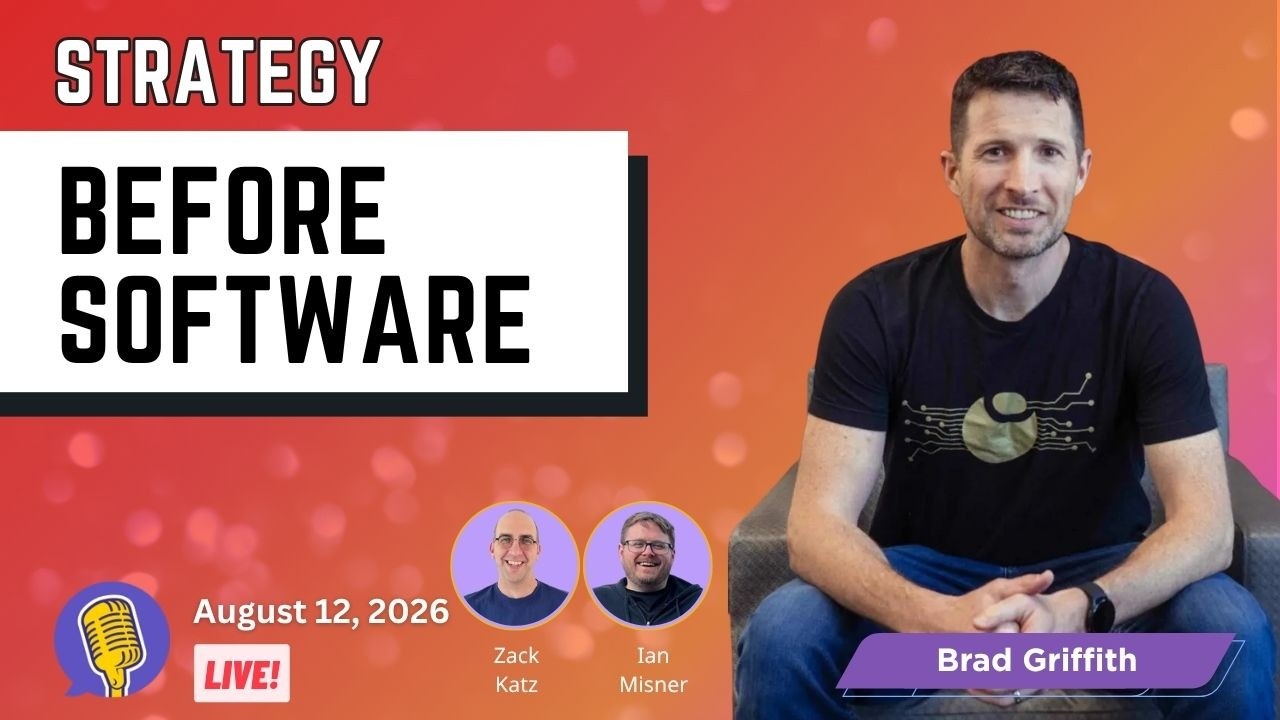

Before a single line of code is written, the most important product decisions have already been made. Join us on August 12th as Zack Katz and Ian Misner welcome Brad Griffith of Buckeye Innovation for a conversation about why so many digital projects fail long before development begins. From unclear goals and undefined workflows to misunderstood user needs, Brad shares practical lessons from building websites, applications, and digital tools for purpose-driven organizations.
Using a digital product strategy approach, Brad will explore how product teams can align strategy, design, and development to create solutions that solve real problems and deliver measurable outcomes. Whether you’re launching a new WordPress product, planning a major feature, or evaluating your product roadmap, this episode will provide actionable insights to help you build the right thing before you start building anything at all.
[00:00:00] Zack Katz: Before you write a single line of code, some of the most important decisions about your product have already been made. Today, we discuss how to prevent those failures before development even begins, and how to get clear on your goals, your users, the problems you're actually trying to solve, and help you build things right from the start.
[00:00:22] Welcome to the WP Product Talk.
[00:00:27] Matt Cromwell: This is WP Product Talk, the place where every week we bring you insights on product marketing, business management and growth, customer experience, product development, and more. It's your go-to podcast for WordPress product owners by WordPress product owners. And now, enjoy the show
[00:00:53] Zack Katz: Welcome, welcome, welcome, uh, to WP Product Talk. Uh, before we get started, if you benefit from the show, we'd love your support, and the easiest way to show us support is to hit subscribe right now. It only takes a second, and it makes a big difference. So please do that, and thank you so much.
[00:01:08] Ian Misner: Yeah. Awesome.
[00:01:09] And, uh, thanks so much to Freemius for being our exclusive growth partner, you know, helping software makers grow, monetize, and succeed. It's a merchant of record platform handling everything around selling software. So check out payments, subscriptions, licensing, global tax compliance, all the junk so you can focus on building great software.
[00:01:29] Zack Katz: Yeah. So let's jump into the topic of clarifying and aligning on your strategy to build better software. For this, we've invited w- we've invited Brad to the show. Brad, welcome.
[00:01:40] Brad Griffith: Hi. Thanks. Appreciate you having me, Zack and Ian.
[00:01:43] Zack Katz: Yeah. Thank you for joining us. Uh, please, uh, f- introduce yourself.
[00:01:48] Brad Griffith: Sure. Yeah. I'm...
[00:01:49] So I'm Brad Griffith. I run a company called Buckeye Innovation. Uh, we're located in Columbus, Ohio, uh, in New Albany, a suburb. I've got a team of 12. Uh, it's fully remote, so while I'm here, uh, we have people who are spread throughout the country. Um, we want to make a difference in people's lives. We wanna work with nonprofit organizations and local governments who are bridging equity gaps.
[00:02:11] They're finding people who have differences in, uh, access to resources and opportunity and information and, and they're trying to bridge those gaps, and we build technology that allows them to help more people. Um, so we do a lot of WordPress work. You know, I've got the, the agency side of the business that, uh, builds marketing sites and e-commerce sites.
[00:02:29] We do a little bit of WooCommerce. Uh, we do plenty with WordPress and Elementor and Gravity Forms and a lot of the same stuff that you guys work with. Um, and then we've got a software development side of the business that's more custom web applications and web apps, mobile apps, things like that. So I, I'm personally building a lot of products these days, so I'm particularly excited to, to be on this, uh, show with you guys to talk about building products and monetizing those and what's the strategy around that.
[00:02:55] Ours, most of the products that I'm building are less WordPress related than the, our creative pod that's building marketing sites. Um, but uh, I started as an engineer. Um, you know, I, I won't bore you too much with the background, but I, I grew up, uh, in an entrepreneurial family, went to college for engineering, um, and then went back, got my business degree, started my business 17 years ago.
[00:03:17] Uh, so I've, I've got some experience building software and, um, I'm looking forward to learning from you guys today as well about how you build products, 'cause I'm a little bit newer to that building and commercializing my own products side of things.
[00:03:29] Zack Katz: Very cool. Uh, well, welcome. For those of you watching live on YouTube, please, uh, leave your comments, questions, or feedback in the comments section, and we will highlight your questions and comments, uh, to discuss live on the show.
[00:03:41] So Brad, AI is making product development a heck of a lot easier, I think, right? Like, you, you can write a ton of code, you can have a marketing site. Uh, does any of that matter if you don't have strategy?
[00:03:57] Brad Griffith: Uh, so I, d- well, it doesn't even matter. I mean, uh, maybe a rhetorical question. I, I think it is very cool to be able to build stuff even if you don't have a strategy behind it.
[00:04:06] Experimenting I do think is cool to see what's possible. Uh, but you're not gonna go anywhere with it, like, if you, if you don't have a good strategy. If, um, if you're building a product, uh, you're building a solution that is in seek of a problem, that's not good. Like, you wanna build a product that solves a problem.
[00:04:26] You know, you have a problem that you want to solve. A lot of people will say, "I'm just gonna build this thing. I've got an idea." And, and then you say, "Well, does anyone actually want that product that you're building?" They may not. Yeah. So I... Yeah. Cool being able to build stuff
[00:04:40] Ian Misner: I mean, it used to be a lot harder too.
[00:04:42] Like, you, you wouldn't be able to just go and, you know, invest a bunch of time and tokens into getting something up and running. Um, something that I do find interesting though is that you're, you're coming from, like, the agency side of things, moving into building products. That is something that I think a lot of the folks that, you know, listen to this show, watch this show, are probably experiencing.
[00:05:02] And there's a question that I really think about a lot with, you know, now that AI makes everything easy, is as agencies get more and more into building products, how do you sort of understand, you know, when you're building for one user versus building for a potential many users? Like, you know, how do you- Yeah
[00:05:19] bridge that gap, you know?
[00:05:20] Brad Griffith: That's, that's so... I, I'd love to learn from you guys how you bridge that gap. You know, I, I found it pretty interesting. We've got a few products that we're building, a volunteer management system, uh, an event ticketing system that can be used by nonprofits. Um, so if you have events and you got volunteers who are helping to run the event as well as some paid tickets, uh, we've launched that.
[00:05:40] I think we have now three main customers for it. So when you're, when you're building for that first customer, why... Most of us, I mean, did you guys build your product for you first? Like, when you, the first pro- I know you guys are, you've built a lot of things now.
[00:05:53] Zack Katz: I built many product for, uh, for, for myself, but not, not mu- not GravityKit.
[00:05:58] Brad Griffith: Yeah.
[00:05:58] Ian Misner: Yeah, I mean, anything I've built for myself, I probably haven't released really, you know? We end up using- Yeah ... our own tools eventually. Sure. Um, but typically, yeah, we're-
[00:06:08] Brad Griffith: Right ...
[00:06:08] Ian Misner: building for other people to sell things versus building for ourselves. I, uh,
[00:06:12] Brad Griffith: but, like, when you built something, it was something that you could use, right?
[00:06:15] Like, you had experience as your ideal customer potentially?
[00:06:20] Ian Misner: Yeah, yeah. Well, I mean, so there, there's, like, f- for, well, I mean, for myself, I spent a lot of time in literally just doing support for e-commerce stores, you know, getting a lot of questions from a lot of people, and, you know, eventually understand what those people need, you know, people looking from a various market or whatever.
[00:06:37] Um, I, and I'm hearing for you though, so you've already been working specifically with nonprofits for a while- Yeah ... so you've sort of, you know, as an agency you had a bit of a niche where you, you could focus on the needs of a subset of users instead of just one user. Is that-
[00:06:53] Brad Griffith: Right. Right ...
[00:06:54] Ian Misner: kinda what I mean
[00:06:54] Brad Griffith: by that?
[00:06:55] Yeah, I mean, that's why I, I think it's really important to understand your users and what they need, because a lot of- A lot of people, I've had team members done this, I've even done this for some things and some of the products that, that I built, it's just something that I can use or my- I'm a, a girl dad, you know, if my, my daughters wanted to do something for their Girl Scout cookie sales, I have built way more software than I probably should have for Girl Scout cookie sales orchestration, like the, the logistics of Girl Scout cookie sales.
[00:07:21] Sometimes when we build something, it's just I'm building something for my own needs, and I think that the world is gonna love it, and it's gonna make me a millionaire, and you realize, oh, wait, I've got... I have one customer, and I will only ever have one customer because I'm the only one who thinks this way and needs this specific product.
[00:07:38] So, uh, to get to your, your question or prompt, I do think it's very important to understand how can I build this for... build a product that's scalable, that multiple people can use, where I'm... It, it's very tempting when I wanna build something, I think, "Oh, well, this one person is willing to pay me for a customization.
[00:07:55] I'm gonna do that 'cause they're gonna pay," and that, that gets dangerous very quickly.
[00:08:00] Zack Katz: And how does the total addressable market change your strategic thinking? Because what if the- it's a small total addressable market, and yet those people would pay a lot for it? Like, that is a product- Yeah ... choice that you can make to really drill down into a very niche, uh, area and, and fit their, you know- For sure
[00:08:20] needs exactly.
[00:08:22] Brad Griffith: Yeah. Well, so I, I built one product, um, I won't go into, into deep specifics on this, but it's, it's for an ice cream shop essentially, and it's a franchise. I'm
[00:08:31] Zack Katz: listening.
[00:08:32] Brad Griffith: And, um, it's, it's a, a flavor calendar. So, um, you can find when they have a flavor of the day. My total addressable market is 100 stores.
[00:08:44] I could sell th- there are no more than 100 customers that I could sell this. It... Maybe they end up franchising to more and it gets to 200, but that's a pretty small market. Uh, that changes how I approach it and how I price things, and I, I can't charge $10 a month 'cause then my total potential, if I sold it to 100% of the potential stores, it's $1,000 a month.
[00:09:05] Like, that, that's not great. So it changes pricing model, it changes how I build some of the features. Um, but yeah, that, you know, I think we typically wanna build something that's going to be ... It, it's gonna appeal to a, a wide enough market that if I could sell this to just a s- I mean, that's the typical venture capital thing, right?
[00:09:22] All I need is a 10th of a percent of the market, and I'll be a billionaire. But, uh, you, you count the potential market as it's not the addressable market. Like, it is the, the total worldwide market for food, and you're like, "Well, that's not ... You can't address that market." Um, so yeah, I, I don't know. You gotta balance.
[00:09:40] Yeah. Uh, I have built some niche products that it's gonna be really valuable for this small group, and I can monetize that, and I can build it very customized for them, and I built some other things that have a much wider ... This volunteer management system. How many volunteer organizations are there out there who use SignUpGenius or Volunteer Hub or Signup.com?
[00:10:02] Uh, so I, I, I think I've got a mix. How do you guys, how do you guys address that? Do you look for a super large market or a highly valuable monetizable smaller market?
[00:10:12] Ian Misner: I mean, I feel like I used to have a better answer for this. The, the problem that I struggle with now is, um, it's that because anything's possible, you can explore, you know, you can prototype rather than just writing a pitch.
[00:10:23] You can try something. You can drop it into the market and see if it catches, and I, I d- I haven't figured out the new balance for that, frankly, because the bottleneck used to be, you know, an idea would be hard, right? It would be difficult to bring something to the market, and that was, in a lot of ways, easier for me, actually, because, you know- Yeah
[00:10:45] taking the time to do the research to really truly understand, you know, what that market could be, who the potential buyers are, where they come, where they are, you know, all that was absolutely necessary. I think it is still important, but now you can get into this, like, planning, y- this planning cycle where, I mean, you could just build something and drop it in front of people and see what happens instead.
[00:11:09] Zack Katz: Right.
[00:11:09] Ian Misner: How about you, Zack?
[00:11:10] Zack Katz: Yeah, I mean, you can do that. The question now is making people aware of your product and closing the deal, and, like, the, the attention economy is really the thing that we're dealing with, not the logistics of actually building the product. And y- Yeah ... I was ... You know, that's one of the things that strategically, uh, I, the shift for Gravity Kit is, like, okay, so as we all know, uh, SEO is dead.
[00:11:38] Long live GEO. Like, um, but we're still not getting as many, as much traffic to our website, which used to be the top of our funnel. So what replaces the top of the funnel? How can we change our strategy to it to get more people who are interested in the product? How do we, how does that affect, you know, we're, we're Gravity Kit.
[00:11:56] We're built on top of Gravity Forms that's built on top of WordPress. Is that the stack that needs to happen for our customers to have the most success? Those questions become feasible to, to answer when you no longer need to spend years building out the, the software. It's a matter of months.
[00:12:17] Ian Misner: Yeah.
[00:12:17] Brad Griffith: I, I think the, the architecture, I know how you guys feel about software architecture side of things.
[00:12:22] I do think it's important that we set some good-- As we build products, we set architectural standards or, or we build software in a good, sound way, that we're not building software... You know, I could build 10 apps this week, and each of these 10 apps structures things a completely different way. We need to build modular architecture.
[00:12:41] I mean, GravityKit has a bunch of different tools, so you gotta be careful you don't... Every tool has its own, I don't know, own system for, um, collecting data or your own authen- um, you'd wanna standardize authentication. Like, that's, that's another thing that, that you'd wanna do. So we've gotta make sure that we're building things in a well-structured way.
[00:13:02] Zack Katz: And what the, some of the value that we're going to be delivering to customers in the future is not the same value that we have, which is before it was allowing people to display form data on their website and turn it into reports and exports and stuff like that. You know, AI is making that a lot easier.
[00:13:17] So how can we address the next demands that they're going to have? And one of the things that we've done recently that I'm really excited about is working on our account page and getting the connections really stable and really good and syncing up the licenses through the account so that we can unlock a ton of functionality that happens through, like, you know, syncing through our service that no longer y- do you need to export and import.
[00:13:42] You might be able to sync through the GravityKit account. Like- Nice ... things like that that make people's lives easier, and then also AI's lives easier. So we add like a CLI, like an, um, a code-based layer so that AI agents can understand how to do this stuff as well. It's just a completely different ballgame than, "Let me add the feature that people asked for," because, you know, hundreds of other people are, are doing it themselves and adding that feature already.
[00:14:10] You've gotta think, like, one layer up. What do you, what do you think, Ian?
[00:14:14] Ian Misner: Yeah, I'm actually, I, I'm thinking, as you're speaking, I'm thinking of a specific example I'm literally currently dealing with that I don't really know the answer to, which is, um, you know, we have this access to a relatively big market with a product that's very, very well architected.
[00:14:28] You know, underneath the hood you can do anything for the thing that it's for, you know? And the problem that I'm facing with that is as we're speaking to people, we have this, like, constant stream of like, "Well, that's a good idea. That's a good idea. That's a good idea." And we can do it all. Like, we actually, because of AI, we don't have to pick and choose anymore, and that is actually the hardest problem that I'm facing where, you know, we got 30 PRs waiting for review right now because every good idea is sitting in front of the team to make sure it's done.
[00:15:00] And from like a, like tying that back to the strategy of like, yeah, so the fundamental architecture of the product itself was built the way we would've always built it to allow somebody on this platform to do anything they need to, to expand upon it, to build it further. And the reality there is we used to put all these ideas into like a Trello board, and then into Shortcut, and then into Linear, uh, as we progressed.
[00:15:27] But now it's just code, because it's more fun to see what it looks like when it's working, and once you have it, you should just deploy it. And I, I'm, I, I think that addresses the question, but that's kind of the where I was thinking as you were talking through it, right?
[00:15:41] Brad Griffith: Yeah. That's- I mean- ... that's interesting you say, like the 30 PRs that are there.
[00:15:44] One of my engineers said to me one time, like as we were early on getting into agentic engineering or u- using these AI tools, "We're just shifting the work. Like it- now instead of you asking me to build, you're asking me to review code, and code review is not as much fun for me as actually architecting and building."
[00:16:01] So, so what does that do? So it, it does, it builds up this, this good idea backlog, uh, that, to use that term. I think Zack had used that term, uh, to me earlier. That good idea backlog, um, yeah. I mean, and also there's a backlog of bad ideas in it too. So how do you know which ones are good, which ones are bad?
[00:16:18] Um, this is something that- Yeah ... a challenge that we're facing. I know, have you guys built into any of your apps feature request forms? 'Cause I, I feel like a feature request form and then up and down voting, maybe I... What I've done is I've gotten someone to financially sponsor a feature. That's helpful if you say, "I'm willing to pay for this."
[00:16:35] And I say, "Well, it's going in, everyone's gonna be able to use it. You're gonna pay for the initial version, so you get a lot more say." Uh, how do you guys manage that? That's, that's just one way that we've handled it.
[00:16:44] Zack Katz: Yeah. One of the things that we're playing around with the idea of is using-- Like, having our top tier of our license plan, uh, have a free request where they ask us to build it out.
[00:16:58] I mean, engineering a small feature cha- request is so cheap, it's essentially free, especially if it's just like, "Well, this works for this one person." That's a lot lower bar than this is something that could be generalized and addresses 80% of the, the users. Um, you know, we don't have to think that way anymore, and that's part of what I'm, I'm interested in with the account page syncing functionality, which is like, okay, what if we were to have shared snippets or we could pr- pr- that people can install and activate with the account page that just, I don't know, people could vote on what their favorite snippets are.
[00:17:35] I, I know that a lot of this, a lo- a lot of other people have done this, but it just thinking from the customer standpoint, like, I want something to change, and I can immediately have it changed, and it probably will work, uh, is a nice thing.
[00:17:50] Ian Misner: Yeah. When we, we always had the question of like, can you build it?
[00:17:54] Can it be built? Like, would you stand behind it once it's built? And like, should it exist? Like, those three very simple, very dumb questions that I've always sort of applied to like any feature that we're looking at basically, right? And the problem is we always had this artificial bottleneck of like, well, that's gonna be 100 engineer hours, you know?
[00:18:12] Yeah. It's sort of like, you know, that problem allowed us to sort of budget out and prioritize in a way that made sense to me. Like, I understood what to do with that problem. Now, the problem there b- has moved to like, yeah, like you can review whatever, et cetera, but you know, the bottleneck's moved to code review, but that is still much quicker.
[00:18:32] It's not 100 engineer hours or whatever. And so, like, do you just add every feature? Do you just keep going? And like that- I, my answer so far has been yes. We're, I'm, I'm worried about it, I guess is what I'm saying, right? Yeah.
[00:18:47] Brad Griffith: You guys get less sleep now than you used to? Like I- have you heard about the, um, the Jevons paradox?
[00:18:53] J-E-V-O-N. No. Yeah. That this paradox that, uh, as we get this technology that drives efficiency, like this is amazing. Oh. We're gonna have radical abundance. We're gonna just be able to sit on the beach. It's gonna be so efficient, we're gonna have less work. But the paradox is what actually seems to happen is that it's so efficient, we're just doing more work.
[00:19:10] And so I'm staying up later. I'm pulling more all-nighters. I am producing way more work than I used to. You know, it's, I'm, I may be spending twice as much time, but I'm producing 20 times as much work. That, that's a challenge. Um, so yeah, where do you, where do you draw the line? I sometimes I need my wife to help me draw the line.
[00:19:27] Like where, where do I like let it go? Enough is enough. Let me move on to the next set of features.
[00:19:33] Zack Katz: Yeah. The, it's, it
[00:19:33] Brad Griffith: really does- There, there were some questions here in the, about, I don't know if you're, uh,
[00:19:37] Zack Katz: you're going to these- Yeah. Um, Melanie, uh, uh, melaniem6907 has a question, "How do you adapt your strategy as AI is so rapidly evolving?"
[00:19:46] Uh,
[00:19:46] Brad Griffith: yeah.
[00:19:46] Zack Katz: That's a good question. I mean,
[00:19:48] Brad Griffith: do you guys have strategies for your product? Like an overall strategy statement, vision statement for the organization? How do you handle that?
[00:19:55] Zack Katz: So kind of. Uh, we've recently realized that with AI being, um, so... moving so fast, that we need to be better and more clear on our strategies.
[00:20:07] We started having leadership calls last year, uh, where we really worked to say, "This is kind of the direction we're heading." Um, it's, it's been hard for me to have the, um, the bigger picture strategy stuff though. It's... I like to meet our customers where they are and do what they need done, uh, which is not really changed, uh, so far very much.
[00:20:31] Um, but the, in terms of the adapting as, as, uh, as AI is rapidly evolving, I think that the, the most important thing is the, the pace of development and keeping up with that, uh, has resulted in our completely different workflow for the organization. It has resulted in us having to be more adaptable and, and going outside of our definitions, like the support person is doing bug fixes and the, and the QA person is doing marketing.
[00:21:00] Uh, like, it... we're all kind of doing more of everything, which leads to needing better communication. And we had a team call earlier today where, uh, I just kind of said, "Hey, like, I know this is getting confusing. Uh, we're all kind of working together to try to understand where, what our roles are in this new evolving, uh, s- uh, space because AI is shifting everything."
[00:21:24] So I- Yeah ... I think it is more important to have strategy, and yet, uh, AI, for example, like being able to write code for free, that needs to- Yeah ... that, that fundamentally changes the relationship our customers are going to have with us as they realize they can do that and we are, the service we provide will become more maintenance, support, like advising- Yeah
[00:21:46] things like that.
[00:21:48] Ian Misner: And the, the, the strategy is there and the stra- we're using the old strategies where, you know, like for example, support driven problems, we have this way of measuring them. It's called a FUSE score. It's modeled off of what Intercom, there's blog posts about a RICE score by Intercom where, you know, frequency, users impacted, severity, and effort.
[00:22:06] And, you know, you multiply the first three, you divide the fourth, and then over a certain threshold you just do it. You just, you know, if enough u- Like it, it's very simple, very mathematical, where we apply this to every bug, feature, whatever logged via support, and that decides what gets done automatically before we keep track of what, you know- What you could consider doing as, like, a secondary tier.
[00:22:30] Now, the actual strategy above that though, which is what are we for? You know? Mm-hmm. Like, we have a, you know, very simple people using our products should sell more tomorrow than they sold yesterday. That's it. And, you know, every feature you add, does it do that? Sounds very dumb, but the end ... Like, if you actually apply that very dumb question to everything you do, then you can decide what to say no to very easily actually, right?
[00:22:56] Zack Katz: Yeah.
[00:22:56] Ian Misner: Um, but those two things are what has led to 30 PRs waiting, has led to, you know, is this just going to result in 1,000 features that start confusing people eventually, right? Right. Because we can- Yeah ... the, the threshold has shrunk so it's gotten so low to what you shouldn't do because the effort has gotten so low.
[00:23:18] Anyways, uh,
[00:23:19] Zack Katz: yeah. And Brad- What, what about you? How, how have you adapted your strategy?
[00:23:23] Brad Griffith: Well, yeah, I would say like you, Ian, like, we've added a lot of new features and so it seems like, like the settings page for our organizations in ZipSign up, our, our volunteer management, every organization says, "Oh, I need this new feature."
[00:23:36] I'm like, "Okay, I'll just add that as a setting," because then it enables different organizations to toggle it on and off. We don't have split code bases. But then you end up with this massive list of settings that we eventually need to, to organize differently. So, um, yeah, I mean, I, I, I like what you're saying, Ian, about this very clear we help people to sell more of their product, and if, if it doesn't happen, then the
[00:23:59] Is this gonna help them sell more? Yes or no? Like, if you can have that clear a message, that's fantastic. What, what we're trying to do is we're trying to close equity gaps, help people who don't have access, help organizations that don't have access to the best technology and design, make sure that they all have access to that best technology and design so that they can help more people, so they can close equity gaps.
[00:24:20] So I, I will look at it and say, "Is this client someone who, uh, who has access already? They've got plenty of money. I'm sure they could hire us, might be a good profitable client for us, but is this really serving our mission?" And so that's one way that we do it, and that's, to, to Melly's question, I think if you've got really clear purpose around your mission, your vision statement, the strategy can flow naturally from that.
[00:24:43] So we always wanna lean back to a vision and mission statement that really aren't changing. I, I'm still trying to do that even with AI. You know, it was, um, you know- Previously, it might have been like page builders. Uh, Divi came around and Elementor, and that changed a lot for us and what we did from a, a marketing site design standpoint.
[00:25:04] Um, did it change our mission? No, it didn't. Like, there's still people who have and those who have not, and the people who have a designer on staff and do not. So I, I think that having that purpose statement is really helpful. Uh, the strategy I do think needs to keep evolving. I don't think that AI totally changes the strategy.
[00:25:21] I think it's just the next thing that makes some of the services that we offer less relevant to some people. It's not totally changing our strategy. We are still looking for organizations that have less access than others, and the way that we approach that might change a little bit, but the purpose isn't changing.
[00:25:40] Ian Misner: Yeah, and I'd love to go to Matt's question, but I do wanna double down on what you just said, Brad, that, uh, as you're speaking, I'm actually realizing that that's super helpful for me to think of it that way, of like, you know, that very simple, the, the thing I called a dumb question for myself, you know?
[00:25:55] Like that, we just keep applying that, the answer should work out well. I think there's- Yeah ... a secondary layer that I'm worried about I need to add or consider more deeply though, of like, you know that thing that we're all doing where we're building our own software because it works perfectly for us? Is, is there a way for us to use the new tooling to create that feeling for more people with our products, you know?
[00:26:17] So they feel as though it's custom-built for them even when it isn't. Um- Yeah ... maybe that's a secondary layer. Sorry,
[00:26:25] Zack Katz: go ahead, Sean. The problem when you remove any, any caps to that, so one of the things that we, our, our vision statement I guess, is helping people, uh, make se- like do more with their form data.
[00:26:35] R- but that's Gravity Forms data with inside WordPress, and when you remove the cap, it becomes form data for the whole universe. And like so I think that it, it's important to keep a little bit of a focus on, uh, on the vision. And, or I guess, uh, v- you know, in business school, Brad, I didn't go to business school.
[00:26:55] Uh, it would've been good because I would've learned the difference, like vision is, it can be a big picture, like make a big dent in the universe, and then actual strategy and mission-
[00:27:04] Brad Griffith: Yeah ...
[00:27:04] Zack Katz: um, can be more focused than, than the vision statement.
[00:27:09] Brad Griffith: Yeah. I mean, everyone defines those different. I, I look at a vision as, um, as what is that future picture, this vivid picture of how is the world different if we do our job well?
[00:27:21] And to me, that means that all businesses and organizations have equitable access to the best web and mobile technology. And because of that, because I want that to happen, that's not something that happens overnight. This is something that I am gonna work my whole life on, and it will never be fully achieved.
[00:27:37] Um, but, but because I've got that vision statement, AI is incredible, and people say, "Don't you feel threatened? Like it's gonna take away your developers' job." No, it's not. This is the most powerful technology of my lifetime that drives u- drives us further towards our mission, or to- towards our vision, that it's helping us to make technology accessible to organizations that didn't have it before.
[00:27:58] I mean, who would've thought that you could- But you're not- ... just put a prompt in and have it-
[00:28:00] Zack Katz: You're not cut, you're not limiting yourself to like, you're, you're not trying to expand broadband internet access to people. You're... Like how do you draw the line between like, uh, expanding technology access? Like where do you cut off-
[00:28:13] Brad Griffith: Sure.
[00:28:14] Sure, yeah ... uh, the- One of our clients is, um, Connect- Okay ... uh, there's a Connect Us Coalition, and so that, you know, that's a great-
[00:28:20] Zack Katz: There you
[00:28:20] Brad Griffith: go ... example. Um-
[00:28:22] Zack Katz: Yeah
[00:28:23] Brad Griffith: Yeah. Uh, so I mean, how do you draw those lines? We also, we talk about design development and strategy, content strategy or business strategy. So tho- that's what we do.
[00:28:33] I mean, there's the big vision. Uh, we're not gonna fulfill that on our own. We need other partners to help. There's our mission statement. Um, and so we, we talk about believing in the, the power of innovation and entrepreneurship to make meaningful change in our community. And through design development and content strategy, we, we provide, uh, we amplify the impact these innovators have on our world.
[00:28:53] So we, in our mission statement, we talk about more of what we do. Are you guys Simon Sinek fans? Start with the why? I have my best words are so- I've heard of it,
[00:29:02] Zack Katz: yeah.
[00:29:03] Brad Griffith: Starting with- It's a- ... with why, why are we doing what we do? Yeah, it's like, it's like Apple. They say, you know, uh, we think different. Um, they're empowering the, the, the thinkers and the change makers.
[00:29:15] Uh, and that's what they start with rather than we build phones and computers. Right. And you might say like IBM- Yeah ... would talk about the servers that they build and the specs, and we're gonna talk instead about the why. So I don't know, that, I'm digging too far into the strategy side of things. And
[00:29:28] Zack Katz: then Paul says, "1,000 noes for every yes."
[00:29:31] Ian Misner: Yeah, but it's like when, when you have that why, and that is like, I think start with why is why I also do think that my dumb question is based on, you know, internalizing that advice a very long time ago. It's like a, you know, whether you believe it's like a moral good or not, it's a purpose, it's a thing that your company is for.
[00:29:48] And then from my perspective, the various products that we offer is a way for us to accomplish that larger goal. Now, of course, some are better than others, you know, helping entrepreneur- uh, entrepreneurs boost conversion rates is great. Helping, you know, nonprofit organizations get access to the tools that they need to succeed is maybe a little bit more, you know- It might be a
[00:30:10] Matt Cromwell: little bit different
[00:30:10] aligned.
[00:30:10] Ian Misner: Yeah, yeah. But I mean- We, we need jobs ... regardless, having- We need an
[00:30:13] Matt Cromwell: economy.
[00:30:13] Ian Misner: Right. Yeah. So, uh, regardless though, having that like the, the reason for doing anything is wonderful, but then there is still like 1,000, 10,000, a million different ways you can do that underneath. And then regardless of AI, the biggest struggle that I think that...
[00:30:28] It, it is that if you have the vision, there are so many ways you could do it. I think that the, the total addressable market question though, is one of the ways to zero that down. Maybe we could bring up- Yeah ... here with that.
[00:30:40] Zack Katz: Yeah. So our co-host Matt Cromwell asks, "I'd love to hear more from Brad about how he figures out total addressable market.
[00:30:48] How can you calculate the total addressable market without doing what Ian is saying, shipping experiments to see if anyone bites?"
[00:30:54] Brad Griffith: Yeah. I, I like your approach, Ian. I think that's okay. Um, so-
[00:30:58] Ian Misner: Well, we benefit, we benefit from being on marketplaces that already have customers, so, you know, we have cap- like we have audience- Yeah
[00:31:04] when we do that. Right. But yeah, sorry. Go ahead.
[00:31:06] Brad Griffith: That's cool. That is helpful. Like, if you could see a marketplace, you know how, how many customers are out there. There are a lot of ways to do that. So, um, we work a fair amount with Rev1 Ventures, that's a, um, startup studio here in Columbus. Uh, they do venture capital investing.
[00:31:20] They, they coach businesses. They've got incubator space. They talk about TAM, SAM, and SOM. Total addressable market, serviceable addressable market, and then serviceable obtainable market. What could you actually obtain? Like a... Because I, I could say total addressable market for, um, for our software, you know, there are- I don't know, the, just in Columbus alone there are 17,000 nonprofits.
[00:31:44] Uh, but I could go to the, the country and I don't even know what the number is. There are, you know, hundreds of millions probably of nonprofits around the country, or I could go worldwide. So you could go way too big with it. I do think it's important to look at that total, and, and not the total market, but the total addressable market.
[00:32:00] Who reasonably could buy software, uh, buy services, either products or services that we could use. So I, I don't know. I mean, there are a lot of, lot of public data sources, um, and Matt, I don't know how m- how much you want me to get into the nitty-gritty. I, I'm probably not the best person to help you calculate a TAM, but trying to understand what, uh, who all could reasonably use your software.
[00:32:23] I think looking at who's using... Uh, maybe you guys, do you guys do any competitor research? Like who... You could definitely look at how many users are there of Gravity Forms. Um, so that would be a way to do it. But how, how do you guys do competitor research to know what is the market out there currently who I could take market share from, or those who are not using anything but could use it?
[00:32:43] Ian Misner: Well, there, there's two ways that I try to think of that. Well, first of all, I mean, WordPress we monitor as, like, a community, everyone monitors- Yeah ... you know, the percentage of the internet that it is. And then WooCommerce underneath that has, you know, the, the built with data and just pure number of installs.
[00:32:57] It's all imperfect, of course, but you know, it's directional information. Um, the value, though, of, uh, I, I narrow that down further to, like, looking at the Woo marketplace. Like, what percentage of products and estimated installs are we versus everybody else? And then what percentage do I believe this marketplace captures of all of that?
[00:33:17] Now, going to, you know, 10, 12 different spreadsheets to eventually piece together something that I confidently know kind of sucks at the end of it all, because I have so many assumptions baked in, and yet it is still how I make every decision at the same time. Um, so I mean, does anyone have a better answer, maybe?
[00:33:39] Zack Katz: So I'll, I'll, I'll talk about maybe a better answer. It's not a better answer, though. Uh, 'cause it all, it's what we, uh, we're looking into a new product at Gravity Kit, and one of the things that we did initially was say, "Okay, does, does this help any of our existing customers or customers like our existing customers?"
[00:33:58] The answer is yes. Um, would they pay for it? Are they interested in, in doing that? Do they want... Are the features that we're planning on building features that they actually want and would pay for? That's the question. Um, and we have a, um, prior guest, Kevin Geary, who's talked about, uh, well, you just put up a landing page, take their money, and if they pay for it, uh, then build it, and if they don't, don't build it and give their money back.
[00:34:26] Um, I think that's a really swell idea because, uh, that proves that people want it enough to pay for it, 'cause talk is cheap. So we sent out a survey to everybody, or one of our customers and asked them more about how they use their data, uh, who accesses the data, the type of reports they want. That's all well and good, but the ans- the question of, like, are you going to pay for this and what would you pay for this?
[00:34:49] Uh, the proof is in the, in the pudding, and Kevin Geary's approach, I think, makes a lot of sense.
[00:34:55] Brad Griffith: Yeah. I, I think if you, like you ask your mom, "Hey, what do you, Mom, what do you think?" I mean, who's probably listening right now. Uh, "What do you think about this idea I've got?" She's gonna say, "That's brilliant.
[00:35:04] That's, that's the best idea ever." If I ask a stranger, "What do you think about it?" That's a little bit better. But then if I ask a stranger, "What do you think about my idea, and will you pay me right now? Get your credit card out. Will you pay me right now for this?" It's, it's maybe the opposite approach of a total addressable market, like, uh, 'cause I- Revlon did this for a while of, uh, I think they still do a fair amount of this, like, let's talk about, let's do market research, look at your total addressable market.
[00:35:29] Boil that down and say, of that total addressable market, who could you actually serve? Like, you could address those with unlimited resources. Who are you actually able to serve? And then who do you think is reasonable who actually will buy from you, that serviceable obtainable market? That's one way to start with a really big, uh, big audience and then narrow it down.
[00:35:49] But I, I like, I think what you guys are saying, like, I like the approach of taking it the other way and saying, uh, who is my first customer who is actually going to pay for this? And then you, you wanna not... You wanna find some m- middle ground in there where you're saying, I'm gonna find one customer who represents that serviceable attainable market or some part of the, the TAM, uh, because you don't wanna just always sell to one person.
[00:36:13] You want it to get bigger. But I think a lot of startups fail because they never get that first paying customer. If you're raising venture capital and that's your whole game, that's okay for a while to exit, but in the Midwest, I, I don't think we can afford to do that. You gotta build a profitable business, not-
[00:36:30] Ian Misner: And the thing with WordPress especially is, like, we all already know where the gaps are.
[00:36:35] We know what the big products are, and like, historically I've done all this research to identify what we should build because, you know, the math says it's the right answer. Historically, the things that have succeeded the most have always just been, this is hard right now, I'm gonna make it easy, and that's what actually works.
[00:36:50] You know, forget all the research and all that.
[00:36:53] Zack Katz: Now,
[00:36:53] Ian Misner: again, the-
[00:36:54] Zack Katz: But then the thing in that equation has changed with AI, where, like, everybody who has a knowledge of how to use Claude Code or similar is able to fix that themselves. So the, the pain of migrating, the pain of, of why should they, uh, not fix it themselves is the question that we didn't have to use to answer, um, and now we
[00:37:14] Ian Misner: do.
[00:37:14] Exactly.
[00:37:14] Zack Katz: Yeah.
[00:37:14] Ian Misner: Yeah, and so the bar is higher, so then these little prototypes to drop out to see if people will pay them, pay for them do less than they would've historically as well, right? So, um, yeah,
[00:37:25] Zack Katz: I have a question- And how does that change how we're planning on what products we're actually building?
[00:37:29] Like, what is the strategy for building a product nowadays, uh, like given that AI is rapidly improving?
[00:37:37] Brad Griffith: You know, I, I think there's a big difference between building a product that is the average of all the products that are out there, and that's what, what Claude, that's what AI models do, is they're making the best guess at the next thing that they should say, whether that's writing text or writing code.
[00:37:53] If I want something that looks like everything else and operates kind of like everything else, gives me that average, AI will do that for me. But taste and discernment, like someone who knows what looks good and what doesn't, and what works well and what doesn't, and can think a few steps ahead to think about scalability and how do all your products fit together and that, you know, the account page sync that you're talking about.
[00:38:14] Like, those things AI is not necessarily gonna come up with. If you want someone to think creatively for you... Now, and I, I used to say, like I, I, I love consuming experiences, like being out in the world and having different experiences, because then I can draw from those experiences to produce a product.
[00:38:32] Well, that's what AI does. It, like, just consumes all the content and then gives you something. But it gives you, again, that average or that expected thing, not the thing that's, uh, that's unique. And so I- that's what I'm trying to do, is I'm trying to use my taste to say, "Yeah, I could build something really quickly and just throw it up there," but what's gonna make a very low-friction experience for someone?
[00:38:56] What's gonna be a very sticky experience that it gets them in, it's low friction, so they get in quickly, and then they love it so much that they wanna keep using it over and over again? And that, so, uh, I don't know. That, I think that's more of the approach of what I'm trying to build. Really sticky, low-friction products that have a much better user experience than the average that's out there
[00:39:17] Ian Misner: Yeah, I, I think that that definitely ri- rings true.
[00:39:20] And I, I was just Googling around trying to see, but I think this was a talk Matt Cromwell, one of our co-hosts, did at Press Comp, so I don't think there's a recording up. But it's really, um, I mean, several of these episodes just recently, like we had Vito Peligra on recently. We have... We're seeing this thing where, you know, the services and the, and the product businesses, they're all sort of converging onto the same thing, which is just own the customer problem.
[00:39:46] You know, understand a specific type of problem for a specific type of person so deeply that regardless of how you fix it, you just do. And then the products are sometimes where the money comes from. Sometimes it's leads to the agency. The agency is sometimes the reason you're building the product.
[00:40:01] Sometimes, you know. But like we're all sort of landing somewhere in the middle around that, where taste and discernment is the only thing left.
[00:40:12] Zack Katz: Yeah. The, um, here's, here's something that, uh, that comes up for me is, uh, I just fed a bunch of stuff into Fable. Uh, and r- recently, uh, there's a, there's a great new book out, um, that I've, I parsed into AI, fed it in and said like, "Analyze my strategy based on this."
[00:40:33] And it, one of the things it said was, "You know, you, Zack, you're l- kind of lacking focus in general as a human." Uh, that is not a strength of mine, which is like, "Okay, I'm gonna take this and I'm gonna work on it for nine months," like just head down work on it. No, I like to do so many different things all at once.
[00:40:50] So like owning your strength as well, I think is something that I'm going to try to incorporate more with age of AI. I can take two weeks and build a new product and see if it sticks, whereas that wouldn't have been possible before, and then I can move on and see, you know, hand that off to our marketing team.
[00:41:07] Um, so that's just kind of a j- a thought idea I wanna put out there. Um, but then in terms of another thing that, uh, we've been shifting back to Melanie's question about how we're adapting to AI with our strategy, and what you were just saying with like focusing on nailing the customer experience, one of the things we're working on a lot is our demo sites and our onboarding, 'cause we need to remove all the friction, all the friction.
[00:41:31] So it's like zero friction. Click a, uh, click a demo, move it to your website, configure. It's already pre-configured for a lot of people. You click a pre-configuration thing and you can kind of tweak it with a few settings, not too many settings until you get better at the product. Like all the stuff we've known this whole entire time about making users awesome, about how to build a product that's great, we know all this stuff.
[00:41:54] It's all the same stuff, but it matters so much more now, now that like the AI apocalypse is upon us.
[00:42:03] Brad Griffith: I've definitely gotten to those rabbit holes of, uh, um, late at night building more and more features. I mean, this is gonna be amazing by tomorrow. Right. And then the next morning I get up and I'm like, what did I build?
[00:42:13] Like, I've got this Frankenstein of 100 features, or maybe they're all amazing features, but that's way too much. You need to make it- So then the,
[00:42:21] Zack Katz: so then the question is, okay, we built it. Somebody might want this. Maybe have it in your account page as something we can distribute. Yeah. And then if people are interested in it, then we pick it up and that, that addresses the demand side of things, like Matt was asking about the total addressable market.
[00:42:37] How much do people want this? Well, you have data for SEO is one of the API endpoints we use a lot for studying how many queries, uh, people have about it. We go to Reddit, we scr- we find out whether Reddit has any posts about it. We go to wordpress.org, competitors', uh, plugins, our plugins, look at all the reviews.
[00:42:55] Matt just did an incredible article about, like, s- finding out, uh, what works and what doesn't for plugin authors and, uh, using reviews to, uh, substantively answer that. Um, and then we build up, well, is this something people want based on that, those data points? And then it comes down to execution, and you gotta, you gotta get that right.
[00:43:17] And that, Brad, we haven't really talked about execution and, like, the marketing and the, like, the attention and getting it out there. Um-
[00:43:25] Brad Griffith: Yeah.
[00:43:26] Zack Katz: How do you think about that?
[00:43:28] Brad Griffith: You know, as, as you're talking about, um, get it out there for people, make it low friction, I, I was thinking about, um, collecting data about the actual usage experience, 'cause I- Right
[00:43:37] I think we do a lot on a marketing site, of course, we put Google Analytics on there. We measure traffic, we measure conversion rates, but once someone's actually a customer, are we continuing to measure and collect data about how do they actually use the app? Do I care how many customers I got, or do I care...
[00:43:55] Most of when we sell, we're selling it, it, we're selling to an organization or to a group who is then using our, our volunteer management system with all of their volunteers and all of their attendees and participants. I need to care how those volunteers' and participants' experience goes, and so I need to collect data and understand that.
[00:44:13] So I, and to get to your question, Zack, it's, it's, um- And I think some of how we're doing it, maybe not as much on the marketing side, but the onboarding side, I want to provide a concierge onboarding experience. I wanna make sure that, uh, for the first few customers, you can't do this forever if you wanna scale up.
[00:44:30] But I at least, um, did, did either of you guys use Superhuman for your email?
[00:44:35] Zack Katz: I have, yeah.
[00:44:36] Brad Griffith: Um, so I, I really liked their onboarding experience where they, you buy it- It's good ... and you pay an ungodly amount of money for email that's supposed to be free, isn't it? Like that, it's a different mindset, but I, you know, pay $30 a month for email, and they give me a one-on-one consultation where we go through my inbox, they help me set up all my inbox splits and rules, and, uh, then I come out of that with a c- with inbox zero.
[00:45:03] And it's, for a lot of people, it's probably, "This is the first time my inbox has been clear in years." That's what I want to do for our customers. I want to make sure that when they are onboarding, I thoroughly understand what they need, I help them to get set up. Ideally, I mean, Zack, you're probably farther along than I am.
[00:45:20] Like, ideally it's just, it's easy, it's pre-configured, it's integrated. But, uh, at this, at this stage when we're just a few customers in, we wanna make sure that we are holding their hand and giving them what they need. And all along the way, when they request a feature, we need to be very careful that we don't build absolutely everything that they request, that we put, we prioritize, we put things in a backlog where necessary.
[00:45:45] Uh, but that, that's what we're trying to do. Give them the concierge experience, make sure they're onboarded, and now we've got, when you get tens of thousands of dollars of ticket sales coming in, and hundreds of volunteers that are checking in for events, I know that people are using the app, and that's the data we need to be collecting to learn from.
[00:46:02] Zack Katz: Yeah, we've been focusing on telemetry as well. Um- Yeah ... making sure that we're asking the right questions with the telemetry that we're gathering because if you put just ton of telemetry in there without any questions, you're just gonna not know what it means. Um, and also the, uh, ah, shoot, I forgot the other part.
[00:46:20] But yes, 100% on the telemetry side.
[00:46:24] Ian Misner: Yeah, I mean, when you have that data on the ongoing users, I mean, I find that's the easy part nowadays really, right? Like once, you know, the, we don't have it for all of our WordPress plugins of course, but where we do have proper telemetry, um, you know, uh, making sure that if someone uses the a- app or plugin longer, they are actually, there is measures of usage, whether it's the number of features or the depth of usage of certain features, that you're always driving up across the entire user base.
[00:46:52] I mean, that is- I mean, easier than ever, frankly. Uh, it is the zero to one, like getting them in the door. Uh, I think that's actually a problem that a lot of WordPress product makers actually have, where you sell a product for a price and, like, there is no reason for somebody to upgrade or to expand over time, and I think that's severely limiting, especially now when, you know, the relationship with that user is all that matters.
[00:47:19] Zack Katz: And, uh, we recommend PostHog, or I recommend PostHog. Um, it's, it's free to get set up. Uh, they have great, uh, you know, suite of tools that you can use and integrate into your plugin. Of course, if you're on d- wordpress.org, you need to have opt-in, uh, so that people opt in. And ideally any plugin, uh, especially because of the WordPress or 'cause the European rules around, uh, consent.
[00:47:43] And I, one of the numbers that I wanted to reference before is that we found that it, you have eight days before people ask for a refund, uh, for Gravity Kit, and so that is our onboarding window. So we realized we needed to compress our email onboarding. We needed to really focus on that, and we're gonna be working on that more.
[00:48:03] But, like, that's an example of, like, okay, uh, if, if people don't have the smooth onboarding experience, they are going to want their money back. And Brad, I'm sure they make their, they, they have their first impression a lot, you know, way sooner than that, uh, about whether or not they want to keep this product
[00:48:19] Brad Griffith: Yeah, for, do you know about retention and, uh, 'cause I- that's, that's interesting that when they might request a refund, but then also thinking for someone who buys and they don't request a refund in those first eight days, how long do they stay on average?
[00:48:31] And can you get ahead of that, that you- Right ... start giving them a little bit more attention or something, new feature requests, uh, rollouts, things like that just before they leave?
[00:48:40] Zack Katz: Yeah, and we've, like we're, we're, we've recently co- uh, coordinated all our different data sets into one big query database, and we- Oh, yeah
[00:48:48] we're able to answer these questions a lot better, and say- Yeah ... "Okay, we need be- 80 days before, uh, renewal, we need to reach out to them and make sure that they're happy." Like, not, not one week, not two weeks, like, and obviously ideally throughout, but they're, we need to maintain a, a touch with our customers, um, more now that, like, it's more important than ever to, to make sure that we're addressing everybody's needs.
[00:49:13] Ian Misner: I find that super helpful on our products that have like thousands of users, right? Where it's like you have the ability to identify these common trends and, you know, with like, you know, churn you can have like here's the two or three leading measures that when these things start declining, this is likely to happen, so you know what to address.
[00:49:30] Um, you know, we do have literally two products where we can do that in a way that feels, you know, vaguely scientific. You know what I mean? Like we're cause and effect, you know, we can test things.
[00:49:40] Zack Katz: Vaguely scientific.
[00:49:41] Ian Misner: Yeah. I mean, the thing is though, it's like so many of our products, we have hundreds of users, right?
[00:49:47] So, like a lot of them, and in those cases, uh, like the, we, even when we have data, I don't find it super helpful. It really is more just signals from the inbox, signals from, you know, outreach and discussing with users. Is there a way to do that better in like that time before you have like a significant data set?
[00:50:09] Brad Griffith: That's a good question. I mean, talking as frequently as you can, it seems like. I think about the agency side of our business, where we're working with customers on an ongoing basis. We do check-in meetings. Uh, you know, we've got the, the initial business development process, the kickoff. We do a check-in mid-project to see how things are going, and intentionally don't have the project team members in that.
[00:50:30] We want an unbiased, just please be candid with us, how is this going compared to how you thought before you, like when you hired us, how you thought it would be going. So I, I mean, if you can get those sort of, uh, those touch points. Do you guys ever do focus groups or other sort of,
[00:50:48] Zack Katz: uh- Yeah ... feedback sessions?
[00:50:48] We have some customers who we reach out to on the reg- on a, a semi-regular basis and say like, "Hey, here's something we're building. We'd love your input on it."
[00:50:55] Ian Misner: Yeah. Um- We, we do a few things. Like one, I mean, first of all, we have, any of our newer products, we have like concierge onboarding, like you're saying, Brad, actually.
[00:51:02] Yeah. Which is, we just do way too much in support. Like, literally to the point that they should pay us thousands of dollars, and we're charging, you know, $29 a month or something like that. Which, whatever, we're just gonna keep doing it because it gets people talking to us. We have two other things we do though, is one is I just have a calendar that, floating around.
[00:51:21] Anyone on the team can send a calendar link to any customer at any time.
[00:51:26] Zack Katz: Yeah.
[00:51:26] Ian Misner: And I end up on calls with people that I've never heard of. I don't know what's going on. They are so valuable though. Like, it's one of the best things I do. I love it. Um, and then the other one is we choose hero customers for certain products, and they don't know that they are that.
[00:51:43] Um, which is literally we just pick people that this is a representation of who we believe this product is for. Usually we have at least one for every small product, usually three, four, or sometimes like for a feature within a product even. And like, these people are named, and the team knows who they are, and it's very important the customer does not find out
[00:52:04] who they are. But yeah, um, which is my best effort at sort of bridging that gap between what, you know, the data can give me and what-
[00:52:13] Brad Griffith: Right ...
[00:52:13] Ian Misner: I can just gain from people, I guess.
[00:52:16] Brad Griffith: Right. That's cool.
[00:52:18] Zack Katz: Well, I'm afraid we are reaching the end of the show. Uh, we wrap up every show of WP Product Talk with a quick round table question.
[00:52:26] Uh, what's your best advice for anybody thinking about strategy when developing a product? Brad, how about you first?
[00:52:33] Brad Griffith: Yeah, yeah. Good question. So I don't, I don't think we've specifically talked about this. I, um, so we talked about not building a product that's building a solution without a problem. You know, just trying to solve an actual problem.
[00:52:45] I really like simple, lovable, complete. Uh, most people have probably heard of, uh, minim- minimally viable products. MVP came out of, um... Well, Eric Ries talks a lot about it in Lean Startup. I think it was Steve Blank before that. Um, or I'm probably misquoting that. Anyway, the MVP is a concept, but it leaves things feeling minimally vi- it's barely alive.
[00:53:06] Ian Misner: Yeah.
[00:53:07] Brad Griffith: I don't love that. The simple, lovable, complete, or a slick, SLC, slick product, I really like that. Um, 'cause I think too many founders try to build something, and I, I fall into this trap as well, try to build something that does everything for everyone, or even does, does everything for one person. I like to build products initially that do one thing for one person, and that one person needs to be representative.
[00:53:31] It's simple. It doesn't include too much. It's lovable. They absolutely love using it. Uh, they will keep coming back. It, it solves some sort of problem for them, and it's complete. It feels like this solves a problem. Then they're g- hopefully they will say, "I love this and I'm gonna keep using it. It's delivering value for me.
[00:53:48] I would love init- another feature, and I would love something else." And, and then you can grow it from there. So I, I would say really try to hone in on, um, from a strategy standpoint, back to Melanie's question, who are you serving and who are you not serving? Because it's really important. A lot of people just skip over that who am I not serving or what will I not do.
[00:54:08] Draw those lines, build a, a simple, lovable, complete product, and get someone to pay for it. But until you've done that, until you get someone to pay for it and you've got that simple, lovable pro- complete product, uh, you're probably going down a quest that, that may never end, and it's probably not gonna end with much money if you don't find someone to pay for it
[00:54:27] Zack Katz: I love the lovable part of it, um, because that also suggests being opinionated and having personality in your, in your software, which is really cool.
[00:54:37] Yeah. Yeah. Ian, what do, what's your, uh, best advice?
[00:54:41] Ian Misner: Yeah, I'm actually just thinking this through, is that this has been a helpful conversation for me, so sorry to the listeners. I'm just asking questions that I need help with at this point. Um, but the, um, my immediate thought here is, is that, I mean, we always had this, you know, we knew what the product was for, we knew what measures we were tracking to know if we were successful or not.
[00:55:00] I think the thing that I'm gonna experiment with, and this is not advice so much as, you know, I'm gonna experiment with this, and if this is something that resonates, please reach out, to anyone listening. Which is, I'm gonna look at, for our bigger products, the threshold where we consider actively removing features.
[00:55:16] You know, like what, how far... If we can move faster, we should. How do we offset the risks that that introduces? And I don't know if I've ever really considered that, but, you know, be willing to reconsider your predefined ways of thinking is maybe my advice, then. I mean-
[00:55:34] Zack Katz: Yeah, one of the things, Ian, that we're talking about doing, um, is having...
[00:55:38] Well, we haven't really talked about it as a team. I, uh, talking about it in, in my noggin- ... uh, is having, uh, different levels of, uh, of settings exposed to people. And progressive ex- uh, enhancement is one of the things that people have talked about forever. It's another best practice. And yet WordPress products sometimes slap a bunch of settings in there, like Brad was talking about.
[00:55:59] So- Yeah ... um, just not showing people as many options until they need them is a really nice idea.
[00:56:06] Brad Griffith: Yeah.
[00:56:07] Zack Katz: Um, and my best advice in terms of-
[00:56:08] Brad Griffith: Ian, that idea of pruning is something that AI never does. It always adds. Yeah. Always
[00:56:13] Zack Katz: adds. But here's the thing with WordPress, back compatibility is such a pain in the neck, and it becomes a lot easier if you have a SAS product and you just say, "Well, we removed this product."
[00:56:21] Well, did anybody else build code on it, is the question that you have to ask. In WordPress, do people rely on this setting? Yeah. It's a huge pain in the neck.
[00:56:28] Ian Misner: And, and for a product that's been around 10 or 12 years, there's p- you know, spacebar heating. There's people that are using things that were never intended to even be in there in the first place.
[00:56:36] And, you know, you maintain them anyways because they've been there the whole time, and, you know, they're auto-updating, and I could gripe on this one for another hour, but, you know.
[00:56:47] Zack Katz: So my best advice, uh, I, I'm with Ian. I'm, this has been really helpful, Brad, just, like, thinking, uh, thinking strategically about strategically thinking.
[00:56:55] So I'm glad to have had this conversation. My best advice for anybody out there is to think more about what is your goal for your business as well. Like, it's easy enough to say, like, you know, help people report on their form data and stuff like that. But, um, being clear on that is always a good i- idea.
[00:57:14] Like, a target customer, a target mission for, for that customer.
[00:57:19] Ian Misner: Yeah, I would say I, you know, I don't know if we typically assign homework to people. But check out Start With Why if you haven't read it already, and, uh, Brad brought up the Jevons paradox. Strongly recommend reading up on that if you haven't already.
[00:57:31] It's probably one of the most relevant things to developers in the age of AI out there.
[00:57:37] Zack Katz: Cool.
[00:57:37] Brad Griffith: Yeah. Well, thanks, Brad. Yeah, thank you. I, I, I enjoyed talking to you guys about what you're doing, 'cause it gives me insights about how we approach things. But I, I appreciate you entertaining the topic of strategy and how you plan before you actually build so that you're building something worthwhile.
[00:57:51] Zack Katz: Well, thanks so much for joining us, Brad. Uh, where can people find you online?
[00:57:55] Brad Griffith: Sure. You can find me, uh, buckeyeinnovation.com is our website. Uh, you can find us on Instagram as well, Buckeye Innovation. You're welcome to email me if you've got ideas or wanna continue a conversation, uh, particularly around our, our mission.
[00:58:08] If you're, you're trying to serve people through non-profits or local government, I'd love to have those conversations. I love to rapid prototype something on a call. Uh- Oh, cool ... the joy of AI. Yeah. Um, but feel free to drop me an email, [email protected].
[00:58:22] Ian Misner: Yeah. Awesome. And if, uh, if you're enjoying these shows, folks, do us a favor.
[00:58:25] Hit the subscribe button here on YouTube. It is free, easy, and helps support the show. Oh, a special thanks again to Freemius as well.
[00:58:33] Zack Katz: So y'all, uh, WP Product Talk is off for the next two weeks, uh, due to WordCamp US, but we will be back on September 2nd, uh, for building better product sites for WordPress plugins and themes with Imran Siddique.
[00:58:46] So put that on your calendar, and until next time, thanks for joining us. Thanks, Tim.
Related Episodes


Turning UX Thinking into Better Products

Budgeting for WordPress product: How to Forecast Revenue and Expenses
