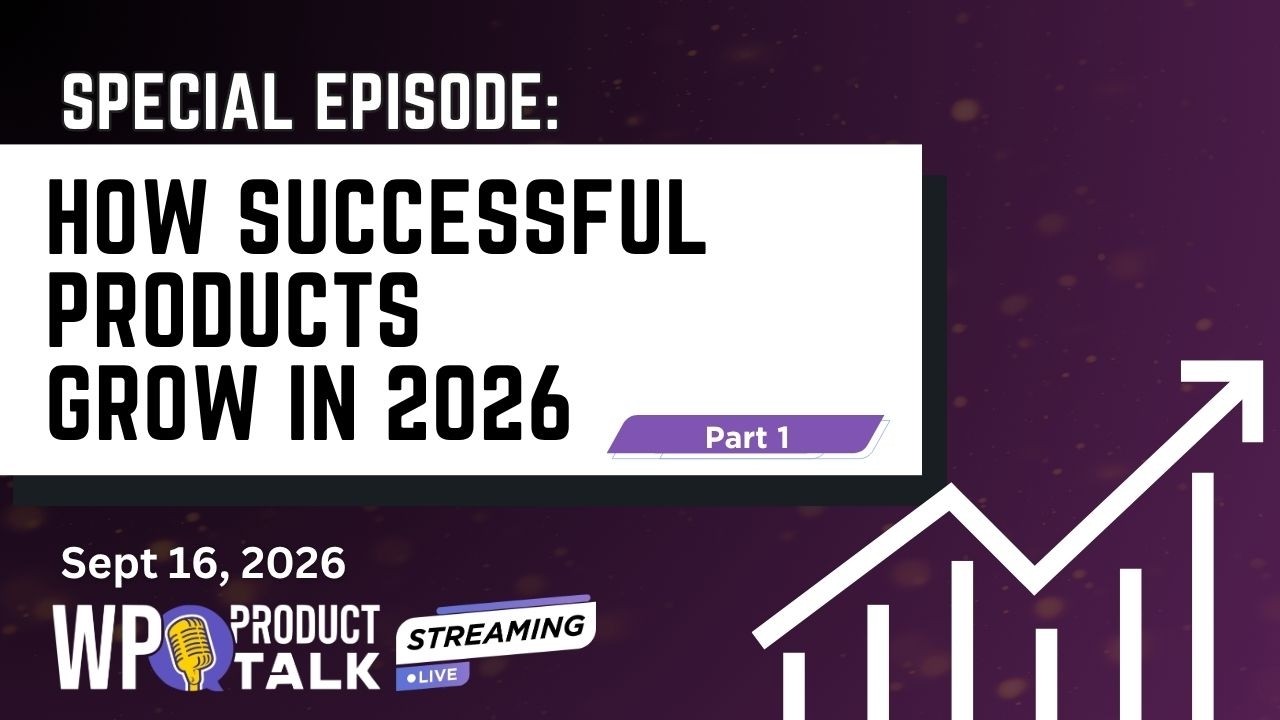

Growth looks different for WordPress product businesses than it did a few years ago. Google organic search is becoming less dependable, AI is changing how people discover and build software, and simply adding more features isn’t necessarily translating into more sales. So what is working? In this special episode of WP Product Talk, Matt Cromwell, Katie Keith, Zack Katz, and Ian Misner dig into the real-world growth strategies behind three WordPress products that are growing right now: Nimesh Patel of Multidots, Mike McAlister of OllieWP, and Robin Pietersen of FooEvents.
The conversation goes beyond marketing tactics to explore what product owners can actually control in a changing market. The guests share how retention and upsells are driving growth, why product-led growth and education can create powerful momentum, how meaningful new features and pricing changes can move the needle, and why customer support can become a source of product insight and revenue. They also tackle a bigger question facing WordPress businesses today: as AI makes it easier to build alternatives to traditional plugins, how can product companies become more valuable, differentiated, and resilient?
[00:00:00] Zack Katz: Okay
[00:00:02] Matt Cromwell: Hey, everybody. Welcome, welcome. It is a special episode of WP Product Talk, where we are doing things different. Um, despite the fact that everyone seems to be complaining about their sales, we got folks here who are, like, excited and doing amazing with all their sales. Right, guys? Mostly, mostly excited, I hope so.
[00:00:24] Um, we have two, uh, special episodes this week and next week. We, um, polled, uh, around for all the t- uh, products that are growing year over year right now, and they submitted a survey and told us why they're growing, why they're not growing, and we're gonna talk about that. And ideally, you all get to take notes and start, um, doing things in the right direction.
[00:00:48] So here we are. We got all of our co-hosts. I'm so excited to have you all here, and we're gonna go around the room super quick, introduce yourselves, um, uh, to our guests. Uh, first off, Nimesh, tell us who you are, what you do, and, uh, and how well are you growing?
[00:01:06] Nimesh Patel: So, hi. My name is Nimesh Patel, and I'm working as a product growth manager, uh, at Do- uh, Multidots and managing the DotStore and MultiCollab, uh, from last six years.
[00:01:17] So if you, if I s- s- tell about maybe DotStore growth story, maybe, uh, growth may be one of the consider that may be retention and is a real growth engine, uh, I consider that. Another may be, uh, another tip may be turning support into profit center as a converter. And third will be listening customer to frus- uh, frustration, how we can make it better.
[00:01:42] So when we started, uh, uh, Google launching with the AI over this and everything, so at that time we started declines, uh, organic because one of the, our main channel will be organic channel to getting the new customer. So that will be out of control from our side. So we will started activity like how we can control within the activity and we can, uh, grow next level.
[00:02:05] So, uh, we will try whatever the c- existing customer, make sure they renew and upgrade the licenses from our side. And also we try create a email campaign, like segmenting each of the customer based on the life cycle, uh, how long with the customer. So when, uh, we also, uh, optimize the, uh, customers category, different, different, uh, category base.
[00:02:29] And then after maybe sending the email to them, like, uh, multiple level, if one customer have purchased one plugin, we will try to sell another upsales at different level. So that type of activity we have started. We getting the good result, and we have around 60 to s- uh, 60, 65% retention, uh, renewal conversion we have.
[00:02:50] Matt Cromwell: That's awesome. Great, Nimesh. Thanks so much for being here. Next up, Mike McAlister. Um, is that the right domain? That's right, right? OllieWP, right?
[00:03:01] Mike McAlister: That's it.
[00:03:02] Matt Cromwell: All right. Tell us who you are, what you do, and how well are you growing.
[00:03:07] Mike McAlister: Hello, Mike McAlister, and, um, I am co-founder of Ollie, which is a design library and editor toolkit for the, uh, WordPress block editor and site editor.
[00:03:19] And, um, yeah, we are, uh, we've been in business now officially as a, as a, as a premium pro product for three years now. And yeah, we're doing well. We're up 25% on subscriptions- And I have one of the worst product problems you can have, is I don't know why. There are questions I have for all of you that maybe you can help me understand.
[00:03:45] Um, we're doing well, but there's big metrics, and you'll understand this as a product owner, there are so many things outside of your control, uh, and things that just happen. So be curious to dig into some of that.
[00:03:56] Matt Cromwell: I love it. You're... I, I'm really tempted to just, like, uh, give you the water fire hose, um, effect right now of all of my thoughts on why you're probably growing, but, uh, I'm going to refrain.
[00:04:07] Um, Robin, you are up next with, I'm getting the domain and the ticker right now. Um, did I do this right?
[00:04:19] Robin Pietersen: Yeah. Perfect. Fooevents.com. Hey, uh, my name's Robin. I'm the co-founder of Fooevents. It's a 11-year-old event and ticketing, uh, software for WooCommerce. So we sell tickets through WooCommerce, turn your WooCommerce store into an event and ticketing system.
[00:04:34] And, uh, yeah, we've consistently grown from day one. Obviously, in the earlier days, it was a, a really nice, uh, quick, you know, growth, growth line going straight up. But over the years, it's tapered down. But nonetheless, it's consistent, and year on year we do see, uh, growth, not just in our total revenue, which is, uh, a subscription-based business.
[00:04:54] So obviously, we, we, we, and we have good retention rates, so we do see growth there. But our, uh, first time customers, so new sales growth, is also pretty consistent over the years. So, uh, month to month, we, or year, yeah, month to month we're looking about 5%, uh, going up on the previous period and the same as, uh, previous year.
[00:05:13] So overall, pretty good. Not bad for an 11-year-old, uh, uh, uh, plugin company. Um, sounds old, but our software is pretty new. You know, it's, it's constantly, uh, updated. So when I say it's an old plugin, the plugin itself is really shiny and new, but, um, it's been around for a long time. It's pretty established. So we're very happy with that type of growth at this, at this point in our, in our business journey.
[00:05:34] Matt Cromwell: Nice. Love it. Uh, real quick, folks, um, like I mentioned, we surveyed everybody. I'm gonna just show some numbers really quick. Um, this is gonna be up on the website, um, uh, sometime soon-ish. Uh, but we, uh... It's not, like, a, a big, giant research survey. We only got 17 responses overall, so it was really just mostly a starter, uh, conversation.
[00:05:59] Um, SaaS shops definitely were growing the fastest. We have a couple SaaS shops in there. Uh, if wordpress.org was your top channel last year, then this year growth was a little bit slower. That was a really interesting one. Uh, organic search is still the biggest source for the growing brands, uh, which is really interesting, but it's definitely getting less and less dependable over time.
[00:06:23] And, uh, keeping customers does not necessarily mean growing, like Robin was just alluding to right now. Uh, they've been around for a long time. They have a lot of renewals, and renewals can keep you really going, but that doesn't necessarily mean you're gonna see a bunch of exponential growth or anything like that.
[00:06:37] Um, but, uh, but if you have it, uh, it's definitely a great foundation, uh, so that it's d- it doesn't make it so hard, uh, on, uh, on new sales. Um, what we wanna go into next overall is, uh, what across all the survey, uh, responses, what didn't work. Uh, and I wanna hear from each of you all about, uh, your brands and what didn't work overall.
[00:07:02] Um, a lot of folks had said, uh, organic search is exactly what didn't work, which we've heard that actually from Katie. Katie's been talking about that publicly and out on the show a lot. Um, even wp.org, if it was really strong in the past, it really started to underperform. We also know that in terms of the WooCommerce extension shops as well, which, uh, is Ian and Katie and, um, and Robin too, actually.
[00:07:28] Um, but, um, that has been going down as well over time. Adding more features didn't necessarily make a big impact. For some folks, they put in a lot into video and YouTube, uh, and that didn't help all that much. Um, so there were shops that were really trying a lot of different things and, and it just didn't go super, super well for them.
[00:07:48] Um, so that's where we wanna start first. I w- I do wanna hear real quick from, like, Katie or Zach or Ian. Uh, you all looked at these responses a lot, uh, before today. What's your initial thought on, uh, the things that were not working or, uh, your initial thoughts on, uh, even for your own shops?
[00:08:10] I'm throwing you a soft, a, a, a curveball, I know. I'm gonna... Uh, Katie, go for it. You go. What were your biggest thoughts from the survey?
[00:08:17] Katie Keith: Yeah, I think Google organic is a really interesting one. That was always our main marketing channel by miles and miles, and that is where we got... How we got where we are today and how we got our previous growth.
[00:08:29] Sadly, that has massively stopped working and our sales are way down. Um, and that is because, uh, we were so dependent on Google organic and a few other factors too. So I understand when people say that it's not working. Um, it does still work. It's still our biggest source of sales, it's just that that is orders of magnitude lower than it was two or three years ago.
[00:08:54] So when people say it's not working they probably mean that. But I do believe it can still get significant sales, it's just if you compare it to the past it's not performing like it used to.
[00:09:06] Matt Cromwell: Yeah. It's a good one. Yeah. That's a little foreshadowing, folks. We are gonna talk about what is working later today and this subject's gonna come up again.
[00:09:14] Um, Ian, Zach, any other additional thoughts?
[00:09:19] Ian Misner: I mean, I could add just that my biggest issue with the last year has been being distributed across so many different products. The things that we put a lot of effort into are growing. The things that we aren't putting a lot of effort into are not. Yeah. And, you know, uh, it shouldn't be too big of a surprise obviously, but that is new, right?
[00:09:38] So that is- Right ... not something that has always been the case.
[00:09:41] Matt Cromwell: Mm.
[00:09:43] Zack Katz: And for us, we, uh, we were big on SEO, and we were also big on pay-per-click. Uh, SEO has tanked for two years straight now. Uh, and but pay-per-click is still working. Um, we are refining our strategy there and putting more money into that. Uh, we have to pay for engagement now, which is okay.
[00:10:04] Uh, we did recently try the OpenAI ads, uh, and we didn't get good conversion on that. So FYI- Mm-hmm ... uh, for a premium-only product, it might not be a good fit. Um, but maybe it's a decent onboarding ramp for other people, but we got very low engagement for people who were... We spent, like, 250 bucks on OpenAI ads, and v- Mm
[00:10:25] like, very little time on site, et cetera. So it wasn't a good match there.
[00:10:28] Matt Cromwell: Mm-hmm. Interesting. I wanna do a fire hose effect on that one too. That one is a big one. I bet you, um, Robin and team have been experimenting with ChatGPT ads too, but, um... No, not at all?
[00:10:42] Robin Pietersen: No.
[00:10:42] Matt Cromwell: No.
[00:10:42] Katie Keith: No. Yeah, we
[00:10:43] Robin Pietersen: have. Not there yet.
[00:10:45] Matt Cromwell: Yeah. Katie, you have, and did you see similar results to Zach?
[00:10:49] Katie Keith: Yeah. We got a huge number of clicks and impressions, and we did track that traffic genuinely to our website via Google Analytics, so they weren't just making it up. We got absolutely no conversions, and the number of impressions was far, far, far higher than the number of people searching for what we do based on other search, um, volume data from other sources.
[00:11:12] So that means that ChatGPT was showing our ads just to everybody. Mm. They were not targeting- Yeah ... it properly. You can't choose- Yeah ... who,
[00:11:21] Robin Pietersen: who it's for. It's
[00:11:21] Katie Keith: too early. You just have to describe your product and let ChatGPT choose, and they are obviously just after- Mm-hmm ... the money. So yeah.
[00:11:28] Zack Katz: Which is a great idea, and they should be good at it, but they're- Mm
[00:11:31] like, they're spreading it too far right now. Yeah. Yeah.
[00:11:33] Katie Keith: Yeah. Try in six months. I bet they'll keep improving it.
[00:11:36] Matt Cromwell: Yeah. Yeah. That's good stuff. Cool, cool. All right. Well, let's jump into what ha- what was not working so well for you all. Let's go reverse order. Robyn, uh, that means you're up first. What, what-
[00:11:48] Robin Pietersen: Okay
[00:11:48] Matt Cromwell: what worked less well, or what didn't work?
[00:11:52] Robin Pietersen: Uh, you know, I s- when I did the survey, I struggled with this one because it never feels like it didn't work. It just didn't work as well as I'd hoped it would work. Hmm. But it still achieved results, and the, the quality of those results was really, uh, like, uh, I think one of you mentioned earlier, it's, it's how much effort you put into it and, you know, like how much attention you give it, how much you invest in it, and that determines the results you, you get.
[00:12:20] Hmm. So I think, you know, you had a list there of all the different things. Like they all work. Like they- Hmm ... 100% work. They tested and proven to work. It depends how much you're willing to invest in them, how good you are at them, and, uh, how it, uh, resonates with your product. Like is it a good match for you?
[00:12:36] So for example, like we don't do a lot of content marketing, not, uh, not as much as most WordPress plugin companies do, and the reason is we started quite late in a, in a sense, and we were very niche with WooCommerce. So, you know, coming from an agency background, we were like we, from day one, we started running ads, and that was kind of the pillar of our, our, uh, strategy.
[00:12:59] And content was really just adding information around our product for customers to, to know about. So we've, we've never had a, a heavy content strategy, but we do do it and we do get organic and, you know, we do get people coming from it. So I wouldn't say it fails, and it's not doing badly, but it's not, it's not something that we're great at, but it's not a failure.
[00:13:18] And it's the same with email. It's the same with, um, running ads. It's the same with, uh, partnerships, integrations. All of these are different ways to, uh, get people, uh, uh, to your product, and some work better than others, and some work better- later, uh, when they didn't work well before. So for example, like you've all experienced with, uh, content.
[00:13:42] You know, last year our content dipped dramatically, like some search, uh, algorithm change. And before, you know, we didn't change. Nothing changed on our side. The environment changed, the marketplace changed, uh, a- and, you know, we had to adapt to that. So we started c- uh, changing the way we produce content and, you know, kind of leveled out.
[00:13:59] We maybe put more money in advertising. So it's like a constant shift on what you're paying attention to and what levers you're pulling, and there is no failure. Like, there's nothing you can do in growing your product that's a failure. It's just a lesson. And, you know, you gotta try these things. You can't not try them because they could...
[00:14:17] You know, you could have a breakthrough, and you could have, uh, uh, a, you know, new sales that, uh, you, you wouldn't have had before, and that makes it, you know, a huge win. But you don't know until you try. And for us, I'd say there's nothing we've done where I said it just didn't work. It just, it doesn't work as well as we had hoped it would, but it still worked, you know?
[00:14:35] So- Yeah ... at, at the end of the day, it's how much did it cost you, and did you break even or did you make profits? And on all of them, we, we make profit. It's just different degrees of it, so. Yeah. I would, I would just add, like, uh, another reason I struggled with the question was, like, I don't think, for me, I don't think the underlying issues is the channels and the marketing.
[00:14:58] I think it's the actual marketplace that's changed.
[00:15:00] Matt Cromwell: Yeah.
[00:15:00] Robin Pietersen: And the way people buy software and the way they create software. It's like, it's a lot cheaper and a lot easier to make things these days than it was five years ago. And, uh, you know, for me, that's the core of the issue. The marketing hasn't changed.
[00:15:12] Marketing's always been difficult. Marketing's always changing, like, that's the only constant in it. But the marketplace has dramatically changed over the last five years. Yeah. And, and you gotta be prepared to change your approach to how you build a product, how you look at what that product is, and validate whether it is a solution to a problem that still exists or not, and how you adapt around that.
[00:15:32] And that's the real, uh, that's the real thing that can, uh, make or break what you're doing.
[00:15:38] Matt Cromwell: Yeah.
[00:15:40] Zack Katz: So. One thing that Robin said really, uh, I, I heard it loud and clear, which is, we weren't good at something, so we haven't been, we didn't really focus on doing that. I think that's okay. Um, like, nobody at the GravityKit team is really great at social media.
[00:15:55] We're, we're all kind of introverts. We've never, we don't have, I don't have an Insta. You know, like, and so we don't really do that. We do the bare minimum on that, and that's okay 'cause we can focus more of our efforts on other things. I just wanna say that out loud, that, like, we don't- Mm ... you don't have to be good at everything.
[00:16:12] You can choose what to really focus on. Yeah.
[00:16:13] Robin Pietersen: Pick, pick your battles, you know?
[00:16:15] Zack Katz: Yeah.
[00:16:17] Matt Cromwell: I like it. Mike, you're up next. What, uh, I like the way that you talked about it in the beginning. Um, you know, you're growing and it's kind of like, well cool, I hope this keeps going. I have no idea why. Um, do you know what did not work super well?
[00:16:32] Do you know, did you try stuff and you're like, "Ah, there's no ROI here." Um, what's going on on that front?
[00:16:38] Mike McAlister: I think, excuse me, like a lot of people, search has been tough because we're, like, a three-year-old product. So, like, it's really hard to get a footing that, with that early of a product. And then WordPress is going through this big transition when we started of, you know, classic to block editor, and you have
[00:17:00] It's one of the most, like, SEO junk saturated industries as well. So search is just, like, a whole big mess. And then kind of throw our, our little product in there, and it's, it's, it's really hard to, to get a footing. Um, we do get some, I think, some inherent benefits of being a product that was kind of, you know, um, uh, cutting edge, bleeding edge, in that we were, like, very early for the block editor and full site editing.
[00:17:29] And so the, the, the content we were writing, the content marketing we were doing to kind of help usher people, um, into that era, uh, certainly helped. And our education angle certainly helped because there's just not a ton of content about kind of moving into the block editor.
[00:17:46] Matt Cromwell: Yeah.
[00:17:47] Mike McAlister: And so that stuff helped.
[00:17:48] But I think still, like, search, and now we, we have this other problem with search in that it's just down everywhere. So, like, you know, even if the, all the other conditions were good, um, it's still just a hard place. We still, um, we're still, um, writing content and, and kind of really dialing that in. But, um, you know, I feel like i- in a sense, I don't know what else to do other than just, like, let's just keep doing this and see how things shake out because it does feel some of it outside of our control.
[00:18:18] Matt Cromwell: Yeah.
[00:18:19] Mike McAlister: Um, so that's kind of it for, for search and, and things like that. But, you know, our posture has be- always been kind of- Our growth strategy is kind of, of a, an accidental product-led growth kind of guerrilla marketing- Mm-hmm ... kind of thing, where- Mm-hmm ... the product is the marketing. We, we try to build cool things and kind of build up, uh, excitement around it, and then that becomes marketing, and then that becomes videos, and that becomes content.
[00:18:48] Um, and that works for us at this scale, but I know there's still a lot of gaps in our, our potential. Like ads, we don't do ads at all. I don't know anything about ads. I don't really wanna know anything about ads. I want someone else to do that. So, um, yeah, I'm hap- I'm certainly here to learn today, too.
[00:19:05] Matt Cromwell: Nice. Yeah. Um, honestly, Robin, you want another, uh, vertical. You know, you just start, uh, charging for Colin to go run ads for other shops. I bet you- Yeah ... that'd be a good new revenue stream for you all.
[00:19:18] Robin Pietersen: Yeah, definitely.
[00:19:20] Matt Cromwell: Um, yeah, it's interesting, Mike. I mean, I, I, I definitely could see that, especially for a relatively new product.
[00:19:27] Um, uh, and, you know, you're not only relatively new, you're also re- in a relatively new niche as well.
[00:19:35] Robin Pietersen: Mm.
[00:19:35] Matt Cromwell: Um, so that, uh, kinda complicates the picture a bit. Yeah, uh- Nimesh, what about you? What has been, um, what has been, uh, difficult or challenging for you and your team?
[00:19:46] Nimesh Patel: So, uh, uh, in drugstore point of view, maybe one of the main channel as like Katie's, uh, said, like maybe organic channel is one of the main channel to getting the new customer.
[00:19:56] So that will be around, uh, we, we have massively dropped or decline in organic channels point of view, uh, traffic is everything. But one of the, uh, good thing about my engagement ratio will be going up, right? So what, uh, what are the customers come from the organic channel, uh, I'm not say 100% decline, but it may be 30% decline, but whatever the customers come, that engagement ratio is really increased, right?
[00:20:21] That, and because of that maybe, uh, uh, uh, number of like maybe conversion also improve. Like maybe, like maybe 100, uh, user will be unique user coming to your website. Maybe at least, uh, 20%, uh, before that maybe that ratio will be down, but now maybe the number of ratio will be increased. So that will be significant, uh, uh, improvement or maybe we consider that organic search is down, but still engagement ratio and conversion will be little bit improved.
[00:20:49] So that's, uh, side good things for
[00:20:52] Matt Cromwell: us. Yeah, really interesting. Um, we actually have a good question here, um, that I'd love to, uh, answer. This is from Mike, actually, uh, from C9 WP. This is from Mike. As a creator of a block theme, what are the biggest hurdles you see users facing when trying to adopt or learn full site editing?
[00:21:13] This, this to me is the big, uh, elephant in the room for, for you in particular, Mike, so I'm glad somebody else asked it.
[00:21:21] Mike McAlister: Yeah, it is a, it's a good question, and I'll say just right up front, it's less hurdles than I think people think. Mm-hmm. And I think it's less hurdles than cu- than users and, and kind of customers, all your customers think when they go into it.
[00:21:38] They've heard, they've maybe tried the block editor early on. It was a little rough, no lie there. Um, and they maybe said, "We'll come back to it," and they've seen people, you know, complain about it or heard it. But I think once they get in there and they start clicking around, they're like, "Oh, okay, this makes sense, and this is way better, and this is way better, and this thing still sucks, and it probably always will."
[00:21:59] So, um, that's kind of WordPress. But, um, I think the, the biggest thing that, that they do kind of have trouble with is just it's, it's more of a mental thing, a paradigm. Because you do have to rethink ki- the kind of website you're making. It's not like the traditional one where it's like all code and kind of you make all these code customizations and snippets and, and all that stuff.
[00:22:21] Um, it is like- A page builder and content and kind of site management all wrapped up in one. And some stuff happens in your database like, you know, uh, creating patterns and things like that. Those are stored on your site, not on your, on your, in your file system. So there are just, I think, and things like template parts, how do that fit in there?
[00:22:39] These, like, more, like, just specific WordPress paradigm-y things that have kind of shifted with the block editor, um, those things people have to relearn and kind of recontextualize, and I, that think that's what takes them more time than anything.
[00:22:54] Matt Cromwell: Yeah, I think that's what makes so much sense why your whole marketing approach is product marketing, because, yeah, you gotta do so much education, um, and, uh, you gotta focus on how you're solving those pain points with the product as much as possible.
[00:23:10] Uh, so that's always made really good sense to me. Um, we, we'll talk more about what is working, um, uh, and I'm, I'm interested to hear that from your perspective. I wanna hear from our co-hosts a bit as well. Uh, Zach, what are your thoughts on all these struggles that folks are going through?
[00:23:27] Zack Katz: Well, I, I was interested by, by what Nima said about, um, the conversion rates increasing, so I, uh, I just asked my AI to analyze our, our traffic data 'cause that kinda sounded strange, and it turns out you're right.
[00:23:44] Uh, ours have been slowly s- increasing. Our, our traffic is in the-
[00:23:48] Ian Misner: Mm ...
[00:23:49] Zack Katz: gutter, but, uh, the conversion rate of people who- Yeah ... land on our website is actually increasing in a way that I didn't expect. So, like, 2025 Q3 was .64 conversion rate, and 2026 Q3 so far is 1.12, so it's almost doubled or it's actually doubled, uh, which is really cool.
[00:24:07] Robin Pietersen: So quality over quantity.
[00:24:10] Zack Katz: What's that? Yeah.
[00:24:11] Robin Pietersen: Quality over quantity.
[00:24:13] Zack Katz: Right.
[00:24:14] Robin Pietersen: You know.
[00:24:16] Matt Cromwell: Uh, Ian, what about you? Uh, any thoughts from all of this, uh, feedback about what's challenging or not working? You know, I find- Except for, like, I relate to everything, so
[00:24:26] Ian Misner: No, I mean, I, I find it really interesting the, the, the confirmation of my own struggles that I'm seeing in the survey data and all that, but hearing Mike specifically with the product-led growth approach is very compelling to me, and maybe why some of our bigger products are doing a lot better than others.
[00:24:42] You know, you choose a surface that you just make the best experience for and really double down on that. And, you know, Ollie is an example. Like, if anyone's exploring using the block editor, I just tell them to go use Ollie, because that's the way to make it so you don't have to go read all this content to figure out how to use it.
[00:24:59] The product just kind of lets you. And I think that that's probably where a lot of that secret comes in, uh, as to why that's working. As far as what's not working on my end is I think it's a lot of, like, the, the, you know, the s- the marketing cycles you're supposed to do. Those are the things that often feel like a waste of time right now, right?
[00:25:16] Like, all the little optimizations with ads and all that. They're getting better. The conversion rates are improving, the volume's decreasing, and whether you wanna blame the number of WordPress sites being created or you wanna blame people solving problems with AI instead, if your product just actually makes using the thing a lot easier, people will tell other people about it.
[00:25:37] Yeah. And maybe I gotta spend more time doing that deliberately instead
[00:25:43] Matt Cromwell: I want to hear from Katie, but, uh, one quick comment from, uh, attendee Elliot Sowersby. Uh, he says that he's been working on content marketing, optimizing ads, improving support workflows and docs. He's tried ChatGPT ads too, and the results were also not great there.
[00:25:59] So a lot of confirmation about what we're saying from Elliot. Um, I know... What, what is Elliot's product again? I know it. I know it. Help me out,
[00:26:09] Ian Misner: folks. The ca- the CAPTCHA thing, the cloud, the turnstile. Is that, is that Elliot?
[00:26:14] Matt Cromwell: Elliot, tell us, tell us your product in the, in the chat. Um, and, uh, I'm gonna kick myself- Yeah, we literally
[00:26:19] Katie Keith: talked about this in June, and I've forgotten.
[00:26:22] Matt Cromwell: Yeah, yeah, we all hung out at, uh, WordCamp Europe. Um, but, um, uh, Katie, tell us, uh, anything that came up in your mind about Barn2 and things that aren't working besides the organic search one, um, which is well-documented.
[00:26:36] Katie Keith: Well, I'm gonna talk about different categories of products and how different marketing methods work for different types of products.
[00:26:44] I also have some theories about why Mike's product is growing when a lot aren't. One is that it is, by definition, it is a platform product. It is fundamental to people's websites. It has a massive moat around it. You... It's harder to vibe code something like that. It's harder to switch to something like that.
[00:27:06] People are gonna be loyal. And often, um, theme-type products like Olly have a very big community around them, a lot of word of mouth, which is not threatened by Google organic or anything, and people have a really loyal following. Every website needs something like Olly, and so agencies and developers are gonna maybe use it for all their products.
[00:27:27] It's incredibly sticky. Um, I would also say that Olly is li- am I allowed to say this? Bill success to Cadence, which- So assuming it's not doing so well. So I would expect that, um, that has played well for Ollie. But I'm gonna then contrast that with my own products, which are mostly more utility type plugins for WooCommerce, and they don't have such a good moat.
[00:27:53] And WooCommerce itself, it maybe is declining a little bit more than WordPress itself, and it's easier for people to move or write code, a smaller WooCommerce solution. So I think that that makes it a lot harder. Like, I can do lots of contacting of agencies, but if they only need a particular plugin occasionally for a specific project, there's no point.
[00:28:16] Whereas to build agency links, if you have more of a universal product, you're gonna do better. But then that leads me to what Zach said about you don't have to be everything. It's okay. Well, it's not. What I am good at is not working for the type of products I sell anymore. So I either have to change the type of products I sell, which I am seriously considering, or I have to learn or hire people that know completely different types of marketing, because Google Organic and small utility plugins are not the way forward, and I think I need to accept that.
[00:28:53] Zack Katz: Or the way that you're positioning your products is, needs to shift around the, the changing realities of how people build sites. Like, or the pricing structures. Like, there are so many different levers we can pull, and it might be that you, all you need to do is, is talk to a different audience now and sell the same products for either more or less.
[00:29:14] Uh, so there, that's... Running a business is really hard. Yeah. It's hard to know which one- Do you really think it's pricing problem? Which ways to go. If the
[00:29:21] Katie Keith: whole market and discoverability has collapsed, I'm not sure our pricing is gonna help. Yeah. Although we do
[00:29:26] Zack Katz: have- Sure. Well, maybe your market is not, maybe your market is actually AI agents that are recommending things, and maybe you should be positioning towards selling t- and making, like, an, a free onboarding ramp, uh, that didn't exist before that AI can automatically install.
[00:29:41] And like, you know, that's one of the things that we are... I, I keep on sending out polls to, or, like, surveys to our customers to understand how they're using AI. And slowly and surely peop- more people are using I- AI, yes. But I feel like I need to increase, I need to be ahead of the curve in how we position the product because that leads our customers to where they know they need to go, rather than being reactive.
[00:30:05] And so what, what's not been working well, uh, is kind of waiting for the demand to, to shift to, like, to where it's going. Like- Yeah ... I need to start repositioning everything on our website to be, use AI to do this, uh- Yeah ... rather than, like, waiting for that actual adoption to happen.
[00:30:24] Matt Cromwell: Yeah. Uh, we have a, a little private chat here, and there's a Other guests on the show that are saying yes, yes, yes.
[00:30:33] Uh, Nimesh, Mike, what are you thinking? Yeah. I, I'm hearing some of approvals here. Nimesh, what about you?
[00:30:39] Nimesh Patel: Yeah, so, uh, in my point of view, like maybe as Cathy said, uh, VIP coding we can create, uh, peoples are, uh, or store owner may be creating or by itself. So our product will be, uh, not selling with them. So at that time, maybe one of the biggest challenge may be k- people's, uh, uh, uh, uh, store owner can create the plugin by itself by the AI tool, but it's really difficult to maintain or upgrades.
[00:31:05] Uh, that's biggest challenge, right? They just create, but then after maybe after three months, six months later, WordPress
[00:31:14] updates and there is a mo- more feature they require. Again, they have a little bit problem to maintain everything, right?
[00:31:17] Mike McAlister: Mm-hmm.
[00:31:17] Nimesh Patel: So my point of view, this is biggest challenge. So maybe, uh, peoples are trying to number of things now, lots of go, uh, AI updates, everything will be going, so people try itself, right?
[00:31:29] So slowly might be, uh, peoples are see, uh, pr- see the itself a problem with the existing VIP coding related. Then still the peoples are trying to a- approach like maybe, uh, what are the expert people available in the market or they know about, uh, what type of problem we are so- solving as a position in the market.
[00:31:47] Okay, yeah, uh, uh, Nimesh and Cathy are one of the product founder. They know better our problem and they already solved the so- solution, so they trust us by we are- Mm-hmm ... sharing our customer problem with them with multiple channels or social media or maybe our, our own content, uh, uh, organic things. Then people are gradually started and they will again, uh, re-back to trust on us, uh, rather than just create the VIP, uh- Yeah
[00:32:12] VIP coding.
[00:32:15] Matt Cromwell: Mike, you're agreeing too?
[00:32:18] Mike McAlister: Yep. Um, two things on that. First, I just wanna jump back to, uh, Katie real quick, because I think what she is experiencing or about to experience is so prolific in WordPress, because her portfolio is kind of also representative, I think, of a lot of traditional WordPress plugins and plugin businesses.
[00:32:39] And I think Katie's gonna be kind of an example. She's leading here, and hopefully, 'cause people are gonna be watching to see, like, what does her business and business model do going through this huge transition where people are thinking about replacing things with vibe-coded things. And so there's a lot of pressure on Katie to see if, if she can make it through this thing and find that pathway, um, because I think it will be representative for a lot of, of, of product companies in, in the WordPress space.
[00:33:10] Matt Cromwell: No pressure, Katie. None- None at all.
[00:33:12] Mike McAlister: No pressure at all. It's just entirely on you to create the blueprint for the rest of the industry to succeed. Uh, good luck. And, um, the other thing just about being vibe coded out is it is a real thing, and we are seeing that in different places, but I think, you know, I don't want this to be too hot of a take, but if you're, if you're being vibe coded out, your, your product's not that good.
[00:33:33] It's not solving the right problem, or it's not hitting the right way, or it's not shaped around the problem right, or it's not pointed directly laser focused on a persona This is always gonna be a problem if you're not just super dialed in on your product, the experience, and making it so no one would even want to think about vibe coding you out and, and- Mm-hmm
[00:33:53] and creating something to replace you. Now is the, the time to, to dial back, look at your product, simplify, and like really focus on what is good about your product and the product experience. It's always been true, but it's even more true right now.
[00:34:10] Matt Cromwell: Yeah. I think it might be a little bit of a hot take at the moment, but like let's also keep in mind that AI just, just helps figure out one of the millennium problems.
[00:34:20] Um, like we're all gonna be vibe coded out of existence.
[00:34:25] Ian Misner: Slash
[00:34:25] Zack Katz: stole, but
[00:34:26] Ian Misner: yes.
[00:34:27] Matt Cromwell: I can't wait,
[00:34:29] Ian Misner: to be honest. The, the thing is though in like all these little WordPress utility plugins we're solving like niche problems from like SEO data, or like, you know, the marketplace searches that we're missing and all that.
[00:34:38] And, you know, those are exactly the things that AI is going to do extremely well. Yeah. Not to mention it's all open source, so we've all provided the training data to ensure that it's doing a very good job in solving those problems. Uh, I fully agree with Mike though, and that's that like the, those utility things, it, it is like a net good for customers, for, for merchants, for users that they can find a cheaper and easier way to solve these little problems that used to require a plugin.
[00:35:06] It's just unfortunate for those of us who have, you know, a couple dozen of those plugins. It's fine though, just, you know, bigger platform solutions like Ollie, like some of the others I think is just- Yeah ... how to do it next.
[00:35:20] Matt Cromwell: Yeah.
[00:35:21] Zack Katz: One of the things I'm considering doing, uh, 'cause I use AI to, to write code, but we as a team are really good at it, right?
[00:35:28] And it still takes us a lot of time and a lot of work. It's not vibe coding for sure. It's vibe engineering or whatever the crap people call it now. Assisted
[00:35:36] Matt Cromwell: coding.
[00:35:36] Zack Katz: Um, but one of the, the proof of work I think is something that I wanna do more about, uh, in marketing, which is saying like- Mm ... "Yeah, we used AI to write this, and it took us like three solid weeks to nail what we've, we've shipped to you.
[00:35:50] Here's a video or something showing how many iterations. Here are all the commits we've done. Like this is not easy. Uh, you can go ahead and try it, but we-
[00:35:59] Matt Cromwell: Yeah ...
[00:35:59] Zack Katz: you know, good luck."
[00:36:00] Matt Cromwell: Yeah, absolutely.
[00:36:02] Ian Misner: Yeah.
[00:36:03] Matt Cromwell: Well, let's jump in next into what is working, uh- Yes ... for you and your brands, um, which, you know, honestly is what everybody's most interested in talking about.
[00:36:13] Um, let's go back to Nimesh. What is actually, um, the stuff that did help you to grow this year overall?
[00:36:21] Nimesh Patel: So, uh, this year we have started with a, like, organic is will be going down, so we are a little bit, uh, afraid about it. So maybe what we can do, uh, in our control. So maybe whatever we have existing customer, let's try to, uh, uh, solve their problem more very deeply, more connected.
[00:36:38] We can focus on that. Our level will be shifted on that level. Like any of the customer, we will not let it be go anyway, right? We will try to solve, uh, as many as problem with them, maybe try to connect on call or maybe in support channel. We have, uh, I have decided like maybe within three trade, we solve the customer problem anyhow, right?
[00:36:59] Either maybe call, record video and share with them, and they are very happy with them. In pre-sales inquiry, uh, uh, any of the pre-sales inquiry, uh, we will not let it be go. At least we will try to ninety-nine percent will be try to convert, except they have decided to let it go us, right? We will not go with that.
[00:37:18] So that will be, uh, our, uh, number of maybe pre-sales inquiry will be, uh, conversion will be around twenty-six percent increase, uh, last year. So I'm really great for that. And, uh, in, uh, support also, uh, like I consider that maybe customer sharing the good number of signal to us, like maybe frustration, happy with them, or they need something new.
[00:37:40] So we will also try to provide the custom support to them within the support. Like they already have complex requirement with our, uh, within the solution and they or maybe some of their random ask, maybe they need this type of solution. We will try to wipe code from our side within the, within one or two days, s- uh, give, uh, give a try, and, uh, they are happy with them.
[00:38:01] And then, then after we will again, we will test from our side and we will release our own plugin. So that custom support will also, uh, getting more, uh, conversion with them. And then apart from we also do some little bit partnership with the other peoples, like guest post, like very, very selected, uh, content we also publish in our, uh, in blog post.
[00:38:21] That is also maybe one of the channel will be, uh, getting the new sales or maybe, uh, new generating around, around, uh, six, uh, maybe twenty percent, uh, total, total, total only we get extra partnership with also getting the sales, right? So this multiple channel we have tried and worked out and is really working well.
[00:38:41] And, uh, last year maybe the actual growth will be around twenty percent we have generated, uh, growth rate, so I'm really happy with that.
[00:38:50] Matt Cromwell: Nice. I actually forgot to bring up the survey results again real quick. Uh, just so we're grounding this in all of the data, uh, this is what did work across all the survey responders.
[00:39:03] Um, the thing that was really interesting to me was how things related to paid really came up very strongly, and pricing in particular, uh, and also one key feature. Uh, als- also the one key feature one came up a lot, uh, with what did work, uh, despite the fact that what didn't work was more features. So it's a little bit of a, uh, of a division there.
[00:39:27] Um- Can you
[00:39:27] Zack Katz: explain what one key feature means?
[00:39:30] Matt Cromwell: I, with, uh, a couple of the different folks, um, it was usually like adding a whole really big new feature, like a new thing that, that, um, that didn't exist before at all. And I think the ones that were more like more features were more like tweaks and enhancements of existing things.
[00:39:47] Um, so it's more of when you, when you have something really big and significant that people were waiting for for a long time, and you get to announce that and, um, and do, and do that, um, that seemed to be more significant. Which honestly, in many ways, I, you know, I've talked with a lot of, uh, shops, uh, this year that, um, if they're on, you know, on the decline, the thing that they're talking about the most is launching new product, um, uh, trying to create new revenue streams.
[00:40:15] And I think in some ways, depending on the shop, but if you are, uh, uh, uh, if you have a large following and whatnot, um, and a large customer base, and you launch something that they've been waiting for for a long time, it has a s- a similar effect as a brand-new, uh, a brand-new product. Um, it's something that, uh
[00:40:33] Actually, I think Robyn and team are, are, are doing that right now. They, they've got a big, um, seeding, uh, product that's, uh, that's getting updated. I'm, uh, I'm assuming- Yeah ... that ... I, I don't wanna take Robyn's talk here, but Oh, good. I, I'm assuming that that's gonna be what you wanna talk about next year in terms of what made growth happen this year, as well as pricing actually.
[00:40:53] Yeah. Okay. Yeah. Um, so anyway, that's some of the context there. Robyn, uh, since I'm already doing your talk for you, why don't you go ahead?
[00:41:00] Robin Pietersen: Okay. Um, yeah. You know, like we, we, we do run ads, and we've run ads from day one, and it does work quite well. But it is a lot of work, and, uh, it's not something you just set up and, and check in on, you know, once a month.
[00:41:14] It's a constant process to make sure that the ... You make more money than what you put in, and you, you keep a, a healthy gap between the two. Pricing updates work. Uh, new features work. Key features work. Email marketing works. Uh, making videos, writing content, they all, they all do work, um, if you put the enough energy into them, if you work hard at being good at them.
[00:41:39] But I think where we at right now, and, uh, kind of I wanna circle back a little bit to the discussion earlier, particularly what, uh, some of the points Katie brought up. Um, like the, the issue people are experiencing now with growth isn't about what kind of marketing is working for them. Like, Katie knows how to market.
[00:41:56] Like we- Yeah ... we all know that she's good at it, but her products are still on the decline. So it's not her ability to To market and or not lack of knowledge on how to market that's an issue. The issue is how the industry's changing, how, uh, people are using products or looking for products or looking for solutions.
[00:42:14] And I think maybe I could give some, uh, suggestions or insights on why I think we have weathered that quite well, and maybe those are things you could translate into your products- Mm-hmm ... and could make them a bit more durable, uh, to the current climate. And I say right now because next year's probably gonna be completely different again anyway.
[00:42:32] So- Yeah ... um, so the underlying issues is, uh, like I'll, I'll compare Katie's... Katie, I hope you don't mind. I'll, I'll compare our, our product to your products, and I do that because I, I know your products well. We, we use them and recommend them to our customers as well. So, uh, and Oli as well. Actually, we use Oli on all our sites by the way.
[00:42:51] So I've got a good, good feeling for, for how Oli works and, and how it's, uh, put in front of people. And, um, you know, our products, Few Events, uh, you know, I call it a ticketing plugin, but it's really a platform. It's... There's a lot to it. You know, you sell tickets, you manage attendees, you manage check-ins.
[00:43:09] You've got iOS and Android apps. You've got point-of-sale system. It's a complete platform that you run your business on. Like, once you're on Few Events, it's an underlying platform, and it's a way, uh, it's an underlying, underlying platform you use to make money that's directly tied to our customers' revenue.
[00:43:27] If you take Few Events away, they can no longer sell tickets. They can no longer manage their events, and they've got a problem that they'll need to solve. So they're willing to pay, you know, uh, let's say it's $249 for our premium, uh,, uh, bundle. That's a y- that's in a year. They're willing to pay that because they're doing $50,000 in ticket sales.
[00:43:47] So it's i- in a... it's not even in a thought whether the 250, uh, 249 is worthwhile for them to, to purchase this product. So pricing is, is pretty straightforward. Um, once they're on our system, it's- It's so tied to their revenue that they would not move to another system that they've vibe coded or built themselves because the risks are extremely high.
[00:44:14] Like we spent 11 years building this platform and same for new customers. We built 11 years, spent 11 years building this platform. To vibe code it over a week or two to only get a fraction of what our system does and risk your entire event where you've got hundreds of people pitching up on the day, if things go wrong, it's a complete disaster.
[00:44:33] It's just not worthwhile. So it's very defensible to custom solutions and vibe coded solutions, right? It's tied to revenue. So it's a very easy decision to make in terms of buying it. And it's also hyper niche. So like if someone wants to use WooCommerce to sell tickets, they'll search WooCommerce tickets and they'll find us instantly.
[00:44:56] Like it's a very niche little sector that we target. And I think that's something that, you know, utility type plugins struggle with all of those things. And what you need to do in order to Adapt to the current changes is, one, you need to tie your plugins to, uh, their infrastructure. It needs to be a part of their business, not just a nice-to-have that gets bolted on.
[00:45:24] So if your, if your plugin is something that adds something to the product page, it's, it's nice to have, but they could probably vibe code that. If your product is something that allows them to make money and it's a vital tool to their, to their business, then it's, it's much less likely that they're gonna build something on their own, and it's gonna become a critical part of their business.
[00:45:44] So, like, Katie, with, with your products, a good example would be, like, your wholesale offering, the, your wholesale extensions. That could quite, you know, that could be built into a platform for wholesalers to run- Mm-hmm ... you know, a big portion of their business on. They'd be very unlike- very unlikely to build a custom solution that does things around those.
[00:46:02] And once they're using it, that's the basis of that business. That's like- Mm ... how they, they run that whole segment. So I would double down. I'd look for the opportunities, uh, for products that can form underlying, uh, platforms within businesses that are tied to revenue and the customer's ability to make revenue.
[00:46:20] I would make it, uh, hyper niche. Like, we're not talking about getting 20,000 customers a month, right? Like, if you get two, 200 new customers a month, um, that's, you know, on a, on a subscription model, that's really good money. So you, you can double down on a niche that you can target really well. Yeah. And you can, uh, uh, compared to creating general extensions that have a much bigger audience, you can be more successful with that.
[00:46:45] And then, uh, the, the last thing that I'd add is, uh, building a moat around your product is critical. Like, through events, you know, we sell tickets, but once you're in, it's, it's very hard for anyone to, from scratch, even a new product, um, new plugin companies, to build what we have because they've gotta build apps for check-ins.
[00:47:05] They've gotta build a ticketing platform. They can ensure reliability. They've gotta have a point-of-sale platform. There's a lot you've gotta build around that. So our moat's quite big. It's very difficult for someone to come and compete from nowhere, and I'd do the same with your products. Build that moat.
[00:47:18] Make it difficult for people to compete with you. Make it difficult for new people to come in and take over that space, um, because if you, if you aren't doing that, then like, I think Mike said it, uh, pretty well, like, if, if the, if you can't do all of these things, did you have a product? You know, it's, it's...
[00:47:34] If it's that easy to wipe out your, your product, was it really a product, or was it just something that was a little bit more difficult for people to do themselves at the time, and now that's no longer the case?
[00:47:44] Matt Cromwell: Yeah.
[00:47:44] Robin Pietersen: So-
[00:47:46] Matt Cromwell: Katie, what's your ... Yeah. Katie, what's your take there, especially about the wholesale product in particular?
[00:47:52] Katie Keith: Yeah, I think there's lots of good points there. I, I totally agree about the importance of being a platform, part of the infrastructure and all of that. Um, the wholesale one's interesting because a wholesale plugin is a platform and has many features, and which brings me to a point we haven't discussed.
[00:48:11] I've been discussing this with my husband and semi business partner these days. Um, and we think that the reason the wholesale plugin sales are down, actually more than most of our plugins, it's one of the biggest drops despite being platform level, is that there's a also a move to kind of winner takes all in marketing in the last few years.
[00:48:34] So Google Organic seems to very heavily promote very authoritative sites. That might be something on woocommerce.com rather than an independent website. It might be wordpress.org and a free plugin with lots of installs and lots of reviews. And we've never been very heavy on free plugins, and we have a very powerful wholesale competitor, which has a really popular free plugin.
[00:48:58] Mm. And it's very clearly the market leader. So I think that that is also a big factor for our wholesale plugin, which is platform level. Um, so but with other plugins, some of them, yeah, we need to make it more platform-like, thinking what's the moat we can build around it. An example might be our product options plugin, where you can use it to add a little checkbox to the product page that's easy to vibe code.
[00:49:24] You can also use it to create a really complex, uh, product customizer or configurator or something, which is more fundamental. Mm. So we need to lean into that, uh, angle of the plugin and focus on the more complex end of the market. But then we've got other plugins like WooCommerce multiple email recipients, which just literally adds an extra email field to the checkout.
[00:49:47] Um, I don't think we can make that a platform, can we? No. That is an easy win that it's good we've made a lot of money from it in the past, but I don't think we can save something like that in the world of AI. So each product needs considering in the new world- Yeah ... and whether it's relevant. Yeah.
[00:50:05] Zack Katz: So do you take that product that anybody can now vibe code and turn it into a free, uh, lead magnet?
[00:50:13] Katie Keith: I don't know, lead for what? It still makes money. It still gets regular sales. It's just not doing over 1,000 a month like it used to in new sales two years ago. It's just a smaller amount. But it still makes money, and also we, it makes significant renewals. Yeah. All of our renewals are incredibly strong.
[00:50:31] Yeah. So if we made it free, we'd presumably have to cancel everybody's subscriptions, and we'd still be maintaining it. So it's still there. Um- Mm-hmm. Yeah.
[00:50:41] Ian Misner: Yeah. I, I have a similar thing, and Robin, your advice on the, you know, the, the reason you think you're doing well, I can double down on, is rental products is one of our solutions.
[00:50:51] And, you know- Mm ... it's for physical shipped rentals, pickups, and shipments. Mm-hmm. And, like, that's doing very well, and it's, you know, there is two or three competitors out there that are also fine, but once you install it, you're gonna use it until the business closes. Yeah. Like, it's not something you take off of a site, ever.
[00:51:08] Mm. And like, so that's growing well now. A couple of agencies pass it around, but really it's, you know, you find it on, in our case, most likely the Woo Marketplace. There is a fly flying around me.
[00:51:19] Matt Cromwell: It's just incredible. Yeah, it's a big
[00:51:20] Ian Misner: one.
[00:51:20] Matt Cromwell: I can see it. Yeah. It's like- ... it's either a fly- Super nice ... or a, a hummingbird maybe.
[00:51:25] It's
[00:51:26] Ian Misner: huge. But yeah, no, so that, that is very good. Now to your point though, Katie, on the smaller items, like, we have a sales report email plugin that our competitive- Like, we've done well with it. It's fine. You know, it's like, you know, so you can, as the developer, send the administration operations people an email saying what's selling, what isn't.
[00:51:44] It's all it does. It's nothing, nothing fancy. And like, we're losing to Claude on that. That's the one that people are vibe coding instead. Yeah. And we're just gonna keep selling it. You know, we'll make it better still, as we always would've. It'll sell less, but it'll be a perfectly good alternative to vibe coding your own.
[00:52:01] And, you know, I'm just gonna keep doing that. Now, I'm gonna accept that that's not gonna grow meaningfully. That's not something that I see getting bigger as a result. But that comes to my main point here, which is, like, our competition now, like, w- regardless of why you think the pie isn't growing as fast as it used to, your competition can be each other or you can compete with the AI replacements for what you do.
[00:52:25] And so like I'm really just doubling down on giving away more for less, which whether that's a good thing or not, I'll let you know in a year or two. Um, but also, you know, trying to simplify the buying decision in as many places as I can. Uh, so you know, it- some of our products have multiple tiers. Now they're, you know, light or pro.
[00:52:43] Mm-hmm. And, you know, really just make it less complicated for people to choose whether they should go vibe code it or- Yeah ... just pay us. So.
[00:52:52] Robin Pietersen: Well, g- you know, I just, I think what we also need to do is change what we build. Like, w- when we all started, we were building these plugins because it was too difficult for other people to build it, so that's why we built it and we could sell it, 'cause it was easier for them to buy it from us, right?
[00:53:08] Yeah. Then AI came along and they don't need us anymore. They can build the, the simpler plugins themselves. So just like their skills got- got pushed up and they can now do what we used to do, we need to push our skills up. And instead of building things like we did, you know, five to 10 years ago, we gotta build, you know, the unicorns that, that your average person can't build anymore.
[00:53:29] Like, uh, uh, we mentioned our new seating extension. It's... For 10 years we've wanted to build this. It was just too hard. Like, it was just- Yeah ... too difficult to actually build it. We've spent a year building it with AI. Like, it's taken a year. It's very hard, it's very difficult, it's very complex, but we wouldn't have built it without AI.
[00:53:48] And like, uh, quite honestly, it's like our unicorn. It's like the most difficult thing we could build, and it's, it's pretty much ready for release, and we wouldn't have built this before AI existed. So-
[00:54:00] Mike McAlister: Yeah ...
[00:54:00] Robin Pietersen: I think that's what we all need to do is, like, we need to up our game and we need to build things that are not just good.
[00:54:06] They need to be incredible, and they need to be the unicorns. And then, and i- if your product- Yeah ... is a unicorn, if that's what you're building, like, people are gonna use it. They're not gonna vibe code an alternative. They're gonna go for your unicorn. What is-
[00:54:17] Ian Misner: And you could either be so complicated that it's like they couldn't go vibe code it still.
[00:54:22] That's one option. Yeah. Or you could just make it so it's literally just cheaper and easier to just pay you instead. Yeah. And like, you know, our checkout- 100% true ... plugin's a good example of that, where it's not that complicated what it really is. Like, it does a lot of stuff and it's like it's great.
[00:54:35] Mm-hmm. It does what... You know, boosts sales, whatever. But the reality is, like, you having to maintain that becomes a burden. It is a problem- Yeah. Yeah ... for you to need to care about, so just make the buying decision simple enough.
[00:54:46] Robin Pietersen: Totally.
[00:54:47] Ian Misner: So.
[00:54:47] Robin Pietersen: I don't know if... Like, I'll just... You know, we got a pause as well, which is very complicated and, and we've had people vibe code alternatives to it, which I always thought was quite amazing because this, it's like really hard.
[00:54:57] Like, it's really difficult- Yeah ... building a WooCommerce pause. And, uh, we, we get a probably monthly one, so it's one or two people, uh, canceling, uh, their subscriptions because they vibe coded, you know? So-
[00:55:07] Matt Cromwell: Yeah ...
[00:55:07] Robin Pietersen: they, they, they are still out there, you know? Some people are just gonna go for it. Yeah. But the, the thing is, like WordPress- Yeah.
[00:55:13] Real quick,
[00:55:13] Matt Cromwell: just to clarify folks, he means point of sale, a point of sale software.
[00:55:17] Robin Pietersen: Yeah, sorry. Yeah. Um, i- if you... WordPress attracts, like, the tinkerers, right? That's who we are. That's like where we got into WordPress. We like making things, and like WordPress was a really fun, interesting way to, to be able to build something quite quickly, quite easily with a great community around it.
[00:55:34] And it still attracts those people, but now they have AI powering them, so they don't- Yeah ... necessarily need to find plugins for the, the more difficult jobs. They can now build their own, and that's why they're building complicated things like a point of sale that they will need to maintain and, you know, might, might regret some of their decisions later.
[00:55:53] Matt Cromwell: Yeah. Uh, wanna get to Mike real quick. Um, Mike, what is working, um, for you all? You said, you opened by saying you don't know exactly. Um, and uh, I think I have lots of thoughts on what's working for you, but um, but you tell us. What's working for you?
[00:56:11] Mike McAlister: I c- I could throw out a, a s- several things that I think are working too.
[00:56:15] Um, I think just not being able to directly measure those things as the like, you know, what's the moving, uh, the mover here. Um, so, uh, I do think the one thing that keeps us kind of moving forward and keeps us in, in the view of, of, of potential customers is that we are just kind of relentlessly shipping and creating and pushing different things, and we're not afraid to, to try new things.
[00:56:46] And I think earlier this year, I also turned a corner on kind of what Ollie was and where I'm going with it, and that, you know, it was this, a block theme for a while, but like, a block theme is basically nothing. It's just like this little shell. So you have to build it up into a product, and that's what we've done with, with Ollie Pro, is that it is now kind of a builder suite in a way.
[00:57:07] It's not just a theme. It's kind of a workspace and a workflow and a little ecosystem growing around it, and a community. So, you know, all of these things are coming together And I think, like I was saying earlier, that product-led growth, I think, is what works for us. I don't, it, it doesn't necessarily work for everyone.
[00:57:24] It's the kind of product and the kind of visual nature we have to it, and the educational kind of cloud around it, which was, you know, uh, very intentional from the start. Creating a product space, I was, you know, telling myself, "There's no way this works if I don't show people how to use it along the way."
[00:57:44] You, you absolutely have to have it, and I would say that's true for many products in this, this new ecosystem. But, uh, all of that combined, kind of this package, I think is a little more comprehensive and maybe a little more thoughtful and a little more kind of forward-leaning than WordPress users are used to, and I think that helps us.
[00:58:04] It sets us apart. It makes it feel like a product that's on the move. Um, it makes it feel like a product that you can trust and that will kind of carry you, uh, through the, the block editor and through some of these changes. Like, I'm on the pulse, and I'm putting this, this stuff in the product. So I think, I think users feel that.
[00:58:23] And then also just, uh, the last thing I would say is, you know, we are a core native product. We're built on the block editor. We're proud to kind of play in that, that space. But there are shortcomings, uh, longstanding ones that core hasn't fixed or, or won't or can't for, for any number of reasons. And I kinda made the decision earlier this year to start leaning into those, fixing those holes-
[00:58:50] Matt Cromwell: Hmm
[00:58:50] Mike McAlister: in a very native way that feels like it came from WordPress, but just kind of, like, just fixes this experience so that what we're getting now is a more comprehensive, like, this is a site-building thing. It's not just, like- WordPress, where it's you manage your site here, and it's like you do users and you also build kind of here.
[00:59:08] I f- feel like we got used to building in, like, building websites in a cPanel, you know? This is like- Mm-hmm ... WordPress admin is, like, everything, and we're trying to build websites in there, and it's just not really great for it. So, just kind of having an opinion with Ollie and taking it there and, and blasting it out there, I think is, is doing us a lot of, of favors.
[00:59:29] Matt Cromwell: Yeah. Yep, 100%. I think it's great. I, you know, Katie mentioned how, um, you are catching the wave of several different evolutions in the space, like that, that Kadence is not necessarily on the up at the moment. I mean, Kadence honestly was on the up when it was a first mover, when it was-
[00:59:48] Mike McAlister: Yeah ...
[00:59:48] Matt Cromwell: the one saying, like, this is what it means and what it looks like to be, uh, a, a block-driven theme in WordPress.
[00:59:55] Um, when they were that, um, they were growing leaps and bounds. Um, yeah, and that's kind of what you're doing right now. This is what it means to have an opinion about full site editing, um, and to really lean into it, and there's been really great stuff coming alongside that shows how a pure full site editing WordPress is really lean and really slick and really fast.
[01:00:18] Um, and in comparison and in contrast to so many of the big page builders out there, um, and I think that that's been really positive. To me, all of that is, is like, you know, f- um, innovation. You know, when you are on the cusp of, of something innovative, no matter what niche of the market it might be or what kind of customer base it might be, um, that can still win the day right now, and I think that's what, what Ollie is showing us for, uh, personally.
[01:00:46] Um, as long as... But the thing with innovation is, like- Now you gotta be the Tony Stark of full site editing and just be constantly- Yeah ... constantly doing it more and more, which is like, again, no pressure, but like
[01:00:58] Mike McAlister: what have you learned next? Well, and it's also, it also ends up being product risk to, to some degree.
[01:01:03] Mm-hmm. You have to be careful, like being out here on the bleeding edge. You, you, you do have to go and kind of build things out to a degree and scout and see what's possible and see what's practical. That's what having like legacy information about, legacy knowledge about WordPress helps me. It's like I know what will fly with WordPress users and what won't, and so, um, you know, it is, it's an investment, uh, like any other business investment, kind of getting out here and-
[01:01:28] Matt Cromwell: Yeah
[01:01:28] Mike McAlister: you know, trying things out and, and dialing back, um, where you need to.
[01:01:32] Matt Cromwell: Yeah. And as soon as you do it, then it makes it easy for competitors to do it, too, um, which is another-
[01:01:38] Zack Katz: I do wanna call out, um, Mike and I chatted in Press Conf in Arizona in April, and, uh, I was asking Mike what he does to get the, uh, community side of things going because it's not easy to do, and he's done such a great job of it.
[01:01:53] And Mike was telling me about how, you know, you just set up a Slack instance and make it a welcoming place, and keep, and like, you know, nurture your customers. And whenever I wonder about whether or not to do a feature, I just ask my Slack in, in a normal co- uh, you know, casual way. I'm like, Mike, I don't know how to be normal or casual.
[01:02:12] Uh, this is not as easy as you make it sound, but like I just wanna f- like highlight that Mike has done an excellent job with community, and like the intentionality with which you bring, uh, the community focus and like y- the way that you engage your customers is great, so.
[01:02:26] Matt Cromwell: Yeah.
[01:02:26] Zack Katz: It, it, it sounds easy. Just like, you know, build a, build a community.
[01:02:29] You've done a great job, and, uh, you put a lot of thought into it, and that, I think that has shown and that does b- build word of mouth. And Ollie is the default that I install on new websites, too. Like, uh, it's become the default, I think, in a way that, uh, just grows upon itself. Um, so don't screw it up.
[01:02:46] Matt Cromwell: Yeah.
[01:02:48] Mike McAlister: Dang it.
[01:02:49] Matt Cromwell: Yeah. Lot of pressure. Mark, just don't be a weirdo, Zach. Just don't be a weirdo. That's, uh... Cool, cool. Hey, folks, this has been great. Um, h- and honestly, the biggest thing is it gave me the next idea for our next show. We gotta do how declining brands are pivoting. That, we gotta do a show on that.
[01:03:06] I think that'd be great.
[01:03:08] Nimesh Patel: Mm.
[01:03:08] Matt Cromwell: Um, lots of, lots of food for thought there, I think. Um, um, I w- we end every single show with best advice. We have way too many people on to do best advice, so I'm going to like pull random, uh, folks out of a hat, and I'm gonna ask, uh, Ian and Robin and Mike to give us their best advice.
[01:03:28] Um, and, uh, let's start with, uh, Robin. What's your best advice for folks, uh, who wanna grow this year?
[01:03:35] Robin Pietersen: Uh, I think look at what your product is, look at where it sits in the market, look how the market's changed, and then, you know, just shoot for the stars. Like build some- build that unicorn, you know?
[01:03:46] Matt Cromwell: Yep.
[01:03:47] Robin Pietersen: Yep.
[01:03:49] Matt Cromwell: Actually, no, let's make sure N- Nimesh, what about you? What's your best advice? Oh, you're, you're muted right now, Nimesh
[01:04:03] Nimesh Patel: Uh, from-
[01:04:03] Matt Cromwell: There you go.
[01:04:04] Nimesh Patel: Yeah, okay. So my, uh, best advice for that maybe, uh, every, uh, plugin owner maybe, or founder maybe need to think about how, uh, whatever the solution they build, uh, what's related to its revenue generated for, for them, or maybe as a, a ec- ecosystem they are building or not, so that they need to focus on that.
[01:04:26] And marketing channel, currently keep, uh, doing your best from your side as a product level, product experience level, and, uh, uh, and, or website optimized level. My, uh, and it will be working really well, uh, uh, if you are keep doing, and maybe whatever the customer you already have in, in your, maybe make sure they are renewal, uh, without any bad experience or maybe they will not try to, uh, wipe coding from your side.
[01:04:52] You can put more efforts from your side and getting, uh, more trust to customer. Nice. That I can consider.
[01:04:59] Matt Cromwell: Love it. Mike, what about you? Best advice.
[01:05:03] Mike McAlister: Best advice. Have an opinion, have a vision, have a personality, and know the problem you're solving deeply. I think people are choosing right now, this new era, they're deciding where they're gonna, where they're gonna stake their claims, what tools they're gonna use, what tools they're getting rid of, and it's your chance to kind of carve out a space and, and create a new ecosystem.
[01:05:28] Matt Cromwell: Love it. This is great. Folks, thanks so much. This has been a great conversation. We are gonna have some new guests on next week who are also experiencing, we'll call it just growth. I don't think anybody in, in our space is experiencing- Wow ... exponential growth, uh, as we said, but it's growth. Growth is growth.
[01:05:49] And, um, we're gonna keep this conversation going. Thanks, Mike. Thanks, Nimesh. Thanks, Robin. Everybody have a good week. We'll see you next time. Bye. Thanks, y'all. Bye. See ya.
Related Episodes

Product Marketing Techniques — Getting off the Ground with Marketing Your Product
Get Your Products Ready for the European Accessibility Act