
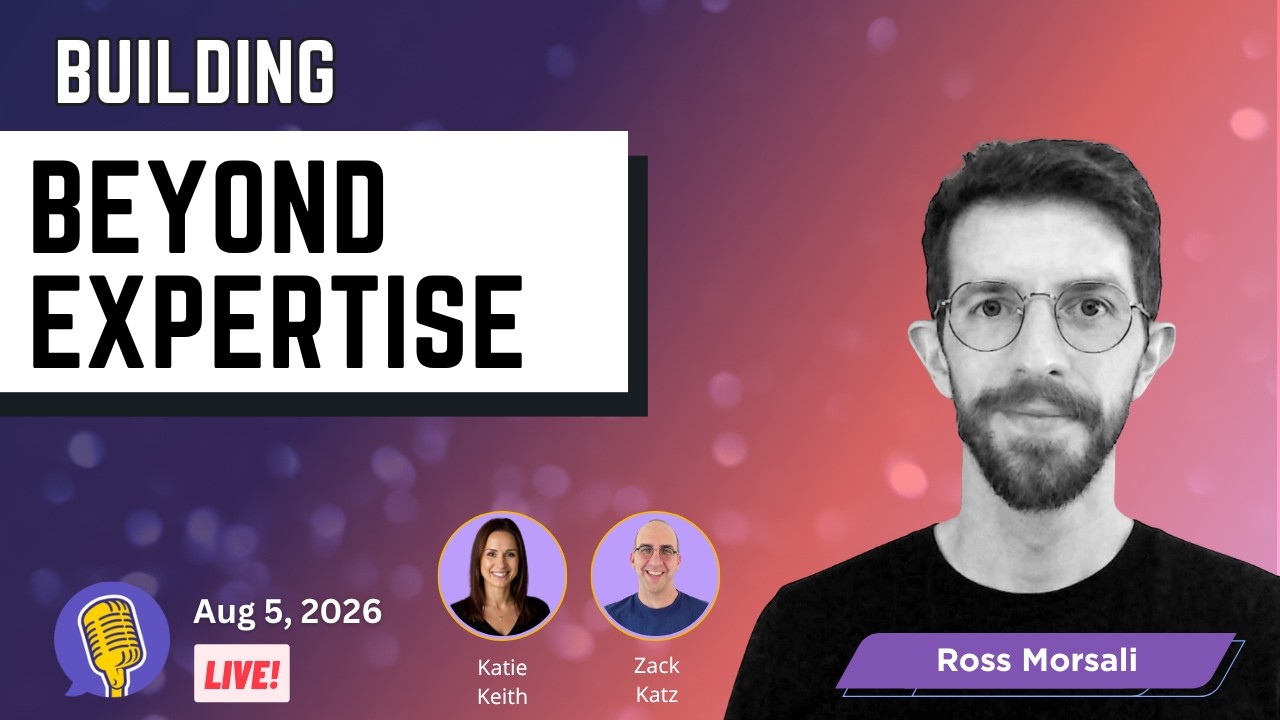


Artificial intelligence is changing the role of software developers in ways that go far beyond code generation. On August 5, Katie Keith and Zack Katz welcome Ross Morsali to explore how AI research workflows are helping developers tackle problems that once seemed far outside their expertise, unlocking new opportunities for WordPress products and beyond.
Ross shares how AI-guided research helped him completely rethink the indexing architecture behind Search & Filter by borrowing ideas from enterprise search systems and adapting them for WordPress. From there, the conversation expands into an exciting look at what’s possible when developers use AI to venture into unfamiliar territory, including speech-to-text systems, custom language models, and other ambitious projects that would have once required years of specialized experience. Instead of asking AI to help us build faster, we should ask how AI can help us build things we never thought we could.
[00:00:00] Katie Keith: Vibe coders are now building things that only developers used to be able to make. I know I am. But while most people are using AI to ship the same work but faster, some people are using it to achieve things that they could never have imagined being able to do themselves before. So today, we're talking about how to build beyond your own expertise
[00:00:28] Matt Cromwell: This is WP Product Talk, the place where every week we bring you insights on product marketing, business management and growth, customer experience, product development, and more. It's your go-to podcast for WordPress product owners by WordPress product owners. And now, enjoy the show
[00:01:00] Katie Keith: Hi, I'm Katie Keith from Barn2.
[00:01:03] Zack Katz: And I'm Zach Katz from Gravity Kit.
[00:01:06] Katie Keith: Now, before we get started, if you benefit from WP Product Talk, we'd love your support. The easiest way is just to hit subscribe right now, which only takes you a second, and it makes a big difference. Thank you so much.
[00:01:20] Zack Katz: And a huge thanks to Freemius for being our exclusive growth partner.
[00:01:24] If you don't know about Freemius, uh, they help software makers grow, monetize, and succeed. They're a merchant of record platform, which means they handle everything around selling software like checkout, payment, subscriptions, licensing, updates, global tax compliance. No, thanks. Let, let Freemius handle that for you.
[00:01:41] U- uh, using Freemius means you can focus on building amazing products and not all that other stuff.
[00:01:47] Katie Keith: Absolutely. Right. Well, let's get into the topic of using AI to build beyond your own expertise. For this, we've invited Ross to the show. Welcome, Ross.
[00:01:58] Ross Morsali: Hi, guys.
[00:02:00] Katie Keith: Thank you so much for coming on. To start, could you tell everyone a bit about yourself and what you do?
[00:02:07] Ross Morsali: Uh, yeah. My name is Ross Marcotti. I'm the founder of the Search and Filter plugin. Um, I've been in WordPress for over 10 years. Started with an agency based in London. Um, built a plugin called Search and Filter as a side gig. Um, and then a few years ago it became my main gig, and the agency became the side gig.
[00:02:30] Katie Keith: Nice. Well, thank you for coming on. And for anybody watching on YouTube, we encourage you to leave your questions, comments, or feedback in the comments section, and we'll highlight your comments and questions and your experiences of using AI for development yourself to discuss live on the show. But now let's talk about using AI to go beyond what you could normally do yourself.
[00:02:54] So Ross, you contacted us because you have got some particularly exam- impressive examples of work that you're doing in this area. Could you tell us a bit about how you've been using AI in that way? And I'm particularly keen to hear about how to do it responsibly if it's things you're building that you couldn't actually do as a developer yourself.
[00:03:15] Ross Morsali: Yeah. So I think, like, um, a lot of developers, we've been dabbling with AI for a little, a little while now, um, more and more as time goes on. Um, and I guess, like, over time you get more comfortable, you find the limits, and kind of like push more and more and more. So for me, um, started all the way back with, say, the, the Cursor IDE, which is like a AI-powered auto-complete when you're coding, and that was like magic, um, a year ago-ish or maybe a bit more than that.
[00:03:43] Um, and then from there eventually, um, the models got better and you started to, you know, being able to like prompt your way to features and prompt your way to, to, to, to quite big pieces of work. Um, and that's all kind of within quite familiar territory. You've got a WordPress plugin, you know it inside out, so you start kind of expanding on that, and it's quite comfortable.
[00:04:05] Um, and then I don't know when the turning point was. I think it was, for me, it was, um, when Opus 4.6 came out, which might have been like October last year or something like that. Um, and you just kind of... The, the game leveled up a little bit, or at least I got more comfortable, one or the other. Um, and then the, the kind of first time I wanted to really, I would say I really pushed a little bit further than usual, uh, was with search and filter.
[00:04:29] Um, we have a- Really complex. The, one of the most complex parts of the plugin is the indexing system. Um, it's like the bottleneck for performance. It's just generally complex on so many levels. It has to sync with all the data on your site and with a bunch of plugins. So I decided to kind of go down a rabbit hole on that one and see, like, is there stuff that I haven't tried that I could do?
[00:04:50] Um, just, you know... Basically, I, I felt like I exhausted most of my options without sinking, you know, months of research and time into this specific topic. Um, so yeah, I got kind of cloud, um, cloud.ai, the research mode, the deep research mode, um, to go and investigate what, you know, uh, enterprise is doing, what the big companies are doing, what people are doing at scale, um, rather than, you know, in a WordPress site constrained by MySQL and kind of a smaller, more restrictive environment.
[00:05:19] And yeah, just kind of did a really deep dive with that. Um, and from there we got lots of, I got lots of interesting information, uh, synthesized all the information, and kind of just came up with these cool techniques that I haven't seen in WordPress, and maybe someone's done it somewhere. Um, but I've, you know, I've researched competitors and I've researched similar plugins.
[00:05:37] I've never s- really seen these techniques being used, so kind of just building these huge research reports from, um, you know, like Algolia, um, Elasticsearch and, and all kinds of things. Um, and kind of collecting all these techniques and data and, you know, pulling in like, uh, research papers and articles that experts have written, and just kind of having this huge brain dump of info that I didn't really know much about.
[00:06:02] I, I wa- I was able to understand it more or less, um, 'cause it's kind of adjacent to what I do. Um, so just kind of did a deep dive into that. And then, yeah, basically just kind of the, the method that I, that I have when I do these research tasks is to kind of, you know, cast the net wide, get a- all the data in that you can kind of gather.
[00:06:23] I specifically prompt it to say like, "Don't exclude anything." Like, you know, include weird left field ideas, things that haven't been proven, because then I want to decide whether or not it's worthy or not. Um, so then we get all that data back, and then the kind of responsible part is proving every theory with, with a test or with a benchmark.
[00:06:44] So you'll, you'll get a technique that you found, you'll write it in isolation, completely separate from the plugin that you're building, and you'll kind of build a testing framework, and you'll make sure that, um, it does what it's supposed to do or, or maybe it doesn't. Um, and then you've kind of, you can rule that one out.
[00:06:59] So it's this kind of like iterative loop, iterative loop of gathering data, casting the net wide, and then just like mo- step by step, um, testing everything. And kind of just using the results to guide my, my, my decisions. Um, and obviously in this particular field, I have some expertise, so it's a bit easier, but it's the same principle that I've been using to do kind of more, um, left field work, let's say.
[00:07:26] Yeah.
[00:07:28] Zack Katz: I've been doing similar things. Uh, I love, I love everything you were talking about, Ross. Uh, especially one of the, one of the tips that I have for people is, you know, what, asking AI to ask what questions you should be asking, uh, about the topic that you, you have, and then having it do the deep research, having it find the scientific papers, having it find the, the battle-tested different libraries that are out there, and then having it compare them.
[00:07:55] Um, one of the things that is most useful for me is, um, 'cause AI just creates so much content for us to have to digest, is to have a pros and cons table, uh, and have AI say, "Well, this, this is good for this reason, but it also could be a problem for this reason." Um, and one of the things that I've found it leads to is over-engineering if, uh, if, if I just let it do whatever is the best.
[00:08:23] WordPress, we have a whole-- Our customer bases use antiquated servers, old PHP versions, old MySQL versions. Like, we can't rely on a good tech stack. So that's one of the things that I would caution people about as well is, like, as you're-- if you are experimenting in the code way and, like, uh, and trying to come up with, like, novel ways to implement something in WordPress, the, the technical requirements are really a blocker in a lot of places.
[00:08:52] Ross Morsali: Yeah, for sure. Um, I, I run into the exact same thing as you. Um, I would keep getting all this cool stuff, um, coming back to me, but you just can't run on a, on a shared server on some random host where you have absolutely zero control. Um, so yeah, I kept having to remind it that we're we have limitations.
[00:09:10] And I think actually that's w- what the cool thing is, um, 'cause in some of this research, I'm not able to apply all of it, but I'm r- I'm able to apply some of it. And I think sometimes we just gloss over some of the things because it's, "Oh, you need X, Y, and Z on your server," or, "You need certain PHP extensions installed."
[00:09:27] Um, but if you kind of, like, dig into some of, like, the sub-ideas and concepts, you can find a way to make it applicable, uh, in, in a constrained environment.
[00:09:39] Katie Keith: Yeah. You know, we're talking about building beyond our expertise, but actually what both of you have said indicates you are adding a huge amount of your expertise to the process.
[00:09:50] So, like, the knowing you know what to ask it to do, that's really important because somebody with no experience wouldn't be able to say to it, "Remember that lots of WordPress users have am-" "... amputated environments," and all of that stuff. So actually you are bringing your expertise.
[00:10:10] Zack Katz: Yeah, so, er, last year I was just, okay, I, I was asking the question: what, what is a...
[00:10:17] What is possible with AI? Because the- AI can do anything. You can... If it, if it's solving mathematical proofs that nobody's been able to solve before, what can we do? Uh, and I was like, okay, uh, let's think about all the different aspects for... That are might have been under-researched in, in, in all of industry.
[00:10:35] Like, I wanted to... I said, "Hey, AI, find all the different possible places that are under-researched that we could possibly have a, a patent filed." I was like, "Okay, look into, l- l- you know, come up with some options." So we ended up doing, like, sprinkler systems for residential serv- uh, systems, and, like, coming up with an algorithm that accurately, uh, like, calculated how much pressure and, like, maximizing and minimizing the number of, of sprinklers needed for a residential, uh, garden and, like, lawn and stuff.
[00:11:10] I learned a lot about lawn , lawn care and residential sprinkler systems that I didn't know before. Uh, and we came up with something that might have been novel. Uh, they did a whole patent search thing with the US trademark, uh, uh, pat- and patent office. Um, but in the end, I didn't know what I was doing, so I didn't end up, like, moving forward with it.
[00:11:32] But what I did realize was that when you're, when you are expanding beyond your expertise, it's probably a good idea to find something you actually care about. Because-
[00:11:43] Katie Keith: You're not passionate about sprinklers?
[00:11:45] Zack Katz: Well, I was passionate about exploring new areas of interest and, you know, it was interesting learning all about, like, fluid pressure and, and, like, the, the- Really?
[00:11:55] the difference in, in, in slope in a lawn and how much, uh, that affects your pressure. Like, I didn't r- really think about this stuff. Um, and now I do more than I would've. But I, I do think that it's worth exploring and going beyond your expertise in places that you actually care about.
[00:12:16] Ross Morsali: Yeah. I, I agree. Um, yeah, if you don't have any interest in it, um, you won't be, you won't be interested in covering all the nooks and crannies and all the, you know, little details.
[00:12:26] You kind of, you have to learn on the job at the same time. Like, you have to be open-minded, and you have to plan that you're gonna also learn. It's not gonna do everything for you, so you have to be ready to, to learn and interact, and kind of get a bit smarter so you can ask the right questions. Um, one thing I think is, um, as, as a dev, I think we have, like, a, a- an advantage in...
[00:12:48] And I think when you're, when you're operating in something that you don't know too much about, like, I think one of the most important things is to have, like, in your back pocket is, like, how do you approach problems that you don't know anything about? Like, what's the mental model? How do you construct a mental model about something that you don't know about?
[00:13:06] Um, and I think devs have been doing that kind of, like, abstract mental models about problem spaces for ages. So I think we're kind of well-equipped, um, to kind of like, you know, um, transfer that approach over to- to- to other fields and other things. 'Cause then we have this kind of like systematic, um, logical approach of, like, if A then B, and you know, like, do this.
[00:13:30] If that doesn't work then do this other option and, and kind of like, you know, approach things in that kind of way.
[00:13:36] Zack Katz: So I agree, Ross. And, uh, Katie's been on a journey for the past year of just kicking so much butt with AI stuff. Uh, Katie, you're not a developer, but you've r- you've fully been able to do ev- like, all sorts of stuff.
[00:13:54] I'd love to hear, uh, your experience, like, going beyond, uh, your comfort zone.
[00:14:00] Katie Keith: Yeah. Weirdly, I'm actually the best example of this out of the three of us, because I am not a developer. Um, it's actually not even a year, it's five months since I discovered- Wow ... that AI had got good. Uh, so I first tried, at your insistence, Zach, last September, and it was just terrible.
[00:14:18] I couldn't get anything good out of it as a non-developer. Interesting that Ross said it was about October that it got good. That was just after I gave up. So I waited for a time- ... and then tried again, and it was amazing and totally different. And I don't think I'd changed at all the prompting. I think the, um, AI models improved that much in that time.
[00:14:41] So I've, my work has changed immeasurably since I started properly using AI, not just as chat, which I was obviously already doing, but as a proper agent, and writing code, and things like that. My favorite example is the SAS that I've just single-handedly built and launched myself. We even have some paying customers.
[00:15:03] So our most popular plugin is Document Library Pro. Um, and- So basically I just went off on my own and built a SaaS with Claude Code. So it's the same WordPress plugin, but it's a multisite and the user doesn't know they're using WordPress. So they have this multisite subsite created. They add a document library.
[00:15:25] It doesn't look like WordPress at all, and then they can embed it in any platform, um, like Wix, Shopify, Squarespace, whatever. And while the functionality of the plugin mostly came from the WordPress plugin, which real developers work, uh, built themselves, I built the whole SaaS and, um, obviously I'm not at all qualified to do that, but I think the ways that I did it responsibly was my knowledge of WordPress and the space and the main gotchas to be aware of.
[00:15:58] I used WordPress and WordPress multisite for a reason. I know about the security and how all that works, whereas vibe coding a completely custom platform I think would not have been responsible. Also, I used Stripe for the payments. I know how that works, and th- there's no loopholes in there. So by combining things I did know, I was able to create a whole SaaS, which I wouldn't have dreamed of doing before.
[00:16:26] So I'm not sure what my team think of me, 'cause I have a whole team of developers and I just, I didn't even tell them I was doing it. I just... 'Cause I didn't know it'd work. It was an experiment. And then after a few weeks I was like, "This is launchable. This is actually going to be a real product." So I told my team quite late in the day in the end, and I had a whole marketing site built, vibe coded, the design, the logo, everything, and I think it's really good.
[00:16:52] And we have got our first paying customers, like I said. So that's going way beyond my expertise. But again, I think the theme that is coming through is that you need to have some sort of foundation and knowledge in the area that you're doing it in so that you know what questions to ask.
[00:17:10] Zack Katz: So Katie, regarding questions to ask, uh, I'm interested in what questions you asked the AI during building out the, the, your Document Library Pro.
[00:17:22] Katie Keith: Um, well, I did a lot of testing myself. This is not a one-shot thing. This is weeks of iteration. But I also listened to people like you, Zach, and what our mastermind group talks about. Things like getting it to do a security audit. You guys told me about Fable when that came out, um, partway through the project, so I got that to do a massive audit.
[00:17:43] Um, what, what did you say about trying to get it, um, not aggression testing, but you've got a word for- Adversarial ... yeah, that's it. Adversarial testing- Mm-hmm ... to try and break it. So I did put it through its paces. I also followed your guys' advice about things like using multiple AI models. So I might have had, um, like, AI- uh, OpenAI's model looking at Claude code work and so on, and had multiple models fighting it out t- and so on.
[00:18:12] So I tried to do that responsibly. Um, and then kind of after it was launched, I got my QA to, um, and, and my support team to QA it. But I was in full on founder mode by then. I wasn't gonna let people delay me. I was just going ahead.
[00:18:28] Zack Katz: Well, and if you have no active users, um, you know, a minor bug isn't a huge issue.
[00:18:34] Uh-
[00:18:35] Katie Keith: Yeah. It's not like- And if you're good- ... Document Library Pro, the plugin, which has tens of thousands of people using it. Right. It was just a brand new SaaS, so feels a bit less high stakes initially.
[00:18:47] Ross Morsali: Yeah, so I think, uh, when you talk about the responsible part, I think it's while you're making a product or while you're investigating something or while you're trying something new and you don't have any users, then there's not much to be responsible for unless you're actually releasing something.
[00:19:02] You, you've released it, so obviously that ups the game a little bit. Um, but up until that stage, I think you just, you know, you can just go, you can just be free to experiment. Um, I think the, the main thing is just to make sure that you're going in a direction and not being kind of led astray by the AI because you don't know the direction you're going in.
[00:19:20] I've had a couple of, you know, eureka moments where I think I've created something completely new and all I needed to do was actually just research if there were things out there and, and there were things out there.
[00:19:29] Zack Katz: Yeah. One of the things that I have AI do on a regular basis, because the longer you chat in a AI session, the more your context gets polluted.
[00:19:39] Like, it, it becomes less reliable. It relies more on its own experience in your chat. If it thinks something's a good idea in your chat, it kind of builds on that and builds on that. And so, like, you have this one chat session that thinks it's a great idea. Um, one tool that I use regularly while I have a chat session is having a sub-agent created in that chat session that says, "Run this idea through a sub-agent with no other context," so that you just start fresh and give the, the idea as all that you've-- like, it removes all the other context.
[00:20:11] It just says, "Here's the idea. Analyze it, find gaps in it, like do, you know, critique this idea." And then h- that comes back in and the agent's always like, "Oh yeah, that's a good point. Like, that's... I was completely wrong about what I thought."
[00:20:24] Ross Morsali: Yeah. That's the, that's exactly my approach as well. I've, I've, I've kind of built a kind of orchestration system to, to, to work the way that I like to work, and almost anything that I do that's of any significance, I will run it against like three different models, um, and have them feedback and even then get them to re-review, um, whatever's happening or as we go along or a, a checkpoint.
[00:20:46] So I'll use Claude, I'll use, um, OpenAI, uh, Codex, um, Kimi I'm using now as well, and I'm using Cursor, and they're all in the CLI, they're all fed into the system. So I just click a button and send, send a review off and, and get the feedback, and they don't know anything that's been discussed up until that point.
[00:21:03] They might, they might just get a reference to like a plan document or something like that
[00:21:08] Zack Katz: So I just saw a talk... I went to Laracon, which is Laravel's conference that was recently held in Boston, which is just an hour and a half away from me, so I figured I should see how the other half lives, right? Um, and there was a really good talk there by, uh, somebody named Matt Stauffer, who runs Titan dot, uh, titan.com, like Titan the screw.
[00:21:28] Uh, they're one of the, the big Laracon, uh, or Laravel developers. Um, and he had a great talk, I recommend everybody check it out, uh, about it... That I found really inspiring, about cognitive surrender, uh, is the t- is the phrase. Which is like, "You know what? I don't need to know any of this, AI knows it." And his point was that, uh, that is a failure of us as humans, uh, to kind of build our own knowledge and, and learn and grow, and why would we grow until AI and then plateau out instead of just continuing to grow?
[00:22:05] And he was suggesting that rather than cognitive surrender, as you learn how to use AI, as AI keeps, um, pushing your boundaries beyond your previous expertise, have AI kind of t- talk to your AI. Have your AI kind of train you on what it's doing and why and, and try to learn some of the ideas that AI is implementing so that as you get to be better, as you go beyond your levels of expertise before, AI kind of helps tutor you and onboard you into what it's been doing so that you just continue to grow.
[00:22:39] And I love that because it's so easy to say, "I don't need to know this. You know what? It... This t- new technology is beyond me. I will never know it, AI knows it." Well, I, I, I now refuse that notion, and I, I love the idea of, like, continuing to get better at what we're doing.
[00:22:56] Ross Morsali: Yeah. That's, uh, I completely agree.
[00:22:59] That's, that's kind of what I think is happening, at least for me, when I'm trying all these new things. Like, I'm genuinely learning more. Like, I, I know more about different fields. Sure, I'm not an expert, but I know I'm learning every step of the way as I go along, and then that helps you keep working in, in the, in, in the kind of problem space that you're in.
[00:23:17] Katie Keith: So what about if you are building some software with AI that requires a programming language that you simply don't know? I know Jack Arturo from WP Fusion has done this a lot, where his AI has used languages that he has no knowledge of. So he knows PHP and whatever else, but he's using his knowledge as a developer to guide it, but he cannot check its code.
[00:23:39] How do you both feel about that?
[00:23:43] Zack Katz: I'm comfortable with it because I feel like it's... As a, when you're a developer, it's like knowing a romance language, and you, you go to France and you hear somebody speaking French. Well, if you already know Italian, you've got a leg up or similar with, uh, you know, Spanish.
[00:24:00] You, you know the concepts, you know the, the way that code generally works. So if you look at, uh, some code that you don't understand, you, it is understandable as long as you understand the concepts. So if you don't understand the concepts, that's a whole nother thing. Like when, um, when I started learning object-oriented programming rather than functional programming, and I had to like...
[00:24:19] I read a book on functional programming, PHP for functional programming. I'm like, "Okay, cool. Now I know functional programming." I was like, "Hold on a second. Objects and, and like dependency injection and all this wild stuff." I had to up my game in terms of the concepts that I had to learn, but now that I know those concepts, if I go to another language, it doesn't matter.
[00:24:38] So I see AI writing code, and it's essentially an immersion language training system for me. I read the code. I'm like, "Oh, so that's how that works in that language." And you just kinda learn the language natively, and you... I don't write React, but now I can s- I understand React concepts so much better than I did before when I wasn't seeing React being built and ask, and find, seeing the bugs being fixed.
[00:25:06] And I natively now in, uh, have internalized some of the n- uh, the, the best practices for React by seeing the AI implement them based on what it knows as best practices.
[00:25:19] Ross Morsali: Yeah. I think, um, learning another language as a developer who has maybe already done more than one language is not that kind of crazy out there, um, getting out of your comfort zone.
[00:25:30] I think you could have trained yourself to, to, to learn another language just given X amount of time. So it, it's not that kind of going to unknown territory. There, there's a bit of a like a, an on-ramp where you're sure, like maybe you've never seen this type of syntax before, so like kind of get your head around that a little bit, and after a few sessions or a few projects or whatever, you kind of, like you say, get familiar with it.
[00:25:52] Um, but I think it's like, I think it's still within the comfort zone. That's not, it's not too crazy. It's not too out there. Like I'm, I'm writing in quite a few different languages as well, or the AI is, but I've been doing Rust for like over a year now, and now I can read it and write it. Maybe not the best, but I can spot things and, and, and things like that.
[00:26:12] Katie Keith: So I have a question for Zach. Why are you looking at the code?
[00:26:17] Zack Katz: Uh, I, I watch as the AI writes the code, um, because it, it outputs what it does some- uh, sometimes. I like to watch it write the code. And then during poll requests, I do review the code to make sure that terrible mistakes aren't being made. Um, one of the things that as a developer, you, you kind of get to know as you get to know a language, as you become an expert in the language, WordPress space especially, th- WordPress has so many functionality, like so many functions that, that it should...
[00:26:47] it wants you to use instead of having, uh, the, your own custom version of it. So, like time ver- time functions. You wanna use the WordPress time functions. Using remote requests to, like, get stuff from external data sources, you should use WordPress's remote request stuff. So you just get to develop a code smell, uh, sensory input where you look at code, it's like, "Well, that's not right.
[00:27:12] Uh, let me find out why it's not right." So I like to review all the code that we, we ship. Um, even if it's just kind of scrolling through some of the more, um, boilerplate stuff. Uh, I, I do wanna make sure that I look at the code.
[00:27:28] Katie Keith: Yeah. I've noticed that there are different levels of what it's responsible to build with AI.
[00:27:34] Um, internal tools are the easiest thing because y- as long as it's not a site with customer data on it, I have a separate site that I use for reporting and things like that, so there's no customer data or anything that could go terribly wrong, and I've added some amazing things to that, but it's never gonna be shipped.
[00:27:52] It's just internal. So I think that's fine. The next level is something like a SAS where you control the environment and nobody can access the code, which I'm finding remarkably easy. Mm-hmm. But then the challenge comes with WordPress plugins. Um, so for example, I have got Claude Code to add features to our plugins and then do a poll request for the developer, and usually they'll say it's okay overall, but they will find major problems or something I've overlooked in the testing, or that something that was approached wrong, the sort of things that Zach's talking about, that I'm finding with plugin development on existing products in particular, you really do need that oversight and you can't just go and release stuff
[00:28:37] Zack Katz: Yeah.
[00:28:37] And, you know, we've talked a lot about code so far, and you're absolutely right, Katie, that having a human review in the l- like, having humans in the loop is important. Uh, and as, as experts, we can talk about, like, what we know. Um, one of the things that I, I've been using AI for is, um, to do better meetings, and I, I've read some books about being a good leader.
[00:29:05] I try to internalize things. I've done a lot of therapy. I don't know, like I, I j- you know, it helps to, to have empathy and, and all... But what a- what also is helpful for a leader is to have, um, to express your goals, to, to a- put forward a path that everybody gets aligned on and everybody can see a common outcome that, that we agree to and we work toward that goal.
[00:29:30] That kind of stuff for me is so hard to, um, to shape, and I've been using AI to read m- our calls after the calls and say, "Well, what did I do well? What did I do badly? How could I be a better leader?" And the expertise that we're talking about so far is code and, like, do- you know, building products and stuff.
[00:29:50] I... How do I be a better person? How can I, how can I systematize this? And I've got a lot of, like, reminders that I have set up all over, like, all over my world where, like, um, I, I, I want to make it easier for me to get better at all sorts of things that I do. Um, and having a system for that is one of the things that I've asked AI to help with.
[00:30:16] Ross Morsali: Um, yeah, for, from my side, I think a little bit, um, like what you're saying. So I like to use, um, tools like, uh, like Hermes or, or something similar, which is something that helps, uh, organize you and helps you stay organized. So my mind is, is a bit of a mess. Um, I'm always chasing deadlines and, and deeply disorganized.
[00:30:37] So, um, I like to use it to filter, you know, I can, I can basically brain dump and it can organize things for me. Um, and yeah, a- and do research for me kind of more passively. Uh, and when I forget about things, it will have found things in the background and remind me that, oh, this is, you know, X, Y, and Z, um, things that, that need my attention and I might have forgotten about.
[00:31:00] So that's the kind of stuff I've been using it for.
[00:31:04] Katie Keith: I love it when it makes things more human for me, ironically. Like, I might give it a draft email to say something difficult to a team member or something like that, and often it humanizes it further. So yeah. Anyway. I,
[00:31:18] Zack Katz: when it humanize... It takes my good draft and it makes it sound like drivel though.
[00:31:22] So like-
[00:31:22] Katie Keith: Sometimes, yeah. Yeah, I don't always go with its recommendations. I would never, ever just accept wording from an AI without my own input. But it's interesting to see its perspective and it's, like, says, "Well, the team member may interpret this this way," and something like that that I may not have thought of
[00:31:42] Zack Katz: So what do we want? Like, one of the things that the Laracon presentation talked about was, uh, he was building a video game. Uh, he was building a game with a, a JavaScript library that he had never used before, uh, built on technology stacks that he had never known before. But he was interested in building a video game because he liked, um, he, he liked, uh, Minecraft, and he wanted to do something like Minecraft and have it represent the real world instead of a, a imaginary world.
[00:32:13] Art Kidding and I are in a mastermind group. One of our pals, uh, Jason Coleman, uh, I love hearing all the projects that he does with his children. Um, he... They do, like, s- audio synthesizer apps where, like, they, you, you can tune frequencies and have, like, basslines and stuff like that and, and have, like, really interesting visualizations of, of tones and, and chords and stuff like that.
[00:32:38] And I find that I'm not that in, like, maybe creative, uh, when it comes to expanding my expertise. I don't really wanna build a video game. I don't really wanna, like, I don't know, synthesize sound. Maybe
[00:32:52] Katie Keith: that's not your passion.
[00:32:53] Zack Katz: It's not my passion. My passion is building stuff, apparently, on Work- on WordPress and on, online.
[00:33:00] I've always been just a web nerd. Um, I'd love to hear what y'all, uh, are interested in exploring more with AI and, and what your... what expertise you want to expand beyond.
[00:33:12] Ross Morsali: So, uh, you were just talking about the music side. So I'm, I'm really big into music. I used to DJ and do a bit of production. Okay. It's like a, a past life.
[00:33:20] Um, but I, I love music, I love creating music, and I love, like, playing records and things. So one thing that you just touched on about the synthesizers, um, something that I've been doing is, um, is kind of like the next kind of level, I think, from dev is, is kind of like learning how to build, um, AI models themselves.
[00:33:38] So like super small bespoke models, um, that run, like, on device. It's not like, it's not like your cloud.ai. It's not, um, they're not hugely complex, but they kind of do one task and do it really well if you, you, you make a good model at the end of the day. Um, so on the music side, um, I've been building a, like, a drum machine.
[00:33:57] I don't know if you guys know too much about this stuff, but it's like a sequencer. It's like a... You draw in the pattern of the drums and, and it plays it, and it's a really typical kind of workflow when you're, when you're writing music, um, like music software like Ableton or something like that. So something that I used to get into, uh, quite a lot was I would, I would get creative blocks, so I wouldn't know, okay, maybe I would, you know, wouldn't know what to do with the drums next, like how I would program in them in next.
[00:34:23] So I'm building an AI model to do suggestions. So, like, I'll have, like, say, half a pattern written, and it can maybe suggest the next bit or, or, like, uh, in, for, for drums, like, you'll have a kick and a hi-hat. Um, so maybe I'll have painted in the kick, so I want my kick to be like this, and then it will suggest some hi-hats to go with it.
[00:34:44] So that's one thing that I'm kind of... I'm kind of diving into building AI models basically. So I've found a few little places, um, where I think they could be useful, so I'm kind of experimenting with that So one is this like hobby project, which is the drum machine. Um, another one is, um, I'm building like a screenshot tool for the team at Search and Filter.
[00:35:05] I've been kind of on and off building it for a while to make life super easy for all of us. Um, th- they're not that complex, but there's, there's some workflow issues there that I never liked. Um-
[00:35:13] Zack Katz: There are a lot of... There are so many nuances to screenshots.
[00:35:18] Ross Morsali: Yeah. It's, it's more complex than it looks like from the outside, I guess.
[00:35:22] Um, but there's one thing that, um, I wanted to do. So I've, I've got a little model in the screenshot tool which is only 10 megabytes in size, and if you just give it an image, it's been trained to identify call to actions.
[00:35:35] Katie Keith: Hmm.
[00:35:35] Ross Morsali: So if I'm doing a screenshot, um, of a Search and Filter admin page or the Search and Filter fields on the front end, we're, and we're gonna put that in the documentation somewhere, um, it will identify form fields and call to actions.
[00:35:48] So it's like one click. So you just like kind of hover over and it will suggest some buttons, and you can say, "Click the submit button on your screenshot," and it will highlight it, add an arrow, label it all like automatically.
[00:36:00] Zack Katz: Oh,
[00:36:00] Ross Morsali: cool. And that's this like super tiny little embedded model with some, some obviously kind of complex logic around it, like infrastructure.
[00:36:06] Zack Katz: Ross, we gotta talk.
[00:36:08] Ross Morsali: Yeah, yeah. I'm, I'm, I'm gonna be demoing this thing in the next couple of days. Great. There's some really, some really nice videos, um, of what it can do. It's, it's... I haven't seen anyone else doing anything like this, so that's cool. Um-
[00:36:17] Katie Keith: Yeah, screenshots are a pain, and AIs aren't that great at them.
[00:36:21] I've, I've got an okay thing going with it, but it's not very good yet
[00:36:28] Zack Katz: So Ross, I'd love to hear more about how you went about conceptualizing expanding your knowledge into building a drum machine. Like, you know, how did you go about saying like, "This is something I wanna do," and then how did you, how did you, how did you do it?
[00:36:43] Like, not, not the technical aspect of it- Yeah ... but like the, the I'm going to learn how to build a drum machine side of things.
[00:36:52] Ross Morsali: Like the first kind of AI model I was dabbling with, um, did something specific, but it's, it's as I'm like, like you say, you have to like learn the field that you're going into. So as I'm learning more, my like my, my, my point of view is expanding and I'm like, "Oh, could I apply it to this field?
[00:37:10] Could I apply it to this?" And as I'm getting more and more comfortable, I'm starting to think of like the business cases for models in certain spaces, but that's kind of actually the hard part is like where is, where is a model suitable over like a, especially like a small one that can't do a lot over just writing, you know, some really advanced code that, you know, covers all kinds of use cases.
[00:37:28] So the drum machine was like one of the last things I've started dabbling with, but the foundation is trying other things first. And the first thing, um, that I, that I did and I'm still working on now is a speech-to-text model. So I mean, we can get into like how do you even go down that road, which is kind of insane to me also, 'cause I, I'm, I'm definitely not experienced in any of that stuff.
[00:37:50] But, um, I was-- I use obviously, uh, a lot of speech-to-text models here and there, and I don't think my accent is crazy, but they always seem to trip up on, on lots of things that I say. I think I mumble a bit, my voice is a little bit deep sometimes, and then also I have a bit of a northern accent, so it's not like, um, you know, a good example of British English or, or US English or anything like that.
[00:38:12] So there's all these little errors. And then one time I was just in bed just thinking, oh, y- I don't know. I don't get these eureka moments in bed. It wasn't even a eureka moment at the time, but I was like, all these speech-to-text models, they all like have to work really well for everybody. Like, like you use the same model as the n- person next to you uses probably Whisper or one of the few, the handful that are out there.
[00:38:34] So what if there was like a model that wasn't like for everybody, but it was trained on you, like on your, your characteristics of your voice? So I was like, how about that? So how, like if it could learn my voice and the way I say things, maybe it could be really effective for me. So that was like a crazy rabbit hole, so I didn't really find much out there.
[00:38:54] And then, yeah, then I started to get into the LLM side, um, the, the model building side of things and just, you know, baby steps, trying things, uh, looking at theories and doing some of this deep research stuff and building out little systems and little, you know, proof of concepts. And then kinda going, this thing actually has legs.
[00:39:14] Like, I think if I do put all these like eight different things together, maybe we have a pipeline here that can kind of work for, for, for this particular like problem space. So that was like the f- probably still the most challenging model, um, to build out of all the kind of my experiments. But that got me thinking, oh, okay, maybe like, you know, we could get a model to fill in some other gaps in some other, you know, places.
[00:39:41] I mean, I can di- I can dive in a little bit deeper on, on that stuff No, that, that
[00:39:44] Zack Katz: sounds really great. Like, um, if, if anybody has n- uh, not played around with ElevenLabs, uh, they're a text-to-speech, um, AI company, and one of the things that they do is they train an AI to sound like you. But the... You're talking about the inverse of that, having, you know, uh, your voice being understood.
[00:40:05] The, the ElevenLabs interface has you read out a long, l- like a long tome. I think it has, uh, like The Great Gatsby is one of the things that it, it suggests you read, and it wants you to read, like, at least 15 minutes of it. It's really interesting. Uh, so I, I recommend everybody go to ElevenLabs, sign up. Uh, they have a free trial, I think.
[00:40:25] Uh, train, train your own voice and just, like, experience what it's like to hear what computers think you sound like- ... um, and your nuances and your, your, your tics and things like that. It's, it's fascinating to... It got very close to me, but it's still not me, which, uh, i- is pretty cool. Like,
[00:40:46] Katie Keith: um- So what's the purpose?
[00:40:47] What are some real use cases that you might use it for?
[00:40:51] Ross Morsali: So obviously this was just like a random offshoot experiment, crazy idea that I had, like just could it be better for me? Um, but that's kind of snowballed a little bit into maybe some real use cases and maybe a real product one day or, or, or something like that.
[00:41:06] Um, but the thing is with the, with the, um, the current models that you've got that are on device, like you can, you can pay for like a Whisper flow and it's a subscription and your voice goes off and they have all the compute and they send it back to you quickly. But that's not on device, it's not private.
[00:41:21] So, um, so when you're looking at what's on device and, and private, um, you've got a few options today, maybe four-ish options. Um, and we're, we're all privileged probably that we have decent computers with, you know, some decent specs, and we can probably run those models and they work reasonably well aside from the caveats that I've been finding generally speaking.
[00:41:42] Um, but when you wanna talk about, um, you know, machi- machines, uh, with less power or, or if you're doing, you know, like heavy workloads on your machine, you don't also wanna be doing a heavy speech-to-text workload on your machine. Sometimes I notice things whirring when, when, when we're doing this kind of stuff.
[00:41:57] So, um, with the thing that I've been building, um, it's like, um, way, uh, less resource intensive and way faster. So normally when you, when you speak, you'll say like it'll wait for like a pause in, in your speech and then it'll kind of bunch that text up. Might be a few words, might be a sentence, and it'll go off and come back and, I don't know, maybe you have to wait a couple of hundred milliseconds or something like that.
[00:42:22] Um, the... What I've got working so far, and it isn't complete and it's not without its flaws and not without some, you know, concepts I have to kind of get over first, but it will do almost word by word as you speak in like 50 milliseconds. So it feels like you're finishing the word and you'll see the word on screen as you finish the word.
[00:42:41] So, um, you asked about use cases, but it's kind of just, you know, like laying the foundation. Um, it's super fast and super small and, and not so, you know, resource intensive. And it uses a similar concept that you mentioned from ElevenLabs. Like it has to learn your voice first, so you have to give it some words.
[00:42:56] Uh, I, I've not read The Great Gatsby yet. I've only given it like just 20 words and it kind of, you know, it does reasonably well. Um, it doesn't need to copy me, it just needs to understand me. Um, so when you think about like where could it work well So I think accessibility is an amazing one. So, um, people with speech impairments.
[00:43:18] Um, so, you know, they'll say things in their way, but conventional systems won't recognize those words. So if you train it on, on someone's voice, they can use these systems freely. So I think that's, like, a just a really cool use case. Um, another one is, let's say, uh, language learners. So, um, I was talking to a friend of mine, um, from the US who's learning Dutch, and he was just saying it's super annoying that all these systems never recognize his Dutch because his Dutch is bad.
[00:43:46] But the way he speaks Dutch is at least consistent to him, so if it was trained on his voice, he could also do speech-to-text in Dutch. Um, so you could, you know, cover more use cases, cover more kind of... There- there's lots of places where the, the, the systems out there today, they c- they just don't fill. Um, and then you can do, like, on-device stuff, so, um, it could be on your mobile, and it could be fast, and n- you know, your mobile wouldn't heat up, and you could be offline.
[00:44:13] So, um, there's not many things doing that today. So what I like to... W- what I'm kind of want to go with as, like, a MVP is, like, a limited set of words for, like, commands a- and instructions that will respond really, really well, really fast, offline, uh, and really accurately, um, for, like, you know, add to calendar.
[00:44:31] Like, like, if I use add to calendar on my Google phone, even with the new AI stuff they've got there, it still gets it wrong all the time. So just having that reliable and fast and offline, which you can't even do, that's like an upgrade already on what's out there. So I would be happy if we got there, which I think is very, very achievable.
[00:44:49] But then you can go, you know, um, you could maybe do other, other hardware like, um, let's say you have a, a camera, and you wanna, like, tell it to take a photo of you. You know, you put it over there, and you run over there. Um, and you can speak to it instead, and because it's trained on your voice, um, other people's voices won't get in the way, and it will recognize your voice better in a, in a noisy situation.
[00:45:10] Um, there's, there's kind of a crazy number of applications, um, so I'm super excited to kind of dive further into it.
[00:45:18] Katie Keith: Yeah. You know, so many people are doing such amazing work with AI and really bringing things forward. It's always interesting how to make that decision as to whether to keep something internal for your own use and when to release it as a product.
[00:45:32] And a lot of people have released products just because they can- ... but then not followed through with any marketing or anything like that, so they're not realistically gonna be successful with these products, 'cause it's all about the follow-through and the execution, isn't it, once it's out there. But it's an interesting decision because we can now build products, like really advanced stuff like what you're describing, so easily now.
[00:45:56] Ross Morsali: Well, I wouldn't say easily, but No, but- It's, it's attainable, right?
[00:45:59] Katie Keith: But beyond what you could have imagined-
[00:45:59] Ross Morsali: I mean, it was never attainable, yeah ...
[00:46:01] Katie Keith: four years ago- Yeah, yeah, yeah ...
[00:46:02] Ross Morsali: you
[00:46:02] Katie Keith: could have imagined doing this on your own.
[00:46:05] Ross Morsali: Yeah. I f- I feel like, um, you know, I'm just gonna, like, open a webpage one day and realize, oh, what I've been doing is like, is, it's not rocket science.
[00:46:13] It's already been done. I just didn't look in the right place. 'Cause this, that's how unfamiliar this, you know, the, you know, the, the field is to me, and feeling like a, a bit of a novice even though I'm building things. Um, but yeah, it's kind of crazy.
[00:46:27] Zack Katz: But one of the things that I think modernity is asking of us is to have that kind of interest and the go-get-'em attitude where, where you just take it on, you learn it, you, you build it.
[00:46:40] Um, I think a question that, that is going to come up or that has come up a lot for me is, well, what do I do with this now? Why have I built this? Um, what is my goal? And Ross, for example, your, your speech model, like are you planning an exit on this? Are you trying to sell it? Are you trying to license it?
[00:46:59] And if so, that's a whole 'nother, that's a whole 'nother can of worms that you have to open. Um, or is this just for fun?
[00:47:08] Ross Morsali: Um, I think it's good enough to start thinking a bit seriously about those- Yeah ... crazy, um, options. You know, going into a whole... That's, that's going to a different field in terms of like creating things, but then there's also like of running a business or the type of business you have to run.
[00:47:25] Um, and that's a whole, that's, that's another scary thing to think about. But, um, yeah, I mean, it's got legs. I, I, I, I really think it does. So I'll be exploring it. I'll be exploring it. If worst case scenario, I'll just open source it, right? Um, but I,
[00:47:39] Zack Katz: I think this- Well, I, I know that Apple, for example, is always, is, has been doing a lot of work on their, their local models for speech-to-text.
[00:47:47] Um, and, m- you know, uh, you use a Google phone, but it seems like maybe you could, uh, be convinced to join the Apple team.
[00:47:57] Ross Morsali: Yeah, I mean, um, well, Google's a bit behind o- on that side of things, but I think the cool thing is with something like this, um, because it learns your voice, the, the way I'm thinking about it is you don't wanna have to train all your different devices and all your things.
[00:48:12] I think maybe we're gonna get to a point at some point where, you know, all the big guys, they, they've probably got research a- and things like that, they just haven't released it yet. Mm-hmm. Um, and I think, you know, there's lots of improvements just waiting in the pipeline, and they'll come along. So but then, then I'm thinking in that world there is, um- They're all competing, so you'll, you'll train your voice in one system, and you have a similar thing in, in Apple where you have to give it a few words for the, for the wake word stuff, for example.
[00:48:37] Um, and everything's kind of going in that direction and, and my system isn't too dissimilar. I'm, I'm guessing. I don't know their underlying tech exactly. But I like the idea of, like, having, like a, a passport, like a, a voice passport where you teach one system and all these other apps and s- things can just plug into it so you don't have to keep teaching.
[00:48:56] And the more you use it, the, the better it gets at recognizing your voice as part of the system, 'cause you're giving it more words basically. Um, so I, I like the idea of, like, one central thing where it's like a, like a voice passport where you, uh, other, other, other, other software and plugins can kind of like just, you know, enable this API, and if you wanna use, you know, your, your voice passport, it'll work perfectly with that thing.
[00:49:17] Um, rather than like a vendor locking thing. Um, that's what I see is, is out there today is, is all these big vendors that won't work with each other doing something like this, and this is, I guess, something that's kind of, um, vendor agnostic. So that sounds cool.
[00:49:33] Katie Keith: Yeah, that sounds good. It also fits with the whole concept of a voice profile, which is not about the spoken voice, it's about your language and wording so the AIs can write on your behalf, and there's various ways you can do that with MD files and things like that.
[00:49:48] Um, but I've never found anything any good that can write as me. No. And it might be a British thing, so interested in your experiences, Ross. But it does not get me and the way I word things. It just can't do it. Um, so have you had any luck with that?
[00:50:05] Zack Katz: It's not just you, Katie. It's not just the British Isles.
[00:50:07] Katie Keith: Okay.
[00:50:10] Ross Morsali: Yeah. I, I, I have to rewrite absolutely everything. There was a, there was a little period where I was making little, you know, templates for social media posts or, or, and things like that, like, and I would just look at it and go, "God, this just doesn't sound anything like me whatsoever. Let's just scrap it all.
[00:50:24] Good idea. I'm just gonna write it all in my own words," and, and that's what I do now. Yeah. Yeah.
[00:50:28] Zack Katz: And yeah, so I mean, this conversation has sparked my interest in, okay, well, can I train a model? And we've, we've done this. Katie and I have talked about this in the mastermind group is like, okay, building the voice, uh, of myself based on all the writings I've ever done and trying to synthesize it into some, some kind of rules or whatever.
[00:50:49] Those rules pr- produce crap. They're not good. Mm.
[00:50:51] Katie Keith: It doesn't work. Mm. But
[00:50:53] Zack Katz: if, if I were to train an AI model on how I write and how I speak... Well, hopefully more how I write 'cause my speech is pretty disjointed. But if I train the model on how I write, like surely that would do better than just a markdown file that a preexisting model would, that would then ingest.
[00:51:11] Ross Morsali: Yeah, I mean, I'm guessing the, again, the, the models that we use, the real advanced models we use, they're for everybody always. Mm-hmm. So they're very generalized. So maybe you could build a model which looks at grammatical patterns and sentences and that, that's what it does. It identifies the pattern of your grammar and, and, and the, the, you know, the ordering of your words.
[00:51:32] And maybe you could get some, some text from one of the big ones and feed it through that. And, and yeah, I think it sounds like there's some potential there. Yeah,
[00:51:40] Zack Katz: and- Yeah,
[00:51:41] Katie Keith: I like that ...
[00:51:42] Zack Katz: the, the number one
[00:51:44] Ross Morsali: thing that I- Actually sounds like I should just go and do it. Yeah.
[00:51:46] Zack Katz: Go
[00:51:46] Katie Keith: for it.
[00:51:46] Zack Katz: So the next question is to, to AI, I would ask Claude Code, "Well, how do I build that?"
[00:51:52] Right? Like, and what... Do some research, compare the best options out there, recommend an approach, uh, and like, let's get started, that type of thing.
[00:52:01] Katie Keith: Yeah. Well, one thing I'm quite fascinated by is the concept of a one-person company. It's not realistic for an existing company to go there because the whole structure is based around a team after a while.
[00:52:14] But with AI, startups are increasingly just one person, and I think that links well into the topic of building beyond your expertise because it means that one person can, say, be a marketing expert or, um, a, a finance expert or whatever, in addition to whatever their main area was that led them to build the product or service that they decided to launch a business for.
[00:52:37] So I think it's also opened up the door for people to b- have kind of more hats instead of having to hire people to do every task.
[00:52:46] Zack Katz: Yeah. We, I recently built out, uh, a thing I call Ledger Kit. I, I like to suffix everything with kit. Um and for internal, uh, for personal finance and also business finance, and, uh, I have it connect through Plaid, which, uh, like is a service that connects to all your bank accounts and your retirement accounts and all that stuff.
[00:53:08] Uh, because I was really tired of having to wait, uh, for my accountants to reconcile all the different, different accounts and tell me what's going on when they never actually know what's going on. Uh, but now with Ledger Kit, uh, I... Every week I have it tell me, uh, like a summary of our account differences and, uh, like it has anomaly detection, it has retirement planning, it has all sorts of things where it's like, "Hey, your cellphone charged you 17% more than normal.
[00:53:37] Is this an acceptable thing?" And, uh, that has led me to understand some different retirement considerations, uh, algorithms. Like know what questions to ask, uh, in a way that I didn't really understand before, uh, in the world of finance. And that was just 'cause I was tired of, of relying on other people to do something poorly when I could ask the world's expert on everything, AI, to research what the experts actually say, uh, and, and implement best practices for, for, for financial advice.
[00:54:10] So I have a new AI chatbot that I can talk to about all my actual finances, uh, and say like, you know, "What are some subscriptions I should cancel?" Or, "Where should I, like, reallocate my finances?" It's, it's been really interesting.
[00:54:27] Katie Keith: Yeah. I like that. I've written down a note to myself of whether AI could reconcile my accounts rather than paying hundreds a month to the accountant to do that.
[00:54:35] Yeah. Where really they're just following a set of rules which I have given them. Um, if it's this sort of thing, reconcile it like this. Yeah. That actually-
[00:54:43] Zack Katz: AI are very good at that.
[00:54:44] Katie Keith: Yeah.
[00:54:45] Ross Morsali: And they might actually be using AI these days because they know what to look for, and they can just automate away and then just- Maybe they are
[00:54:52] anomalies or mistakes.
[00:54:53] Katie Keith: So I can just cut them out. Yes.
[00:54:56] Ross Morsali: Yeah. It's funny. I- you... Um, talking about taxes, I, I did also use AI to help me file my Spanish taxes this year. I, I know you can relate
[00:55:05] Katie Keith: to the Spanish taxes, Clare. Ooh, did you get rid of Eduardo, our shared accountant?
[00:55:06] Ross Morsali: No. No, I didn't get rid of him. But, um, I did all the prep and, and, and checked them workings, the numbers before I sent, sent to him.
[00:55:13] Um, normally I just wait for him to re- uh, send it back to me and I just go, "Yes, that's great." Um, but yeah- Yeah. Can't understand it- ... I've got a bit of a better understanding ... if it's a
[00:55:20] Katie Keith: Spanish one. Yeah.
[00:55:22] Ross Morsali: But, uh, yeah, I've got- I, like, I, I decided to build it as a workflow this time. So hopefully next year, um, I can kind of just like re-trigger some of that workflow and make my life a bit easier.
[00:55:32] Most of it's data gathering, um, all the manual steps of downloading, you know, spreadsheets and things like that.
[00:55:38] Katie Keith: Mm-hmm. Yeah. Good point.
[00:55:44] So I think we've covered that topic in quite a lot of depth and, um, in directions I wasn't expecting, so that's good. Like, way beyond WordPress, which is what AI is bringing really, isn't it? That it is opening us up to experiment with all these new projects. Um, so before we finish, we always wrap up the show with a quick roundtable question, which is, what is your best advice for anyone thinking about using AI to build something outside of their own skillset?
[00:56:12] Do you wanna start, Ross?
[00:56:14] Ross Morsali: Yeah. So, um, this one is for developers out there. Um, you already know how to build and think logically. Um, what I would say is if you... W- what I would encourage you to do is look for opportunities that are outside of standard dev work, but use your approach, the analytical approach, the testing-based approach, to kind of help you and enable you to, to reach further than you're doing today
[00:56:43] Zack Katz: And I'm going to suggest as my best advice, uh, what I was saying earlier, uh, for... That I heard the man say in Laracon, which is, uh, don't surrender to the AI. Um, one of the things he suggested doing is pr- before asking the AI what it thinks the problem is, come up with your own idea for why things might be working.
[00:57:05] Like, don't, don't just turn off your brain. And this is hard for me. I don't, I don't... You know, I just say, like, "Fix it," you know, and enter . But, uh, I, I wanna... I am recommitting to understanding, not just passing along, uh, my understanding of things to the AI. Yeah. So understand what you're doing or try to. Um, one of the things that you can do is say, "Build me a curriculum on this conversation, and teach me what we did that I didn't know about."
[00:57:34] Katie Keith: Yeah. How about you, Katie? That's a good idea. I think, yeah, mine is kinda similar to Ross's. And I would recommend not building outside of your expertils, uh, expertise, but building adjacent to it, taking it a step further so that you can... You know what questions to ask. Any unknowns, let's say they should be known unknowns, not unknown unknowns, because you have knowledge of the area.
[00:57:58] So even if you can't do it exactly yourself, you do know what questions to ask, what to check, and so on. And I would say take more risks if it's an internal project, and fewer risks if it's something that affects real customers. Well, that's a wrap. Ross, thank you so much for joining us. Where can people find you online?
[00:58:19] Ross Morsali: Thanks for having me. Um, you can find me on X, my name, Ross Marsali. Um, and you can find me on my new website, operakit.ai. You might like that one, Zach. Ross,
[00:58:30] Zack Katz: come on, man.
[00:58:32] Ross Morsali: Hey. And that's, that's actually a new little side, side project thing where I'm gonna be talking a bit about AI. I'm, I'm planning to write about how to build a model.
[00:58:39] Oh, cool. Uh, things like that. So a bit of, a bit of information and probably some products will end up there one day too.
[00:58:46] Zack Katz: Very cool. And if you are enjoying these shows, uh, that is WP Product Talk, please do us a favor and hit that subscribe button on YouTube. It's free, easy, and helps us support our work.
[00:58:55] And special thanks again to Freemius.
[00:58:57] Katie Keith: Yep. And next week, Zach and our co-host Ian will be back with guest Brad Griffith to discuss strategy before software, what organizations should clarify before building. So put it on your calendar. Thanks for watching. Bye.
Related Episodes

Product UX and the Allure and Problems with Deceptive Patterns
Should you build that new WordPress plugin?
