


My company Barn2 has been selling WordPress and WooCommerce plugins since 2016. In that time, we’ve seen huge growth and made over $11 million in lifetime revenue. However, our new sales have been falling for about two years, and I’ve spent most of this year working out why.
I’ve avoided talking publicly about this for a while – partly because I wanted to understand the problem first, and partly because I was ashamed that we’re not growing any more. After all, I am co-host of WP Product Talk where we talk about how to grow plugins. I’m also known in the WordPress community for talking openly about my business and being transparent about the numbers, so not sharing the true extent of the problem has been eating away at me.
However, I regularly speak with a large number of WordPress product owners and the majority are in a similar situation. I hope that being open about my own situation will encourage others to share more openly too, so that we can all find solutions together.
How much are sales down?
First, some numbers. I’ll share more detail and charts in my year in review in December. For now, I’ll just give you a flavor, comparing the 12 months to September 2024 with the 12 months to September 2026:
- Total revenue is down 6%. That’s not so bad, right?
- New sales revenue is down 48% 😱
- Renewal revenue is up 32%. Thank God for renewals, which now make up 74% of our revenue ☺️
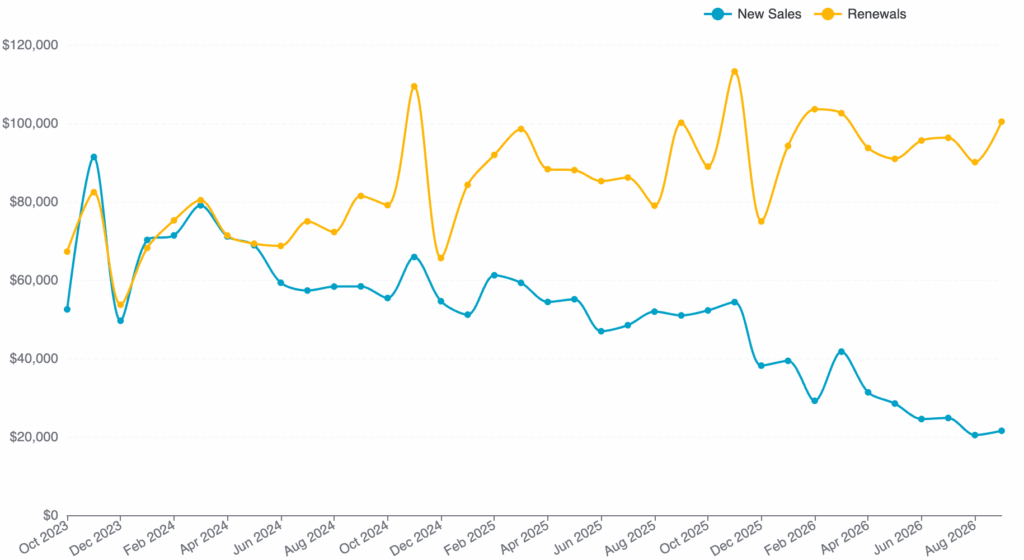
Financially, the company is still in excellent shape. Revenue is still well over $100,000/month. I’ve made some very difficult decisions this year and reduced my team from 20 to 15 people, as well as saving money on software by building internal tools with AI. This has brought profit back to 2024 levels.
However, this hides the longer-term reality. Renewals are our safety net but if new sales keep declining then renewals will start dropping in 2-3 years. It feels like knowing you’re going to be fired several years in advance.
If you run a plugin company then maybe your numbers aren’t as bad as mine. Hopefully you’re one of the minority who are growing. But if your sales are down too, then this post is for you. I’m going to analyze five reasons that I believe are behind the decline, and what I think we can do about each one (if anything).
It isn’t just us
Speaking with other WordPress product companies has made it very clear that the problem is much wider than just Barn2. Here are two examples, who have kindly allowed me to share their data.
Paid Memberships Pro sells membership software and has a large free plugin with 60-90k, installs. GravityKit allows users to build apps powered by Gravity Forms.
New sales revenue over the same two years fell 48% at Barn2, 48% at Paid Memberships Pro and 47% at GravityKit.
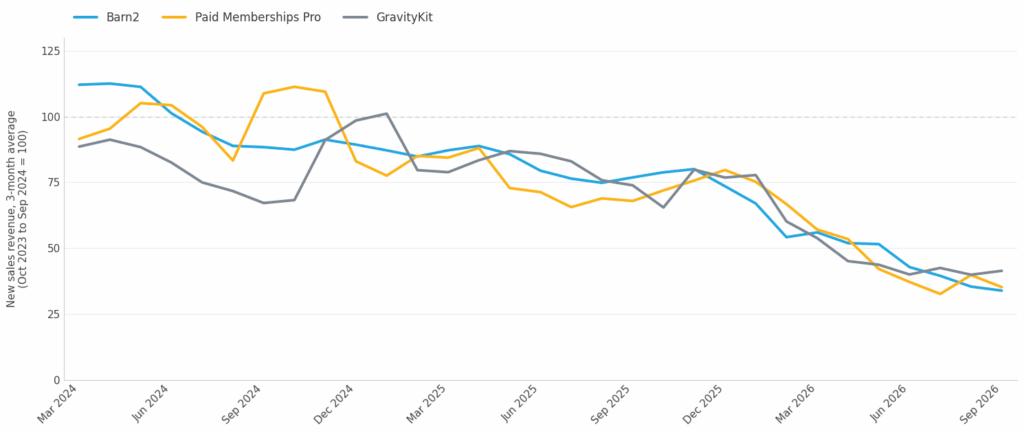
Renewals has kept all three of us strong. Renewal revenue grew 32% at Barn2, 18% at Paid Memberships Pro, and 15% at GravityKit. So total plugin revenue at each company is down only a few percent, rather than down by half which it would be otherwise.
If you sell WordPress plugins and your sales are down too, you’re not alone. The key to moving forwards is to understand what’s happening and focus on what you can realistically do about it.
Check your data before you conclude anything
Before you start analyzing the reason for a decline, it’s important to make sure your numbers are right. This is how I did it:
- Strip out bot and AI crawler traffic from your analytics – Bot traffic has artificially inflated visitor numbers in 2026, so your actual traffic might be worse than it looks. In September 2026, GA4 showed over 6,000 engaged sessions a day on barn2.com but only 440 of those were real people. Raw sessions said our traffic was up 13% on last year but once we filtered out the crawlers, real visits were down 49%. That’s the key number.
- Split new sales from renewals – Focusing on total revenue can hide a drop in new sales. It’s new sales that indicate the future health of your business.
- Split traffic from conversion rate – Our conversion rate went up this year, from 1.2% to 1.8%. The website still sells perfectly well, and the problem is that far fewer people find it. It’s important to know this because otherwise we’d prioritize perfecting our website instead of focusing on the real issues.
- Check whether it’s your fault – Did you make any changes that could have damaged your sales, such as a pricing change, rebrand or restructure?
Having the right data will help you to understand the true extent of the problem and its nuances.
Next I’m going to take you through the five reasons that I think Barn2’s sales have declined, starting with the ones that I believe have had the biggest impact. Read through them all and consider which ones apply to your business.
Reason 1: Search traffic has collapsed
Almost all of Barn2’s growth came from organic search. The main reason we’ve been so successful was that we were so good at this.
In particular, we published tutorials – a lot of them – answering specific WordPress and WooCommerce “How-to” questions. Those tutorials ranked, and the people reading them bought the plugin that solved the problem. That worked brilliantly for about eight years and got us to where we are today.
But it doesn’t work any more. Organic search brought us 86% fewer visits in the first seven months of this year than in the same months of 2024.
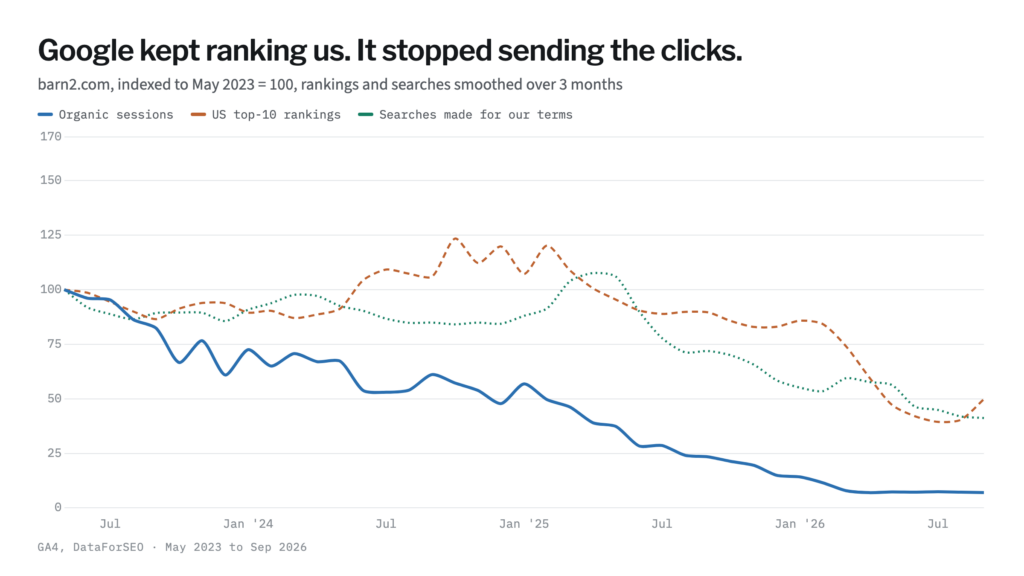
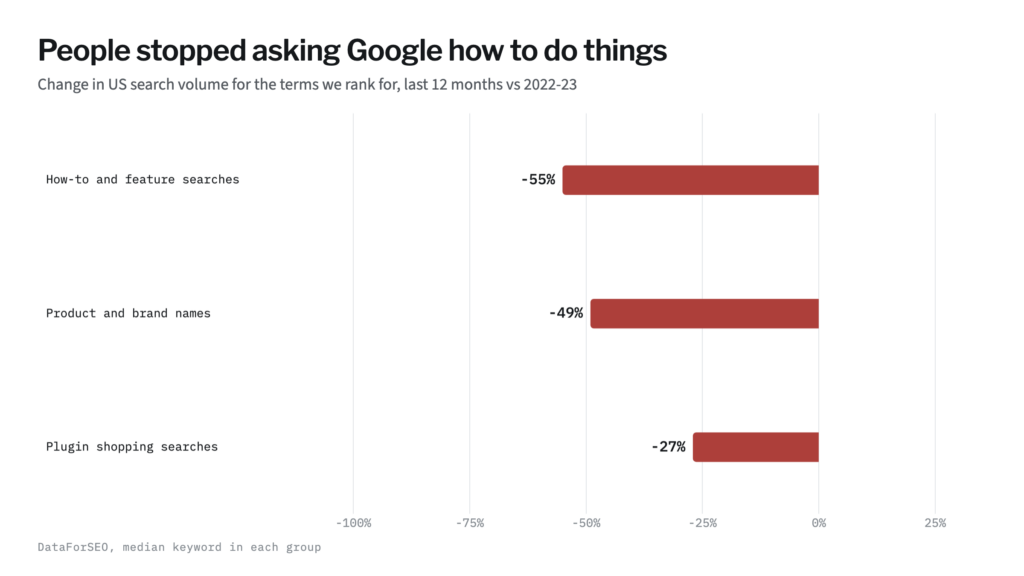
The drop in organic search isn’t universal – some types of query have dropped more than others. And unfortunately, the ones that made us so successful are the ones that have been hit the hardest.
I analyzed our Search Console history by type of query and discovered that the more a search looks like a question, the more of it has gone. Our commercial searches, where someone types a product name or a category, are down 78%. Our how-to searches are down 91%. Long-tail keywords are worse hit than short-tail – two-word searches lost about half their clicks whereas six-word searches lost nearly 90%. This fits with wider data from DataForSEO.

Our plugins solve very specific problems in WordPress and WooCommerce. Someone would Google how to hide prices from logged-out customers, or how to list products in a table instead of a grid. They’d find a Barn2 post answering exactly that question, with our plugin positioned as the clear solution. We have over 800 of those posts, covering every use case we could think of.
But now, Google answers those questions itself. I recently checked 22 of our target searches and 21 of them had an AI Overview. This is known as zero click searches.
We’ve completely dropped out of the top 20 results for how-to queries and page one is filled with Reddit, Stack Overflow and YouTube – not tutorials.
Up until March 2026, our traffic was collapsing but our rankings were still intact. That changed in March, when our rankings dropped due to Google algorithm updates. Our US top-10 keyword count fell from around 1,050 in January to 475 by June. The January update hit our how-to blog posts specifically. The March one was broader and affected our product pages too.
While losing rankings is worrying, the overall loss of clicks has had the biggest impact. Even the posts where we didn’t lose rankings lost 2/3 of their clicks. Overall, I believe that losing rankings only explains about 1/3 of the total click loss or about 15% of lost revenue.
I don’t think Google decided that they don’t like our tutorials or our site any more. This is evident when you look at the types of site it replaced us with. Google has stopped favoring vendor blog posts for the queries that we used to rank for and instead shows Reddit threads, Stack Overflow answers, YouTube videos and WordPress.org listings, with an AI Overview above all of them. Optimizing our blog posts can’t compete with that.
But doesn’t AI just recommend you for the same queries?
You might say that AI is simply the new channel, and we should get ourselves recommended there instead. We do get some of that. However, AI assistants sent us 722 visits this year, against the hundreds of thousands we’ve lost from Google, so it isn’t a replacement.
Even where AI recommends our plugin, I think it converts far less well because:
- An AI answer rarely recommends one plugin. Instead, it will mention ours alongside three competitors, or it suggests doing it with native WordPress/WooCommerce, or with a free plugin, or with something that isn’t WordPress at all, or it offers to write the code for you. We’ve gone from being the top answer in Google to being one of five options, one of which means that the user doesn’t have to buy anything at all.
- AI doesn’t promote us as well as our own website. When someone came to us from Google, they saw a professional design, testimonials, product screenshots, embedded videos, call to action banners and a newsletter signup. We spent years optimizing our website for conversions, and it does the job really well. If someone hears about us in an AI chat window then they don’t see any of this.
Can we recover these sales?
Partly, and not by much. I’ve been working incredibly hard to improve our content, chase AI citations, and make sure our posts are genuinely useful according to Google’s latest algorithm updates. However, at best, this will slow the decline and I don’t expect to recover our lost traffic. That’s just not available any more.
We’ve since won some of those rankings back without doing anything. Our top-10 count recovered to around 815 by September, and our product-name searches are mostly back at the top. The clicks didn’t come back with them.
So I’m not spending much more effort on winning back blog rankings. If Google would rather show a forum thread, a video or its own summary than a vendor tutorial, then writing a better vendor tutorial won’t change its mind. We need different kinds of content, in different places:
- Reddit and community marketing. Being useful in the threads that now outrank us, instead of trying to outrank them.
- Video. YouTube appears on most of our target searches and we barely compete there.
- Guest posts on the sites AI assistants cite, pointing at our product pages rather than our blog.
- Product pages over blog posts. Our commercial searches held up far better than our how-to ones, so the traffic we still have comes through them.
None of that replaces what we had. But I’d get even less from rewriting 800 tutorials that Google has stopped showing.
Reason 2: The market is smaller
The platforms we build for are shrinking. W3Techs tracks this daily and publishes the whole history, so you can check it yourself. Since January 2022, WordPress has fallen from 65.2% of all sites with a known CMS to 58.7%. Over the same period Shopify went from 6.6% to 7.8%, and Wix more than doubled, from 2.9% to 6.1%.
WooCommerce is falling faster than WordPress as a whole, and that’s the number that affects us. Shopify now has more than twice WooCommerce’s share of the top million sites: 15.8% against 9.1%. WooCommerce still leads overall, but its lead comes entirely from smaller sites.
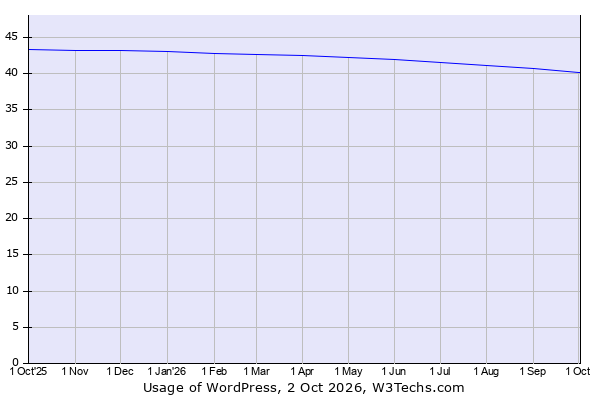
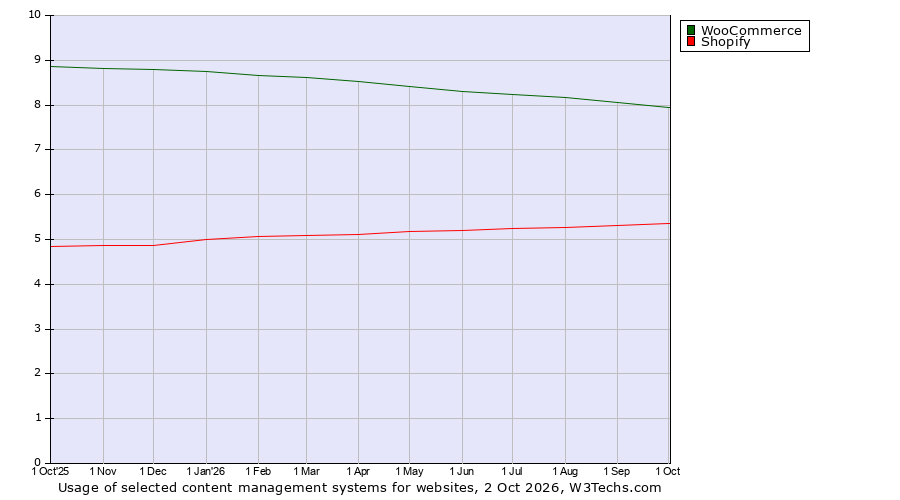
You can’t fix that with better marketing. There are simply fewer new stores to sell to than before, yet you have just as much competition as before so everyone gets their share of a smaller pie.
Can we recover these sales?
In theory, you can improve your marketing in order to increase your share of the pie – but if you already did significant marketing then this won’t bring back everything you have lost. If WordPress and WooCommerce start growing again then you will benefit, but this is outside of your control. (Of course, we should all work together to promote the platforms we build for. That’s largely why I relaunched the Do the Woo podcast to raise WooCommerce’s profile. But my point still stands.)
Instead of sitting around worrying about the decline, my solution is to expand into other platforms. We’ve released several Shopify apps already, plus a Wix app, and a platform-agnostic SaaS version of our Document Library plugin that doesn’t need WordPress at all. I don’t know whether these products will be successful and it will take a very long time to build new products that will rival 10 years of building WordPress plugins. However, this helps to spread the risk and make us less dependent on WordPress and WooCommerce.
Reason 3: Your plugin is easy to vibe code
Small utility plugins are scarily easy for AI to replace. Someone who needs to add an extra stock status to WooCommerce doesn’t need to buy a plugin for it any more. They can just ask ChatGPT or Claude for a snippet (or even a custom plugin) and paste it into their site.
Our smaller utility plugins have been hit the hardest of anything we sell. The smaller and more single-purpose the plugin, the more its sales have dropped.
Admittedly, not everyone is comfortable with vibe coding, and some people still buy utility plugins. All of Barn2’s plugins still get regular sales, even the smaller ones. But the point is that these have declined even more than the bigger plugins.
Can we recover these sales?
No. If a competent AI can build your product from one prompt, it doesn’t have much of a future as a paid product.
There are a few ways forward from here:
- You can expand the scope until your product is too big to generate in a prompt. This means turning a utility into a proper product, which is realistic for some products and not others. (For example, how much can we realistically expand the scope of a plugin like WooCommerce Multiple Email Recipients?)
- Making it free and using it to sell something larger.
- Sometimes you should simply accept that your product has no future and build something different.
In July, Jessica Risch from Woosa revealed that their plugin sales had collapsed from a record €70k month in 2023 down to €15k a month. She blames AI for most of the decline because anyone can now code their own plugin. Their response was to accept the inevitable and make their dropshipping and marketplace plugins free, pivoting their business toward payments, support and an agency network. Read her letter to the WooCommerce community.
Reason 4: Somebody else is the market leader
In the early days, I only released plugins that had no competition – Barn2 created the first ever plugins for creating product tables, document libraries, protected categories, private stores, etc. This made it easy to become (and remain) the market leader, as we had the first-mover advantage.
As our profile grew over time, we started releasing plugins that already had competitors – e.g. product options, wholesale, filters, and discounts. These all did very well, but were generally not the market leader. And that didn’t matter because there was enough room for everyone and our content marketing allowed us to rank for keywords and use cases that our competitors didn’t.
But it does matter now because AI’s often recommend the leader and stop there. Google has also adopted more of a winner-takes-all mentality, with recent algorithm changes filling the top of search results with high-authority sites like Reddit, wordpress.org and woocommerce.com and downgrading low or medium-authority sites (even if their content is better).
This has definitely affected Barn2’s plugins. My analysis shows that AI’s are much more likely to recommend plugins that have very popular free versions on wordpress.org, even when the Barn2 site is higher authority than the competitors’ own site and has more links to it etc.
Can we recover these sales?
Not on a small budget, and probably not at all where the leader got there by building a free plugin over many years.
Having identified how much a free plugin can boost your credibility and discoverability, in May I released a free version of our WooCommerce Wholesale Pro plugin – and it still has fewer than 10 active installs. It takes time to build a successful free plugin and you can’t jump the queue without massive resources.
What you can do is stop fighting over the same territory. This means moving your efforts to other channels, such as email and partnerships.
Reason 5: Your features were added to core
Platform risk is always a possibility when you build software on top of another platform. Your most important feature could be added to core so that people no longer need to buy your product. For example, at some point WordPress will probably add more AI to core so that your own AI features are no longer needed. WooCommerce even have a policy called “More in core”, where they’re actively working to add more features to their core offering.
Of course, a stronger core leads to a stronger ecosystem and more people adopting the technology overall, which benefits everyone. But despite this, it directly leads to lost sales for products who attracted due to that same feature. (Apparently James Kemp doesn’t like me using “More in core” as a negative verb, i.e. “we got more-in-cored”. But I think it could catch on 😅)
Platform risk isn’t one of the main reasons for the decline in Barn2’s sales because Woo haven’t added new features as quickly as I feared. However, some of the new features have had some overlap with Barn2’s, and this is likely to continue.
Can we recover these sales?
Platforms often point out that they only add basic versions of new features to core, which creates an opportunity for third party products to build more sophisticated versions. However, this overlooks the fact that most of the customers who previously bought your product due to that feature probably only needed the basic version. Sure, you’ll still attract people who something more advanced, and they’re willing to pay more – but you’ve still lost the bottom segment of your market, which can hurt.
The only thing you can do to protect your product from platform risk is to stay far enough ahead that the core version doesn’t cover what your customers need, and you have to build that moat before you need it.
If your only product does one thing which is now in core, or got low sales anyway, then it may not be worth trying to save. For example, Easy Digital Downloads added EU VAT support to core, incorporating almost the entire functionality of our lowest selling plugin, and I don’t think there’s any point trying to save it.
What happens when all five combine
Each of these on its own is survivable. Together they’re much worse, because each one removes a different part of the route to a sale.
Maybe only one or two of the reasons I’ve outlined applies to you. For Barn2, they all combine – we’ve lost the traffic from how-to searches that made us so successful. WordPress and WooCommerce aren’t growing like they used to. A smaller share of the remaining searches reaches us. Some people no longer need us because of new features in core. Others ask an AI instead, and get pointed at the market leader or given a code snippet. Each of these removes a portion of the people who would have bought from us before 2024, adding up to the full extent of the problem.
Many of these reasons apply to GravityKit too, whose data I also looked at. However, Paid Membership Pro’s sales are down as much as ours, which is strange because they have a very successful free plugin and aren’t so dependent on Google organic, and they are a platform-level plugin which is hard to vibe code and essential to people’s businesses. However, I think the reasons I’ve outlined are still valid because Paid Membership Pro have additional reasons to explain why they have declined so much – they’ve been raising prices and steering customers toward their new hosting product, which reduces their plugin revenue on purpose.
So, what can we do about it?
We all need to consider whether our products and our marketing methods are still relevant into the future. These are two separate questions.
Do your products have a future?
Ask yourself:
- Is your product easy to replicate with AI?
- Does it have clear moat around it which makes it hard for other products to compete?
- Is it an integral part of their users’ workflow so that they wouldn’t consider leaving?
- Is it well-suited to the marketing channels which have a future (see below)?
If the answer to any of those questions is “No”, then you should either plan how to turn it into a “Yes”, or accept that maybe it’s time to build something else. At Barn2, some of my products pass this test and others fail, so this guides my priorities.
What types of marketing have a future?
While I will keep trying to recover some of my lost SEO traffic, it’s time to be realistic: The vast majority of it is not coming back. However much I love content marketing, the only option is to look for marketing methods which are still relevant.
But the thing is, we’ve always pursued multiple marketing channels at Barn2 – and organic SEO was the one that truly worked for the types of products we sell. Our YouTube videos are down a similar amount to our organic search, as video has been hit by AI search too.
Realistically, the marketing methods of the future are the ones that are independent of Google, and which ideally you control. That includes:
- Marketplaces – Anecdotally, I have heard that people with very successful free WordPress plugins have seen less of a decline than SEO-focussed companies like us. Being on a marketplace taps you into a new audience and partially shields you from changes to search in general. However, it’s incredibly difficult to build a successful free plugin. Some of our competitors have done this over many years and their plugin became popular when the niche was less competitive and it was easy to get installs.
- Partnerships – I hate the word “Partnership” in WordPress because it doesn’t really mean anything. People use it to refer to anything from cross-promotions and link swaps to deep integrations. However, deep partnerships with companies who aren’t your competitor but have the same user base can be an excellent way to get customers and bypass the problems with organic search. This might be an integration with a hosting company, or working with agencies who will use your product on all their projects. This works better for some products than others – generally, it’s more suited to bigger products than smaller utility plugins such as WooCommerce extensions (see bullet point #4 in the previous section).
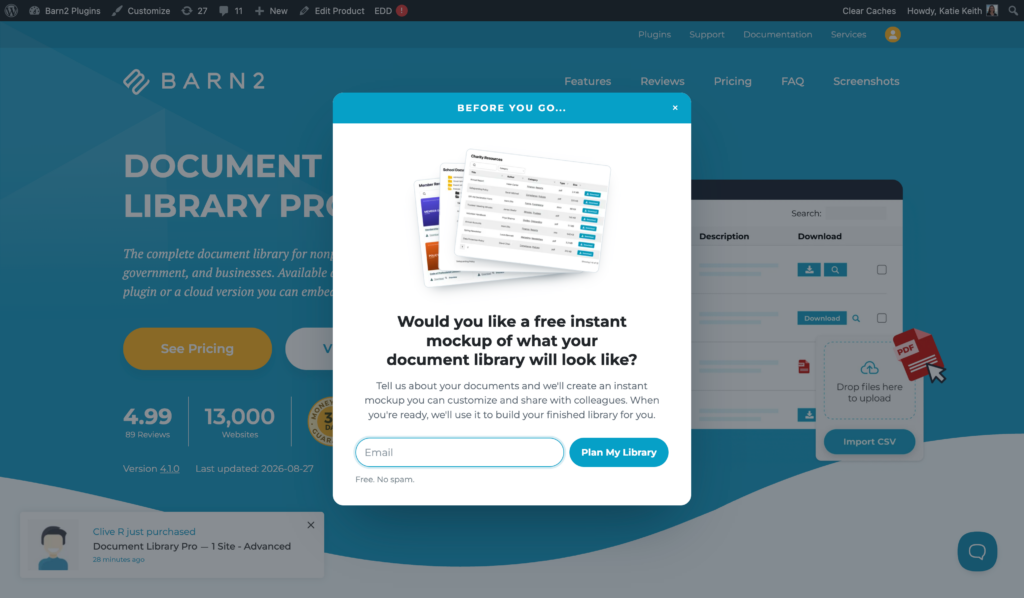
- Email – We have over 60,000 people on our mailing list, and this is a channel we own (unlike Google or a marketplace). I have never made full use of our email list because I personally hate receiving marketing emails🫸. However, I’m trying to be open-minded about this and experiment with things like lead captures which we haven’t done before.
Recover the revenue, or run a smaller business?
It’s wonderful that I was able to grow Barn2 to annual revenue of nearly $2 million and support a team of 20 people while still making more profit than I could ever have dreamed of. But that’s not the only way.
We were equally profitable when the business was half the size, as our costs were lower. So we could achieve that again.
The problem is that once you’ve reached a certain point, it’s very difficult to go back. You have more products, more technical debt to maintain (even with AI), and people’s livelihoods depend on you. Reducing the team size was the hardest decision I’ve ever made at Barn2, and isn’t something I would ever take lightly.
Time to pivot?
I’m not planning for a permanently smaller business – this year’s cuts have bought time, along with the 2-3 year runway that our existing renewals has given us before things get serious.
I plan to spend that time replacing the lost revenue with products that none of these five reasons apply to: Products on other platforms, SaaS products that don’t depend on anybody’s plugin directory, and acquisitions of products that are actively growing. Our new Shopify app, Wix app and the hosted Document Library are all part of that. It’s proving more challenging than I anticipated to grow new Shopify apps from scratch, so I’m currently taking steps to short-cut that by acquiring an app with an existing user base which we can use our experience to grow further. Alongside this, I will continuing working to save the WordPress products which have the most future potential.
Is expanding beyond WordPress the right decision? Only time will tell, but I think it’s the most rational response to the decline.
Where this leaves us
It’s a difficult time across software generally, not only in WordPress products. However, it’s harder for some companies than others because it depends on how much each of the five reasons applies to you:
- Search traffic has collapsed
- The market is smaller
- Your plugin is easy to vibe code
- Somebody else is the market leader
- Your features were added to core
Barn2 are unfortunate because the thing that made us so successful is the same thing that has declined the most. I’m just glad for our annual renewals (and the fact that I don’t run a recipe blog 😬).
Where you can take action, take it. Some of what we’ve lost is recoverable with better content, better links and better channels, so those are actions we should take. But some of it isn’t coming back whatever we do, and pretending otherwise only delays the change of direction you were going to have to make anyway.
If you’re running a WordPress product business, which of the five reasons have hit you? Are there factors I’ve missed completely? And do you think I’ve got this analysis right, or am I wrong about any of it? Please tell me in the comments or on social.